McBride: From Profit Warning to Transformational Deal

A household name maker just had a rollercoaster couple of months — here’s what happened, what the chart’s telling us, and a personal miss worth learning from.
If you’ve been anywhere near UK small-cap chatter recently, you’ll have seen McBride (LSE: MCB) come up. It’s one of Europe’s biggest makers of own-brand household cleaning products — the stuff behind the retailer’s own laundry tablets, dishwasher liquid, and surface cleaner sitting on supermarket shelves. Quiet, unglamorous business. But the last few months have been anything but quiet for the share price.
I’ve got a bit of personal history with this one, too, which I’ll come back to — because it’s a good reminder of why a proper watchlist and a defined process matter, even for a stock you think you know well.
The profit warning
Back in June, McBride put out a trading update that the market didn’t like at all. Shares fell 8% on the day, down to around 151.8p. The company flagged “sustained cost increases,” pointed to the Middle East conflict as one driver, and said inflation was being passed on to customers with a bit of a time lag. It also downgraded expectations for the current and next financial year — adjusted profit was guided to come in 5–10% below what analysts had been expecting.
Not a disaster, but the kind of update that makes a stock drift lower and sit in the “avoid for now” pile.
Then, out of nowhere, a transformational deal
Fast forward to 28 August, and McBride announced something much bigger: a long-term manufacturing partnership with Vestacy, the company behind well-known brands like Air Wick, Calgon, Cillit Bang and Mortein.
The headline numbers are eye-catching:
- Expected to generate around £170 million in annual revenue once fully up and running
- As part of the deal, McBride is acquiring two Vestacy manufacturing sites in Spain and Portugal for a nominal price
- Pushes McBride’s “contract manufacturing” business (making products for other brands, rather than under its own name) well past the 25% of group revenue target it set back in 2024
The market loved it. Shares jumped 23% on the day, to 206p.
This wasn’t a quick bounce-back from the June warning. It’s nearly three months apart, and a completely different story — one’s about near-term cost pressure, the other’s about a multi-year strategic bet.
It’s worth being honest about the pace of delivery. This isn’t an overnight fix. The Spanish and Portuguese sites aren’t expected to transfer until early 2027, and the operation isn’t expected to reach full capacity until early 2028. So while the market re-rated the shares immediately, the actual earnings benefit is still a couple of years out.
What the daily chart is showing
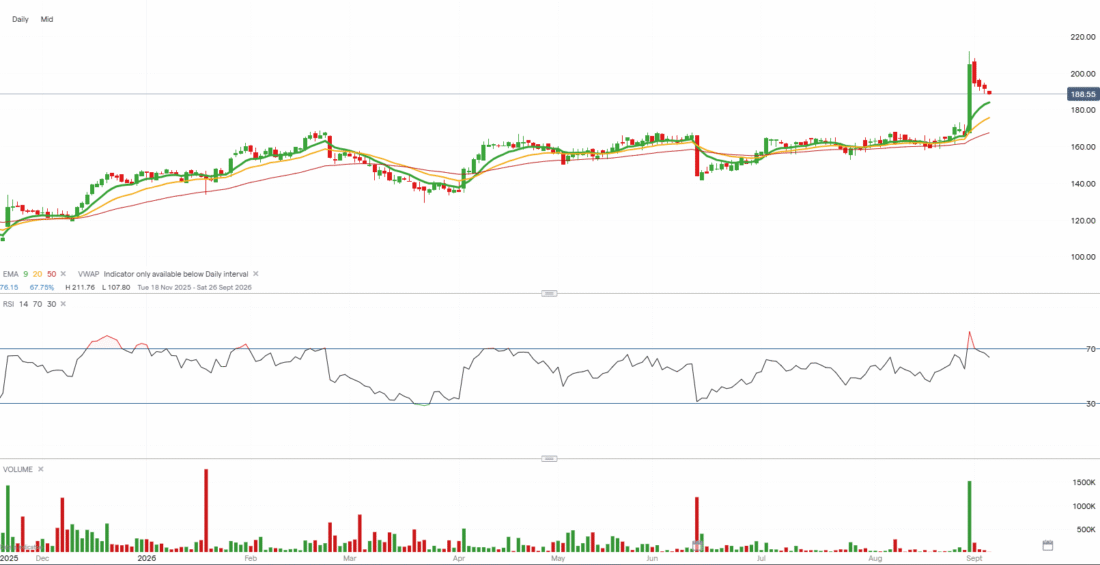
Looking at the daily chart, the move on 28 August was a proper gap higher on heavy volume — a clean break above the range the stock had been stuck in for most of the year (roughly 120p–160p). RSI spiked well above 70 on the spike day, and the price has already eased back from a high near 205p to the low 190s as that overbought reading unwinds.
That’s a fairly normal pattern after a big one-day move — some giving back of the initial spike rather than a breakdown. But right now, this is a stock that’s already run hard, not one quietly building a base. For anyone who prefers buying dips off a settled base rather than chasing a headline, patience looks like the better play here — a retest of that old 160p-ish breakout zone would be the more interesting level to watch than paying up in the low 190s.
The longer view — and a lesson in discipline
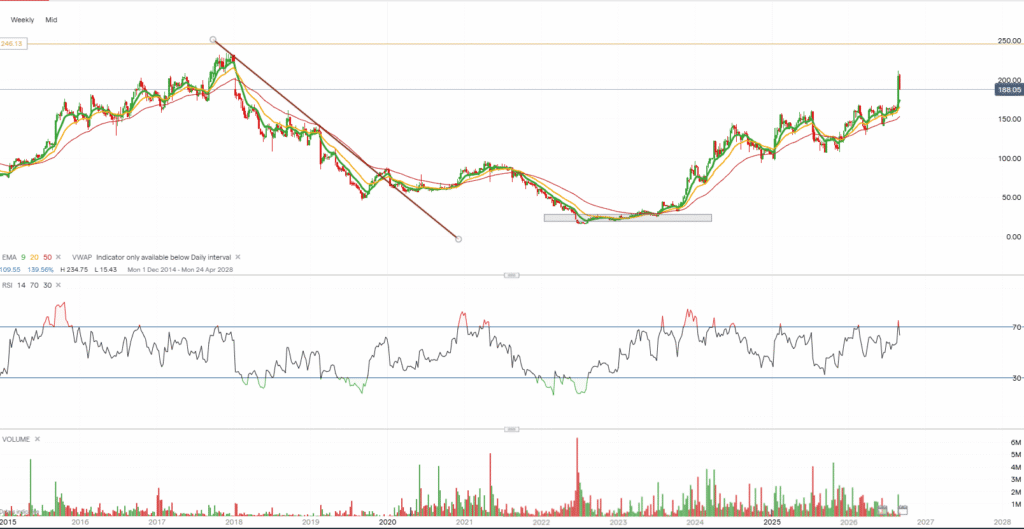
Zoom out to the weekly chart and there’s a much longer story here, one I’ve got personal history with. There’s a McBride manufacturing site near where I grew up, and several people I know — including my dad — worked there over the years. They always spoke well of the place, and it’s part of why I’ve kept half an eye on this company for a long time now. I’ve genuinely still got trendlines drawn on my own chart from back then.
The shares peaked near 250p in 2018, then spent the next four years grinding lower before basing out down around the 15p–50p mark through 2022 and into 2023. I was actually watching that base form in real time — and then, as happens, I got distracted and missed the multi-year recovery that followed. From that base, the shares have now run more than tenfold to today’s levels near 190p.
No sugar-coating it — that’s a genuine miss, and a useful reminder of why a proper watchlist and a defined process matter. Back then I didn’t have either. If I were watching this exact base forming today, with the approach I run now, that’s a trend I’d have been riding the whole way up — not admiring in hindsight.
Digging into the numbers a bit more
A couple of things stood out when we pulled the broker estimates:
The revenue math doesn’t quite add up on paper. McBride’s full-year revenue for the year to June 2025 was £926.5m. £170m against that is actually 18.4%, not the “roughly 15%” the company mentioned. It’s possible that’s measured against a bigger, future revenue base (i.e. by the time the deal is fully up and running, the whole company will be a bit bigger too), or it might just be rounded PR language. Either way, worth treating as a directional number rather than gospel.
The current contract manufacturing business roughly triples. That side of McBride made up 13.6% of group revenue last year — about £126m. Adding £170m of new business on top would take contract manufacturing to somewhere around 30% of the group, comfortably clearing that 25% target.
Margins and cash flow tell a believable story. Broker forecasts show EBITDA margins dipping slightly over the next two years before recovering, and free cash flow taking a real hit in the near term before bouncing back sharply by 2028. That lines up neatly with what McBride itself has said — this deal needs upfront investment (McBride is putting in £17m of capital over two years) before the benefits land. When the numbers behind a deal match the story management is telling, that’s generally a good sign the forecasts aren’t just wishful thinking.
What might the shares be worth?
A simple way to frame it: take an earnings-per-share estimate and multiply by a price-to-earnings multiple.
- Cautious case: if the market decided to ignore the growth story entirely and price the shares on near-term earnings at a low, “prove it to me” multiple, you land somewhere around 130p — a meaningful drop from today’s levels.
- Steady-as-she-goes case: if the current multiple holds and earnings grow as forecast through 2027, the shares are roughly where they’re trading today.
- Optimistic case: if the Vestacy ramp-up delivers as planned by 2028 and the market’s willing to pay a bit more for that growth, there’s a case for meaningfully higher levels — but that’s two years of execution away, not a near-term outcome.
The spread between those scenarios is wide, which tells you this is a name where the story still has to play out. The deal looks genuinely strategic on paper, but a lot rests on delivery over the next 18–24 months, and the shares have already priced in a decent chunk of optimism in one trading session.
The takeaway
McBride’s gone from a company nursing a profit warning to one with a genuinely transformational deal on the table, inside three months. That’s a big swing in sentiment, and the chart reflects it — a sharp breakout that’s now digesting the move.
For anyone watching this one, the interesting entry point probably isn’t chasing the spike, but waiting to see whether the shares settle and build a proper base above the old trading range. And it’s worth keeping an eye on broker notes over the coming weeks — several forecasts may not yet fully reflect the Vestacy deal, so estimates (and therefore valuations) could still move.
As for me — I’ll be watching this next base a lot more closely than I watched the last one.