Week of 24 August 2026
It's Sunday, which means it's time to look at the week ahead and work out where we stand.
As always, a lot is going on. Two huge earnings reports, an inflation reading, and the Jackson Hole conference, all landing within about 48 hours of each other. If that sounds like a lot, don't worry. We're going to break it down piece by piece, the same way we always do, so by the end of this, you know exactly what's happening, when, and how we're planning to trade through it.
Where The Strength Is
Every week we run the same check: which sectors are showing real relative strength, and which are just having a good day?

Healthcare and Basic Materials are still two of the strongest areas on our usual trend screens. Healthcare's up close to 29% over the past year; it's been steady rather than jumpy, and it's backed by real earnings — Eli Lilly (which I have traded in the recent weeks) and UnitedHealth both beat expectations recently, and there's been close to $284 billion of takeover activity in the sector this year. Basic Materials is up around 21% over the past year and has just started showing fresh signs of momentum building again. Energy has actually had the strongest year of any sector, up over 50%, largely for the same refining and oil-price reasons we cover below — so this isn't a case of only two sectors being strong; Healthcare and Materials are the two our process keeps landing on.
Tech is an interesting one. It's strong over the years, but week to week, it can't make up its mind. One week it's leading, the next, it's the worst sector in the market. Last week it fell over 3%, the worst of all eleven sectors, while Healthcare (+4.3%), Energy and Materials all finished the week higher.
Here's why that's happening, and it's worth understanding because it'll matter again this week: it comes down to bond yields. Bond yields are the interest rate you get for lending the government money. They rise on inflation fears, heavy new debt issuance, or shifting Fed expectations. When yields rise, tech gets hit hardest — its value leans on profits far in the future, and higher yields shrink what those future profits are worth today. When yields ease, tech bounces back. That's the "catches a bid" pattern — it's the bond market driving it, not tech itself.
My read: treat any tech bounce this week as a quick trade, not something to hold through. Until yields properly settle, tech's strength isn't the kind you build a position around.
The Pockets Of Real Strength Worth Knowing About
Beyond the big sectors, a few specific areas are showing real strength this month. Some of it makes perfect sense once you know the story behind it.

Biotech has had its best month in a long while. The trigger was Merck and Moderna announcing successful Phase 3 trial results — the first successful late-stage trial of its kind for an individually-made mRNA treatment for cancer (specifically melanoma), building on already-promising earlier data and the same technology that powered the Covid vaccines. It's a big deal because it starts to answer the question everyone's had about Moderna since the pandemic ended: is there life after Covid vaccines? On the day it was announced, the main biotech funds jumped between 6% and 10% in a single session — that's a real, fundamental reason for a sector to move, not hype. The names worth having on your radar here are Moderna, BioNTech, and Merck itself. One word of caution: the big move has already happened. Chasing it after a jump like that rarely ends well — we'd rather wait for a pullback and a proper setup than jump in at the top.

Oil refiners are another one, and this ties nicely into the inflation story later in this post. Refining margins — what a refiner earns turning crude oil into usable fuel like diesel and petrol — have hit record highs. Global refining capacity is down significantly this year, partly from strikes on Russian refineries, partly from plant closures here in the West over the past few years. The result: diesel prices have stayed stubbornly high even as crude oil itself has calmed down. Names like Marathon Petroleum, Valero and Phillips 66 have had a properly strong year on the back of this, some nearly doubling. This doesn't look like a short-lived spike — these pressures look set to persist for as long as global refining capacity stays this constrained.

Gold miners are having a strong run too. Gold has rebounded sharply to around $4,600 an ounce, up from a low below $4,000 back in June — worth being precise here: that's still well below the all-time high near $5,600 gold hit back in January, so this is a strong recovery rather than a fresh record. What's interesting is less the exact level and more the pattern: gold's climbing back up even though Treasury yields remain elevated, which isn't the textbook relationship — normally gold rallies as yields fall. Our read is that this points to investors hedging currency and government-debt worries rather than just reacting to rates, though that's our interpretation rather than a proven cause. Newmont and Agnico Eagle are the two biggest names carrying this move. Worth knowing the risk here too: a fresh pullback in gold combined with rising oil prices would eat into miners' profit margins fast.
Pawn shops — yes, really — are a nice example of following a theme through to its logical conclusion, with a caveat worth knowing. Rising gold prices do lift the value of the gold jewellery pawn shops hold as collateral, and that's part of the story. But it's not the main one: EZCORP's own management said their recent record quarter was driven mostly by their core pawn lending business growing (loans outstanding up over 30%) and by store expansion, not by gold. Their profit margin on scrap gold sales actually fell last quarter, because that margin depends on how fast gold is rising, not just its price level — and gold's gains have slowed since the start of the year. FirstCash and EZCORP have both posted record results, so the growth is real, just don't assume it's a simple "gold up, pawn shops up" trade.
Memory chips round out the list. There's now a dedicated fund tracking this space, made up mostly of Micron, Samsung and SK Hynix, and it's more than doubled since it launched earlier this year. The driver is AI data centres, which need enormous amounts of memory to run. Micron's cloud memory business alone did nearly $13.8 billion in revenue last quarter, at an 83% gross margin — a striking number that shows just how strong pricing power is right now. Micron is already on our watchlist from earlier this year, and this reinforces that thesis. One thing worth keeping an eye on, though we can't call it a proven rule: there's a monthly pricing report from a firm called TrendForce that tracks memory chip prices, and a run of falling prices would be an early warning worth taking seriously. For now, TrendForce's latest forecast still shows prices rising into the autumn, so this isn't a live worry — just one for the diary.
The Big Week Ahead
Now for the calendar. This is where it gets busy, so let's take it one event at a time — all times below are UK time.
Wednesday, early afternoon (1:30pm UK time): inflation data (PCE). This is one of the Fed's favourite ways to measure inflation — it tracks what people are actually spending money on and how those prices are moving. The forecast is for the annual rate to come in unchanged at 3.3%, with the monthly rate ticking up slightly from last month. Cooler than expected is generally good news, easing pressure on yields and on tech. Hotter than expected, and expect yields to push higher again, with a shaky start to the day.
Wednesday evening (from around 9pm UK time): NVIDIA and CrowdStrike both report, on the same day. This is the one to really pay attention to. NVIDIA is the single most influential company on the entire stock market right now, so how its results land doesn't just affect NVIDIA — it sets the tone for the whole tech and AI trade heading into Thursday. The options market (where traders bet on how big a stock's move will be) has been pricing in a swing in the region of 6–7% either way — on a company this size, that's tens of billions of pounds worth of market value potentially moving in a single evening. Worth knowing: NVIDIA has fallen after each of its last four earnings reports, even when the numbers themselves were strong — investors have almost gotten used to it beating expectations, so a beat alone doesn't excite the market like it used to.
CrowdStrike. It's an expensive stock, priced for an excellent quarter, not just a decent one. Last time it reported, it beat estimates and even raised its full-year outlook — and the shares still fell about 11%, because its near-term guidance for the following quarter only matched what analysts expected rather than beating it. At this valuation, matching isn't enough — it likely needs to properly exceed expectations this time, not just meet them.
Do not be tempted to get into any names before earnings release. It's just gambling.
Friday afternoon (3pm UK time): Jackson Hole. Once a year, central bankers from around the world gather in Wyoming for an economic conference, and the Fed chair's speech there is always closely watched. This year it carries extra weight, because it's the first time in the role for Kevin Warsh, the new Fed chair. A recent Bank of America survey found 69% of fund managers expect him to play it safe with a neutral tone, so a good deal of calm is already expected — though markets don't always get what they expect. A firmer tone on inflation than anticipated would push yields up and rattle tech again. A softer tone would ease yields — though the mood going into this speech is cautious, with the Fed's last vote on interest rates notably split, so a soft surprise isn't the safe assumption to make.
Put it all together and Wednesday through Friday is the loaded stretch of the week. Here's how we're handling it:
- Smaller position sizes than usual heading into Wednesday and Friday
- Give any big move an hour or two to settle before acting on it — don't chase the first candle
- Stick with the leaders (Healthcare, Materials, Energy, the pockets above) rather than chasing tech on its good days
- Check each morning whether tech's outperforming or underperforming Healthcare/Materials — that tells you where relative strength is sitting that day
- On biotech and gold especially, remember the move has already happened — we're watching for a pullback or a proper setup, not chasing the headline
The bond market story, explained simply
I've actually covered this before on the blog — you can check it out here. But it's relevant enough right now that I wanted to revisit it.

The Treasury has actually been buying back some of its own older bonds regularly since 2024, as a normal liquidity-management tool — it isn't a brand-new emergency measure. What made headlines last week was the announcement that it's increasing the size of some of these buybacks, from a maximum of $2 billion per operation to at least $4 billion, starting on 9th September. So the bigger buying hasn't actually started yet — what moved the market last week was the announcement itself.
And even that had a mixed effect. Long-term yields did dip on the news — yields on long-term government debt had just hit their highest level in nearly 20 years, so any relief was noticed — but a lot of that move reversed within a couple of days, with yields drifting back toward where they'd been.
There are two ways to read this, and the market itself is split on it, so we'll lay out both sides rather than pick one for you. One view: a government stepping up its own bond-buying, even as a routine tool, is a signal that yields are becoming a genuine concern for policymakers — otherwise why act now. The other view: a government using the tools it already has, well before any real crisis, is showing strength rather than weakness. What's interesting is that gold's rebound over the same period looks a lot like investors hedging against both possibilities at once, rather than confidently picking a side.
One practical thing worth knowing: this isn't a one-off. The bigger buybacks are scheduled to run from 9th September through to the Treasury's next quarterly refunding announcement on 4th November. Whether long-term yields actually calm down once that larger buying begins for real is worth watching — it'll tell us a lot more than the announcement alone could.
The Bottom Line
A lot is happening this week, but none of it needs to feel overwhelming once you break it down like this. We know where the strength is, we know what's coming and when, and we've got a plan for sizing through the volatile bits rather than getting caught out by them. That's really all trading through a busy week is — not predicting exactly what happens, just being prepared for the range of things that could.
I'm going to run through the charts now and see what stands out. Check back later for what I find. Get your plan sorted early so you're not caught off guard.

A quick mid-week update. Sunday's post laid out the week ahead — NVIDIA and CrowdStrike earnings, inflation data, Jackson Hole. All of that's still very much the headline story, and tech is still the one everyone's watching nervously. But there's a second story running underneath it that's easy to miss if you're only looking at the Nasdaq, so let's get into it.
The Market Isn't Just Tech
Here's the thing that's easy to forget when NVIDIA and CrowdStrike are dominating every headline: the S&P 500, when you weigh every company equally instead of letting a handful of giants dominate the index, is still in a clean, steady uptrend. Up close to 13% off its low price sitting above all three of its key moving averages, RSI comfortably in the middle of its range rather than stretched. None of the panic the tech headlines might suggest.

That's the difference between "the market" and "the index." Cap-weighted indexes let seven or eight mega-caps set the mood. Equal-weight strips that out and shows you what's actually happening underneath. And what's happening underneath right now is genuinely broad participation — it's just not coming from the names getting all the attention.
Today's Sector Picture
— and why we're not getting carried away by it
Today Consumer Defensive sector is showing strength up nearly 1.7% on the day, with Utilities, Financials and Communication Services also green. Tech brought up the rear. That's textbook risk-off behaviour — money rotating out of the most crowded trade and into the boring stuff nobody's excited about, right before a loaded run of news.
Keep in mind, Consumer Defensives is actually the worst-performing sector over the past six months. So today's move looks like a short-term hedge into Wednesday and Friday, not a new trend we're about to jump on wholesale.
How We Hunt For Strength – A Quick Tweak
Our usual top-down approach — screen the sectors, find the leaders, drill into the strongest names — has a blind spot. It naturally points you toward stocks that have already run hard, because those are the ones showing up as "strong" on every screen. Target (TGT) is the perfect example this week: up 58% this year, sitting at fresh 52-week highs, RSI pushing into overbought territory. Great company, real turnaround — but even the bulls on Wall Street are saying the easy money's already been made there.

So today we broadened the search. Instead of only looking at what's leading, we went looking for defensive names that are still well below their highs but showing genuine signs of turning up off the bottom — the early stage of a move, not the tail end of one.
Where The Search Led Us:
– grocery stores and discount stores
Drilling into the Consumer Defensive sector by industry threw up a clear pattern. Grocery Stores was the single worst-performing industry in the whole sector over the past three months — down over 10% — but it's now leading both today and the past week. Discount Stores show the same shape: worst performer last week, best performer today. That combination — beaten up over months, suddenly leading the last day or two — is exactly the early-reversal signature we were looking for.

Kroger is the name behind the Grocery Stores move. It's still sitting close to the bottom of its 52-week range, but the story behind the bounce is real: a $2.9 billion share buyback authorisation, a genuinely strong balance sheet, and a helpful macro backdrop — grocery prices are forecast to rise much more slowly than restaurant prices this year, which tends to push spending back toward supermarkets. The scary-looking 59% drop in net income last quarter was a one-off impairment charge, not ongoing decline. Kroger's had a fast couple of days, and RSI has already pushed up to the high 60s as we write this — so the easiest entry point has probably already gone. Worth watching for a pullback rather than chasing it here.
The Names On Watch
Running the wider Consumer Defensive sector through our usual filters — RSI in the 50–65 zone, meaningful room below the 52-week high, price action turning up rather than already extended — gave us a short list. Here's where each one stands:
- Dollar General (DG) — the cleanest textbook setup of the group. RSI in the mid-50s, still 21% below its 52-week high, and it's just reclaimed its 200-day moving average after a long head-and-shoulders style decline. One big catch: it reports earnings this Thursday morning, right in the middle of an already loaded week. Watching the print, not sizing in before it.

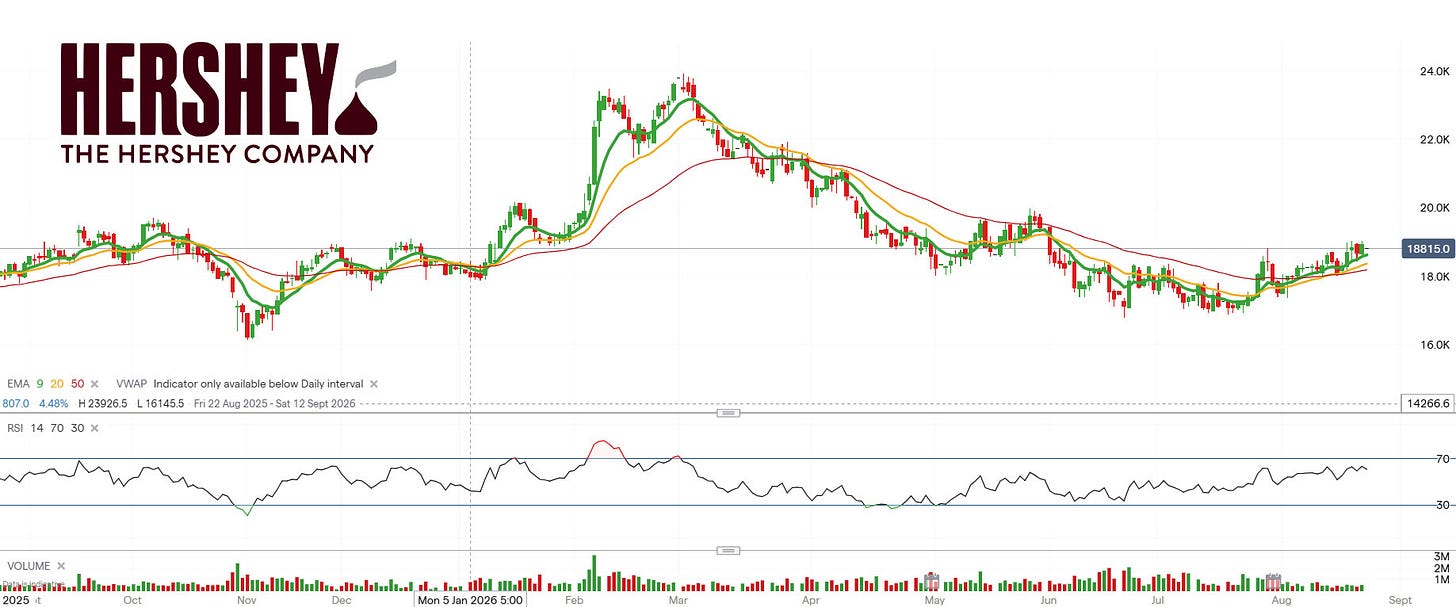
- Hershey (HSY) — down close to 30% top to bottom this year, now turning up with a fresh, rising stack of moving averages. RSI 60, still 20% below its high. Already reported earnings, so no catalyst risk this week. Quietly one of the cleanest reversals on the board.
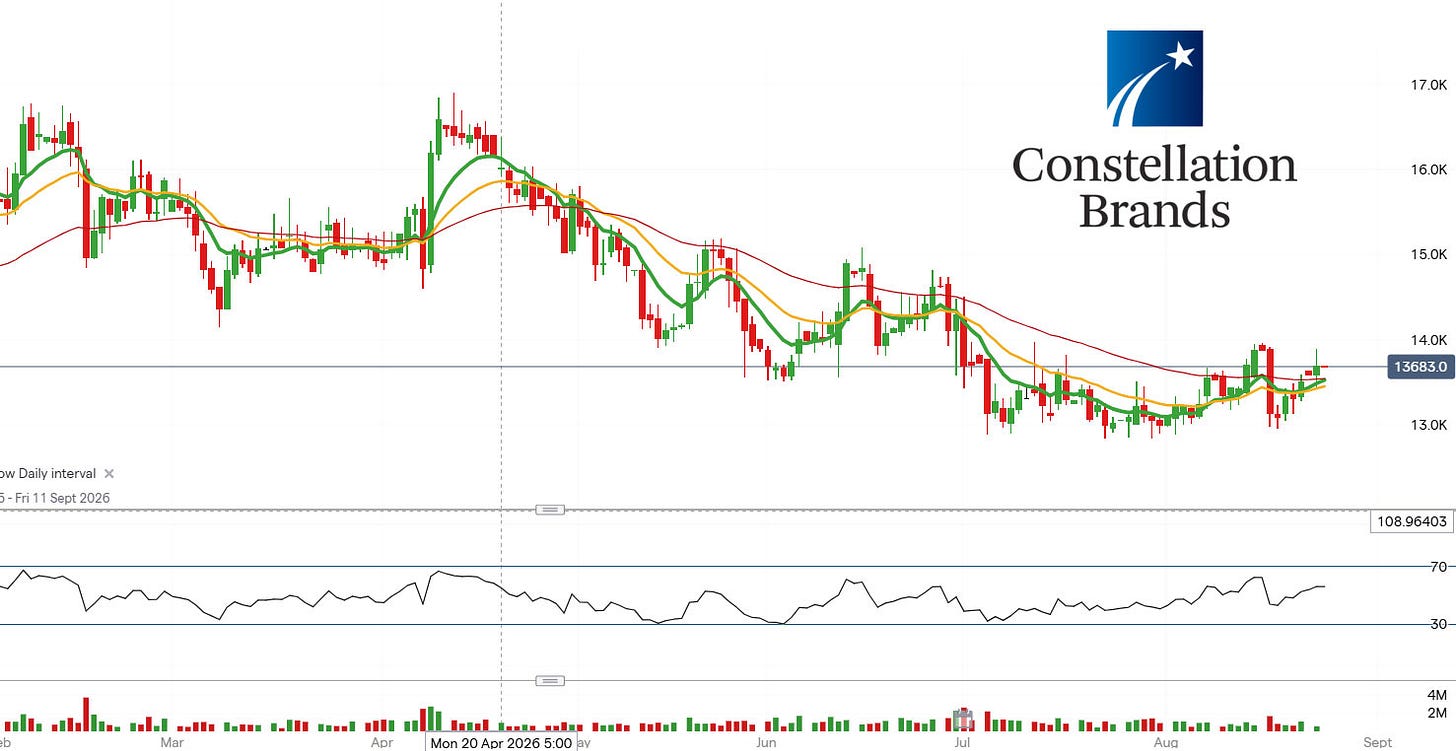
- Constellation Brands (STZ) — RSI in the high-50s, 18% below its high, and carrying the best profit margins of any name in this group by some distance. Already reported, clean runway.
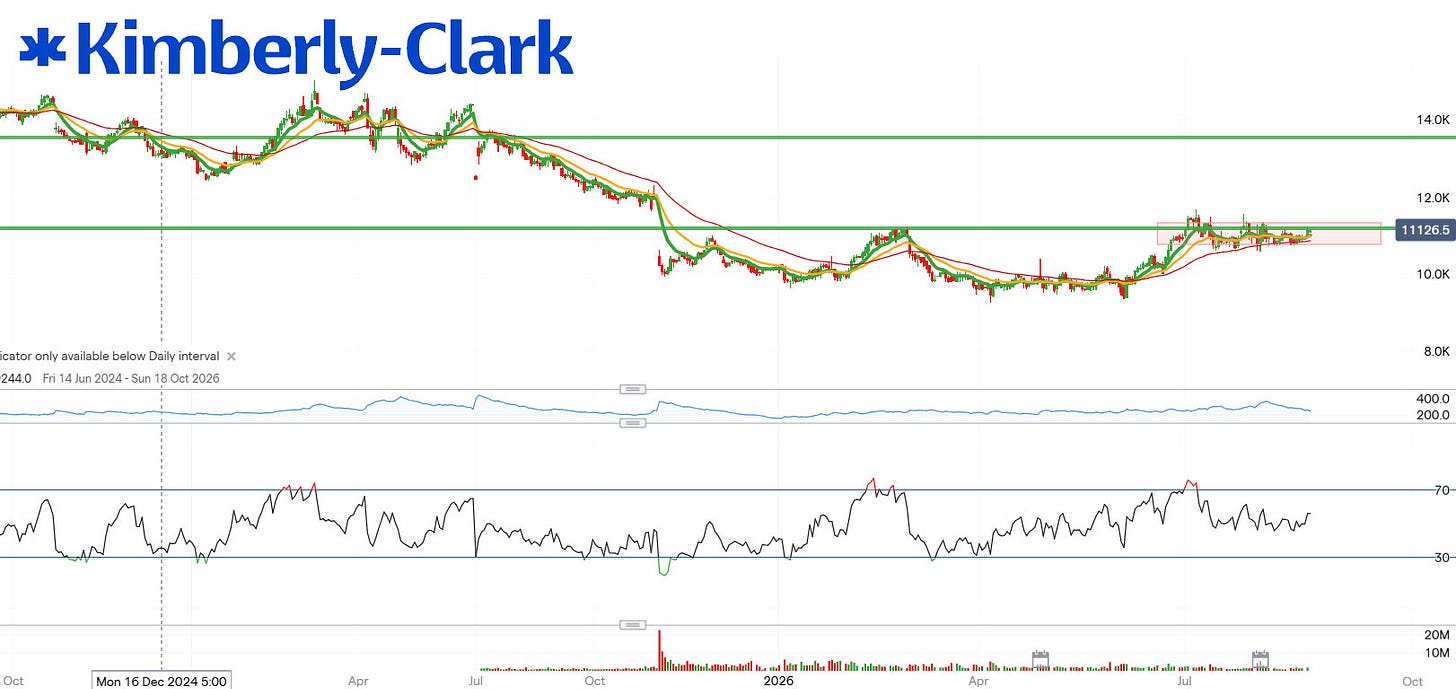
- Kimberly-Clark (KMB) — further along in its recovery than the others. It's spent roughly a year building a base after a hard drop from the low $140s to the low $90s, and is now sitting right at the resistance level that base has repeatedly bumped into. RSI in the mid-50s. A close above that level on real volume would be the confirmation signal; a rejection sends it back into the range.
- Kroger (KR) — covered above. Real story, real catalyst, but already had its pop for now. On the watch list for a pullback rather than an immediate entry.


The Bottom Line
Don't let the NVIDIA and CrowdStrike headlines convince you the whole market is holding its breath. Underneath the noise, there's a genuine, broad-based uptrend running, and this week it's showing up hardest in the sectors nobody's talking about. Our job this week isn't to chase the stocks that have already made their move — it's to find the ones just starting theirs, and to size sensibly through Wednesday and Friday while we do it.
We'll keep tracking this through the week, DG's earnings on Thursday included — more updates to follow.