S4 Capital (SFOR): On The Watchlist, Not In The Basket
There’s a reasonable amount of noise about advertising at the moment. It got a favourable mention alongside the latest UK GDP data, the sector’s been quietly putting together a run of good months, and two London-listed names — WPP and S4 Capital — have both put in decent-looking breakout candles recently.
We’re adding S4 to the watchlist today, not buying it. Watchlist means exactly that: we like the story, we don’t yet like the evidence, and we want somewhere to keep notes so we’re not starting from scratch when (if) the picture changes.
This one’s got a proper story behind it too, so let’s do the background first.
Who’s Martin Sorrell, and why does it matter
If you’ve spent any time near the advertising industry, this name rings a bell. Sir Martin Sorrell spent 33 years building WPP from a wire shopping-basket manufacturer (genuinely — that was the shell company he bought into in 1985) into the largest advertising holding company on the planet. Along the way he became something of a industry celebrity, the guy who turned buying-and-bolting-together ad agencies into an art form.
He left WPP in 2018, following an allegation of personal misconduct which he denied. Within months he’d started again — S4 Capital, built on the same buy-and-build playbook that made WPP, except this time pitched explicitly as “new age, new era”: tech-led, digitally-focused, no legacy TV and print baggage to drag around.
For a while, it worked brilliantly.
The good years
S4 rode the 2020-2021 digital advertising boom about as well as anyone. Lockdown pushed spend online fast, S4 was already positioned exactly there, and the buy-and-build machine kept adding capability through acquisition. The market loved it. At its peak in September 2021, S4 was valued at around £5 billion.
Then the wheels came off, more or less all at once.
The fall
A few things landed together, and none of them were small:
- Accounting problems. S4 had to delay its financial results not once but twice, which is about as fast a way to torch market trust as exists.
- Revenue kept shrinking, quarter after quarter. By the time of the August 2026 half-year results, the company was reporting its 12th consecutive quarter of declining net revenue.
- A structural headwind nobody was pricing in properly: the hyperscalers. Technology accounts for around 42% of S4’s revenue, with clients including Alphabet, Amazon and Meta. In S4’s own H1 presentation, the problem is laid out starkly: historically these platforms grew their marketing spend by around 20% a year. Since 2022, that’s gone essentially flat, while their capital expenditure — building out AI infrastructure — has ballooned over 140% in the same period. Simply put: the money that used to flow toward agencies like S4 is now flowing into data centres and GPUs instead. And on the August call, management flagged the hyperscalers have already guided to roughly a 90% increase in capex for 2026, with some committing to similar increases into 2027. This isn’t a headwind that’s about to ease off.
- Heavy debt. Net debt was £182.9 million in June 2024, still £145.9 million a year later in June 2025 — a real drag on the balance sheet through the worst of the decline.
- The share price reflected all of it. From that £5bn 2021 peak, S4 fell as much as 97-98%, at one point valuing the whole company at around £140 million — less than some single ad campaigns cost.
There was also a takeover subplot worth knowing about: S4 briefly entered preliminary combination talks with private-equity-backed rival MSQ Partners in August 2025, but MSQ ruled out further discussions just three days later. Worth remembering: Sorrell holds a special “B share” that gives him an effective veto over shareholder resolutions, making any takeover requiring shareholder approval extremely difficult without his support — so however a future approach plays out, it plays out largely on his terms.
What’s actually improved
This is where it gets more interesting, and why we’re watching rather than ignoring.
Since the depths of the decline, management has run a genuinely disciplined defensive playbook:
- Margins have nearly doubled. Operational EBITDA margin moved from 6.3% to 12.3% year-on-year in H1 2026 (up 600 basis points reported), driven by cutting non-billable headcount and squeezing the cost base hard. Headcount (“Monks,” in S4-speak) is down around 11% year-on-year.
- Debt has come down sharply. Net debt fell from £145.9 million a year earlier to £66.3 million by June 2026 — a leverage ratio of 0.7x EBITDA, comfortably under their own 1x target and well inside the 4.5x covenant.
- First interim dividend. The board declared its first-ever interim dividend of 1.35p per share, 50% of adjusted earnings, on the back of the improved numbers. (S4 had already paid its first-ever dividend, a 1p final for FY2024, back in March 2025 — this is the first time an interim has been added.)
- The new client wins outside tech. LVMH, Mercado Libre, CapitalOne, Revlon, Air India — a genuine effort to dilute the hyperscaler dependency, even if it hasn’t shown up in the aggregate revenue figures yet.
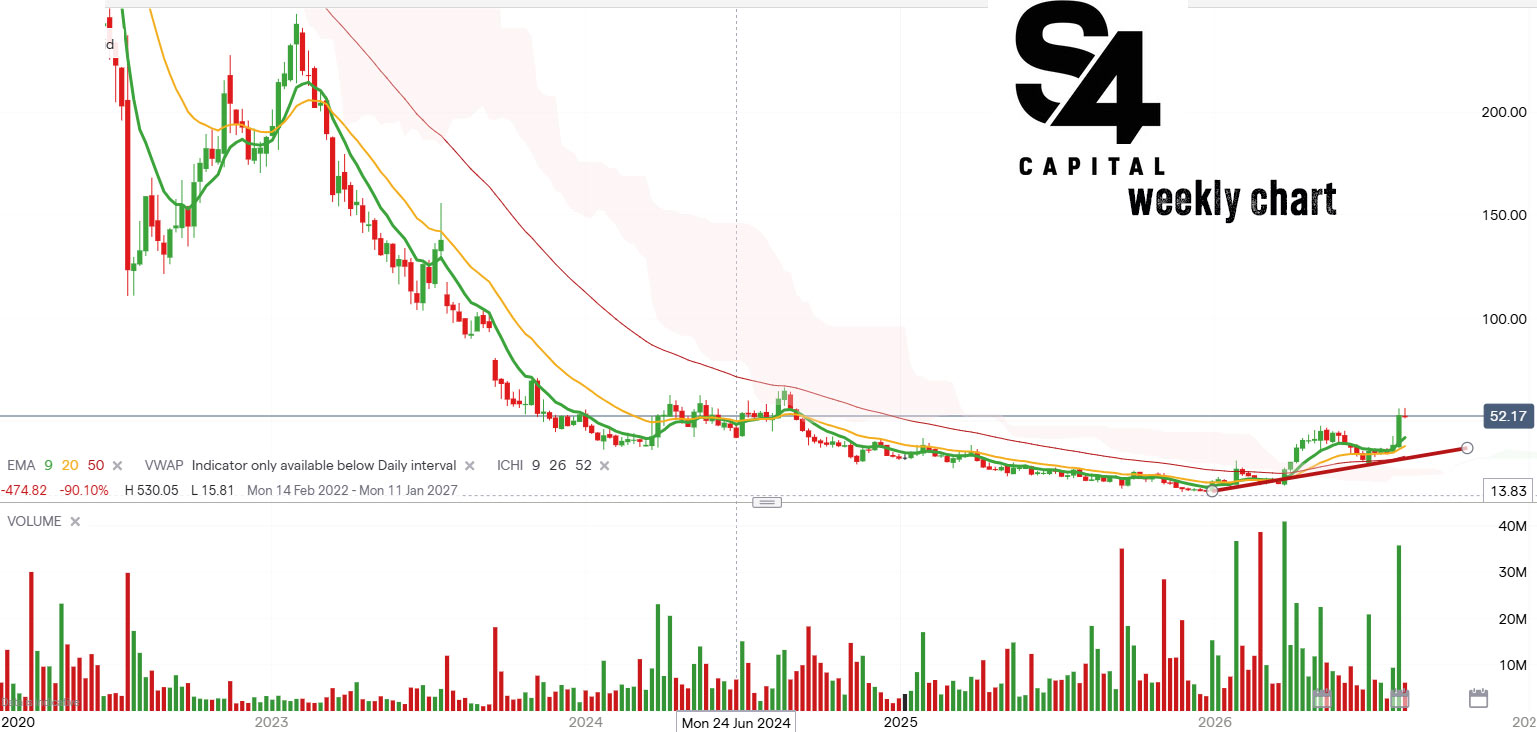
- Chart’s waking up too. After a long, grinding downtrend, price has broken out of a multi-month base with a clean EMA stack turning up on the daily.
One caveat worth flagging so this doesn’t read as universally rosy: free cash flow actually fell in the half, from £16.0 million to £10.4 million, so not every metric has inflected upward.
So: cost discipline, real. Debt reduction, real. Balance sheet, genuinely much healthier. Revenue growth, still absent.
Why we’re not buying yet
A few reasons, and they’re worth separating clearly because they’re different kinds of risk.
- This has been a cost story, not a revenue story. The numbers that excited the market in the H1 2026 print (shares jumped double digits) were margin expansion and balance-sheet improvement, not renewed top-line growth. Operational EBITDA rose 83% to £38 million largely because of cost actions, while net revenue was still down 6.2% reported, 4.7% like-for-like. Nice profitability, same shrinking top line.
- The core headwind isn’t rotating away. Management’s own commentary points to hyperscaler capex accelerating further into 2026 and 2027, not decelerating. That’s the mechanism holding S4’s biggest client category back, and right now there’s no clear sign it’s about to reverse.
- Technically, the breakout is fresh and unconfirmed. A sharp move off a long base is exactly the kind of thing that can either be the start of a genuine trend or a one-week wonder that fades straight back into the range. Our framework wants to see a base-building period after the breakout — a pullback that holds, ideally on lighter volume, before we’d treat this as a confirmed entry rather than a chase.
- This looks like a recovery story more than a swing trade, at least for now. There’s a real difference between a company inflecting off a multi-year trough (interesting for patient, longer-term holders who believe in the operational turnaround) and a company with the volume-confirmed momentum a swing trade needs. Right now S4 sits closer to the former. That might change — but it hasn’t yet.
What we’re actually watching
This is the bit worth bookmarking. Here’s the checklist, roughly in order of when the data lands:
| What | When | What we’re looking for |
| ONS monthly GDP release | Ongoing, monthly | Whether advertising & market research output keeps growing — it rose 4.3% in the three months to June, following the six-month run of monthly gains reported through May |
| IPA Bellwether Q3 report | Mid-October | Whether the main-media net balance reaccelerates (+1.5% in Q2 vs +4.5% in Q1 — these are net balances of companies raising vs cutting budgets, not literal growth rates) |
| S4 Q3 trading update | Wed 28 October 2026 (brought forward from 5 Nov) | Net revenue trend improving beyond “down mid-single digits,” particularly Technology Services; whether “spend stabilising” language upgrades to actual growth in top client cohorts; Americas region trend |
| Alphabet, Meta, Amazon Q3 earnings | Late Oct / early Nov | Sales & marketing spend line, and any FY27 capex guidance — a deceleration here is the single most important leading signal for S4, likely months ahead of it showing in S4’s own numbers |
| Peer holdco Q3s (Publicis, Omnicom, WPP) | Late Oct / Nov | Organic/net-revenue growth and tech-client commentary — particularly whether the gap between S4 and the larger holdcos is narrowing |
| Chart structure | Ongoing | Post-breakout base building, EMA stack (daily, 9/20/50) holding on any pullback, volume confirmation on the next leg up rather than a single vertical candle |
The bottom line
S4 has an unusually clean story attached to it — a well-known founder, a dramatic rise, an even more dramatic fall, and now a genuine (if incomplete) turnaround underway. That makes it a good one to have on the radar and a genuinely interesting one to write about.
But “interesting story” and “confirmed setup” are two different things, and right now the fundamentals (revenue still falling, key headwind still building) and the technicals (fresh, unconfirmed breakout) are both asking for more evidence before this earns a place in an actual trade. The watchlist is exactly where it belongs until that evidence turns up.
We’ll update this one as the Q3 data rolls in.
As ever — this is research, not advice. Advertising stocks, AIM or Main Market, can move fast in both directions. Do your own work before putting money anywhere near this one.