I didn't get into trading so I could spend my life staring at charts.
The whole point was freedom.
Every trade I take has a bigger purpose. Make money in the market, pull some of that profit out, and move it into property. Something tangible. Something that can produce income without me needing to sit in front of a screen all day.
That's the end game.
I'm not interested in chasing green candles just for the buzz of being in a trade. Trading is a tool. The money I make from it is supposed to buy me more freedom — not turn me into someone who watches every tick from the opening bell to the close.
So while my capital is working in the market, I'm usually doing something else. Working on property, sorting jobs, getting things done in the real world.
But there's a trade-off.
The market keeps moving whether I'm watching it or not.
That means when I do sit down to analyse it, I need to be deliberate. I'm not scrolling through hundreds of charts hoping something catches my eye. I start with the bigger picture.
Which sectors are leading?
Where is the money actually flowing?
Once I know that, which companies in those sectors deserve a closer look?
That process keeps me focused and stops me from forcing trades where there isn't one.
And this week, it threw up something I really wasn't expecting.
THE BIG PICTURE
Before the sectors — three things, without turning this into an economics lecture.
Interest rates just went up. The Fed raised its rate to 3.75%-4% on 16 September, the first hike since 2023. Higher rates usually hurt growth stocks: borrowing gets pricier, and future profits get discounted harder.
Oil's elevated too. Brent's been sat around $100-105 a barrel this month, driven by tension around the Strait of Hormuz rather than real demand. Keep half an eye on it, but I wouldn't trade off it directly.
And the AI debt story hasn't gone away. Data-centre builders are increasingly funding the AI buildout with borrowed money, not just cash in the bank. The credit spreads on that debt have started widening — an early warning sign to file away, not panic over.
None of that stopped Tech this week.
KEY OBSERVATION

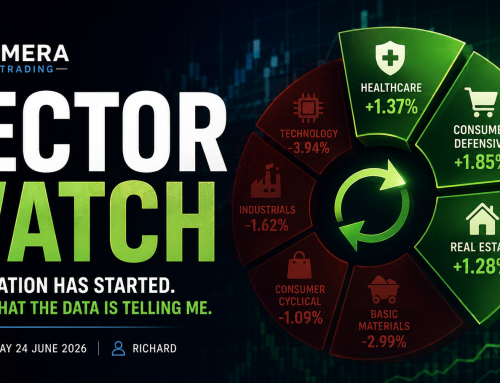
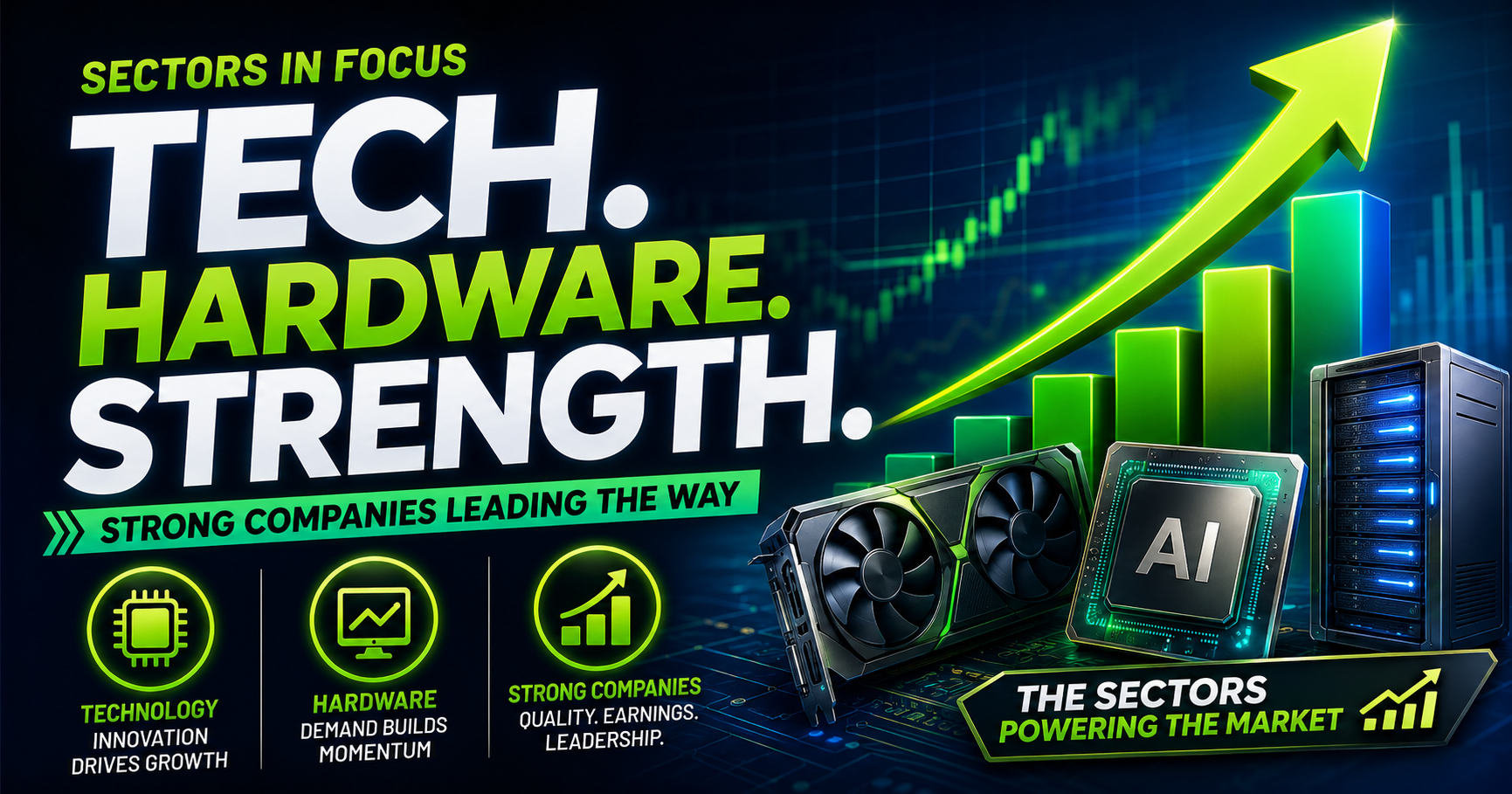
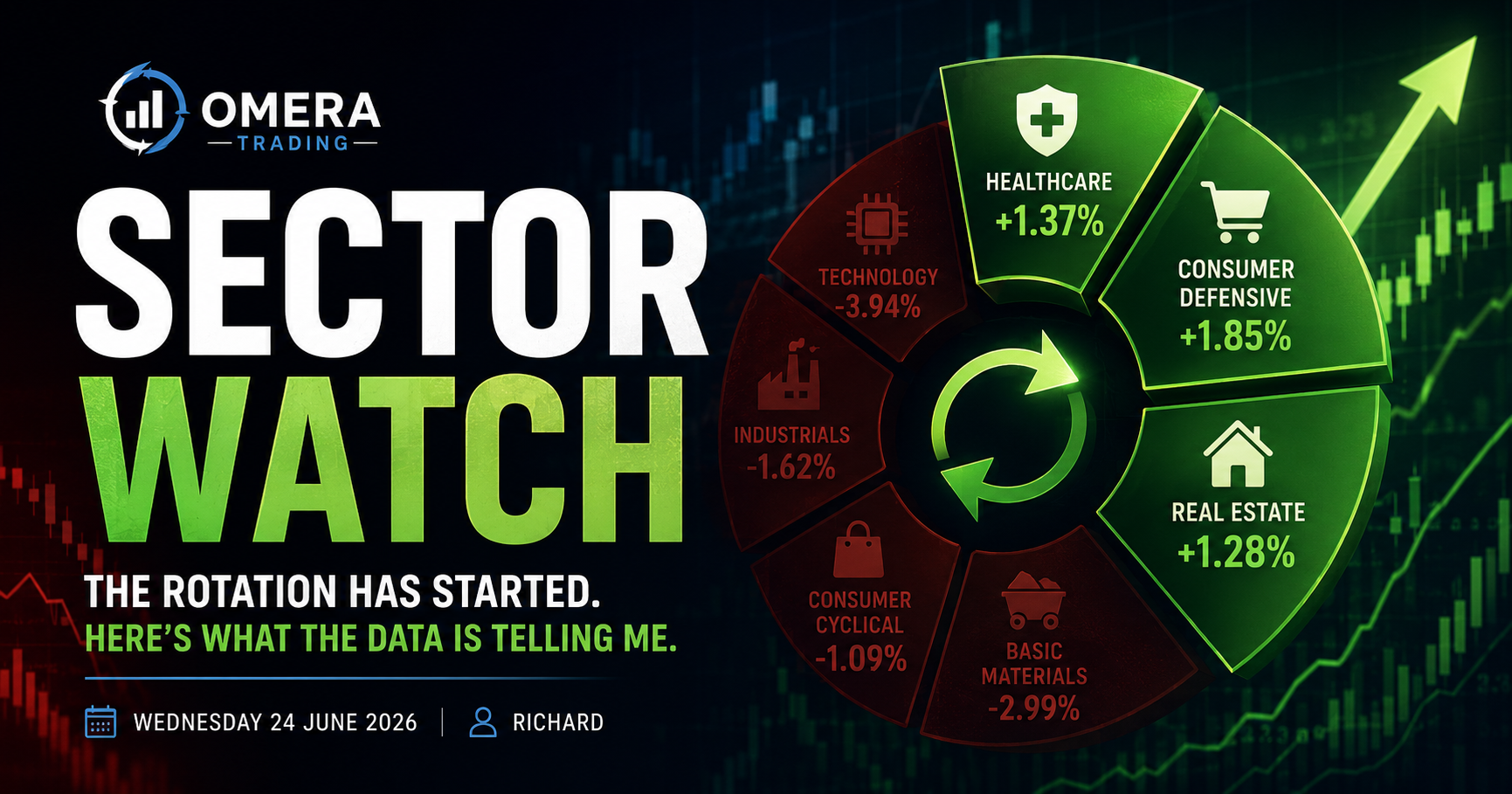
Technology is the only sector on this list that's positive on every single timeframe — one week out to six months. Healthcare, my structural leader for most of the summer, has gone cold on the short term. That's a real shift, not noise.
A sector can lead right up until the moment it doesn't. Rates just rose, and the AI debt story is still simmering in the background. Strength here is a reason to look, not a reason to chase blindly.
INSIDE TECH: IT'S NOT THE CHIPS
Here's what surprised me. Everyone assumes "Tech is up" means Nvidia, AMD, the usual chip names. Not this time.

Computer Hardware is out in front on every timeframe that matters right now. Semiconductors — the more obvious, more crowded trade — is actually cooling: still up on the week and month, but negative over three months. Software's the mirror image: it had its run three months ago and is rolling over now.
So the question isn't "is Tech strong". It's "which bit of Tech". This week, that's hardware — and inside hardware, it's storage.
THIS WEEK'S WATCHLIST
Four names on the radar: SanDisk, Seagate, Super Micro, and Arista. It's Monday morning — this is a first look, not a deep dive. I'll come back to each of these properly over the next few posts once there's more to work with.

SanDisk (SNDK) — Up over 500% this year on AI-driven demand for flash memory: data centres need somewhere to put everything they're processing. RSI sits at 62, right in the zone I want to see, with room left before the 52-week high. Beta of 5.2 though — this one moves hard in both directions, so size accordingly.
Seagate (STX) — Same theme as SanDisk: mass data storage for AI infrastructure. Last quarter's beat was big: revenue up from $2.16bn to $3.11bn year-on-year, and next year's earnings growth is forecast at nearly 57%. RSI's in the zone, decent room to the high. The one number I'm watching is debt — its debt-to-equity is the highest of the four here.
Super Micro (SMCI) — The cheapest of the four on valuation, and still 31% off its 52-week high, so the most room to run if the story holds. Builds the servers AI infrastructure runs on. One thing to flag: SMCI had a serious accounting and late-filing scandal in 2024 that hammered the stock. It's recovering, but that history is exactly why it's still trading well below its old highs while its peers aren't.
Arista Networks (ANET) — The highest-quality balance sheet of the four, effectively no debt. Networking kit for AI data centres, with customers reportedly spending heavily on new gear. The trade-off: it's only 5% off its 52-week high, so there's the least room left of any name here. This is the one I'd call already priced-in, not fresh.
REMEMEBER
SanDisk and Seagate aren't chip stocks — they're the physical storage AI needs to actually function. Different story, different risk profile to an Nvidia or AMD trade. Treat it as its own theme, not lumped in with "AI stocks" generally.
Nothing here's a recommendation. It's what's on my screen this week, and why. Sector rotation says Hardware. The charts on most of these names say watch, don't chase — not one of them has a clean, confirmed breakout yet. That's fine. Watched, not chased.
Richard · Omera Trading
Did we hit peak fear?
Monday gave us the strongest single session in weeks. The Nasdaq closed at a record high, up 2.26%. The S&P 500 added 1.49%.
AMD jumped nearly 10% and briefly crossed $1 trillion in market cap for the first time in the company’s history. Intel put on 12%. ARM ripped over 12%. Meta was up over 11%.
Meta started it. Their new AI agent, Muse, showed early signs it’s driving real demand for the processors that power these agents. That’s not a chip company announcement moving chip stocks. That’s a software product moving hardware stocks.
Add in oil falling over 4% and the 10-year yield dropping back below 5%, and you’ve got the ingredients for a proper risk-on day—two things that had been weighing on this market for weeks easing at once.
One green day doesn’t make a trend. I’m not counting my chickens. But the ingredients are there: fear easing off, direction starting to show. Even if that direction ends up being higher rates for longer, at least it’s a direction. Markets can work with direction. They can’t work with sideways.
The Iran situation is boring people — and that’s bullish
Geopolitical risk that fades from the headlines stops pricing itself into every session. When the market stops flinching at a story, that’s usually a sign the story’s lost its grip on sentiment, not that the story’s resolved. That’s a quiet tailwind, not a loud one — but it’s real.
What I didn’t do — and why
When I saw those moves yesterday, a small part of me did the maths on what a bigger position in AMD would’ve made me. Thousands instead of hundreds. That thought is completely normal, and it’s exactly the thought the market wants you to have.
The market wants you angry you didn’t go in heavier. It wants you chasing size on the next one to make up for it. And no matter how good yesterday looked, it can all rotate tomorrow — this market’s proven that all year.
So here’s the actual question. Do I want the life I’ve got now — paying my bills, no boss, time with my kids — or do I want to gamble that for a Ferrari I might never get? Put like that, it’s not a hard call.
Where that leaves the plan
I think we might be looking at the start of a new up-leg. That’s exactly what this approach is built to catch — but we let it develop first. Piling into AMD, Meta or ARM after moves like yesterday’s isn’t the risk-reward I’m after. I want a pullback to the moving averages, or some consolidation building above the breakout level — a technical entry, not a chase.
If I miss it, I miss it. There’ll be another one.