I spent a chunk of this week doing a proper top-down on the healthcare sector. Not because I had a burning conviction — more because the charts were showing strength while everything else was getting smashed, and I wanted to understand why before I did anything stupid. which isn't hard.
Here's what I found.
The Sector

For most of the past two years, healthcare has been the sector nobody wanted to talk about. While tech and AI were hoovering up institutional capital, healthcare was the wallflower at the party. The sector underperformed the S&P 500, flows were negative, and the narrative centred on drug-pricing risk, Medicaid reform, and policy uncertainty out of Washington.
But the backdrop has shifted. Tech just had its worst week since the tariff chaos of early 2025. A trillion dollars wiped from chip stocks in a single session. The AI trade that consumed institutional attention for two years has hit a wall — at least for now. That capital has to go somewhere. And when I looked at the healthcare sub-sector breakdown, the rotation was already showing up in the numbers.
What the Performance Data Shows
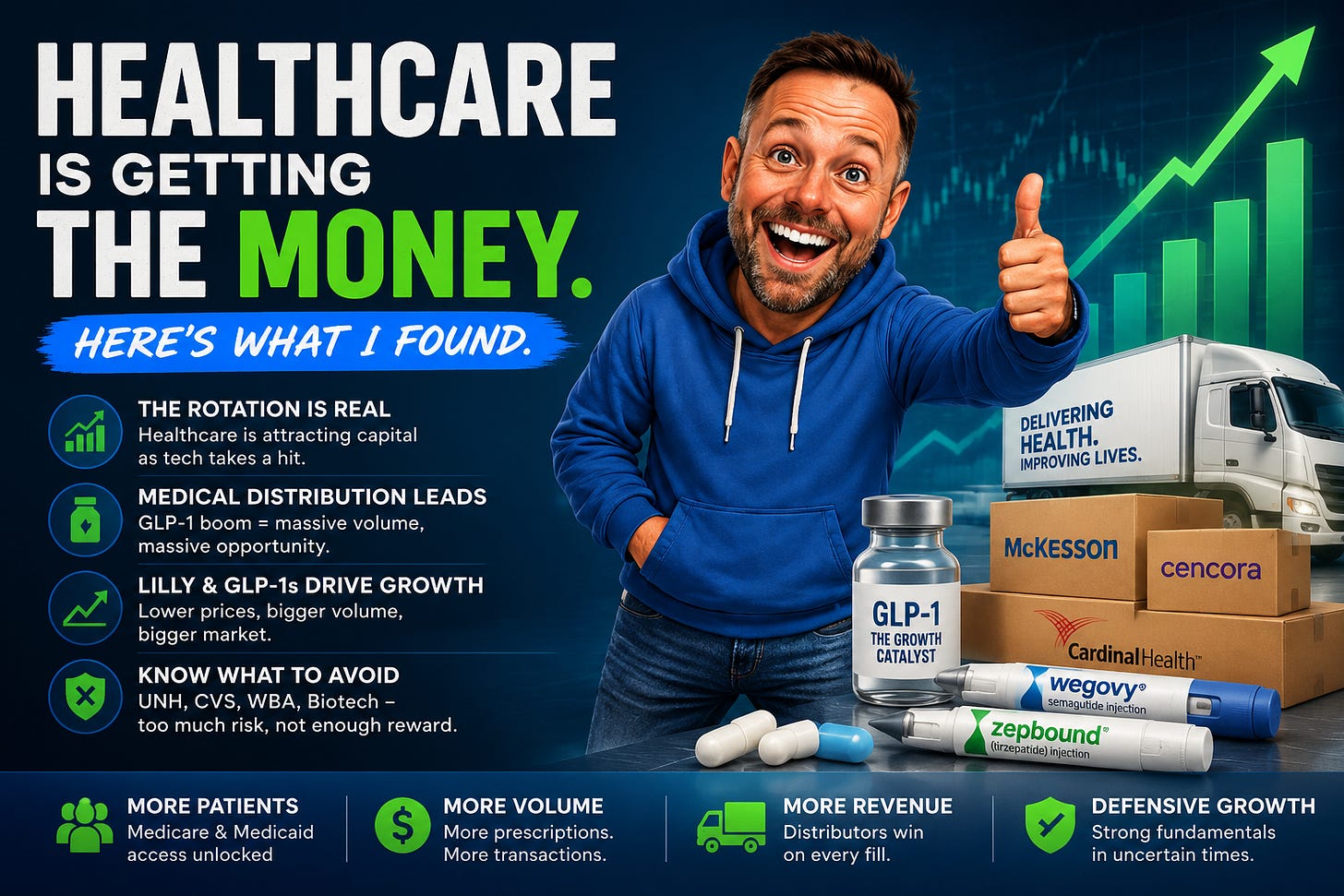
The sub-sectors getting money right now are Medical Distribution, Healthcare Plans, and Diagnostics & Research. Medical Distribution is the standout — leading on both the week and the month, and there's a proper fundamental reason behind it.

Getting punished: Pharmaceutical Retailers (Walgreens and CVS — structurally broken businesses with Medicaid exposure on top), Medical Care Facilities, and Biotechnology. Nothing in those groups worth touching right now.
Why Medical Distribution Is Running
Together they control over 90% of US drug distribution. They buy drugs from manufacturers, warehouse them, and ship them out to pharmacies, hospitals, and clinics. Thin margins, but on revenues of $100 billion-plus, the numbers work. And nobody's building a competing network — the capital required is insane and the customer relationships are locked in long-term.
The reason they're running comes down to one word: GLP-1s.

Every Zepbound and Wegovy prescription that gets filled goes through their network. They don't care what price Eli Lilly charges for the drug — they get paid per transaction. When Lilly and Novo signed their deal with the government to slash prices and open up Medicare and Medicaid access to 120 million people, the pharma companies took lower pricing. The distributors just saw a volume explosion coming down the pipe.
McKesson reported $14 billion in GLP-1 distribution revenue in a single quarter. This isn't a bounce — it's a structural re-rating.
The GLP-1 Story
Eli Lilly is the dominant name in this theme — I currently hold from $1,000. Their Q1 2026 numbers were not normal. Revenue up 43% in the US, volume up nearly 50%. The pricing overhang that had been hanging over the sector for months has now largely cleared — Lilly and Novo agreed to drop list prices dramatically in exchange for Medicare and Medicaid coverage, unlocking a massive new patient pool. Drug spending in the US is expected to grow at 8% annually through 2028, driven almost entirely by GLP-1s and biologics.
Lower price, massively bigger volume. The market is pricing that trade-off correctly.
The Names to Avoid
UnitedHealth (UNH) — the stock went from $599 to under $308 in months. CEO assassination, cyberattack, CEO departure, suspended guidance, and a criminal DOJ investigation into Medicare fraud. The business is still huge but this is uninvestable until there's resolution. Too much event risk.
The Healthcare Plans sub-sector posted a strong week. Some of that is a UNH bounce off deeply oversold. Don't be fooled — the managed care space has genuine Medicaid reform risk on top of the legal overhang. Not touching it.
Pharmaceutical Retailers — CVS and Walgreens. Down hard over the past month and for good reason. Structural problems, Medicaid exposure. Nothing to see here.
The Rotation Backdrop
At the same time, a much hotter-than-expected jobs report sent Treasury yields surging and put rate hikes back on the table. Where did the money go? The Dow hit record highs while the Nasdaq was collapsing — consumer defensives, industrials, healthcare.
This isn't panic selling into cash. It's institutional repositioning into lower-beta sectors with actual earnings behind them. Medical Distribution ticks both boxes: defensive business model and a genuine growth catalyst in GLP-1s. That combination is rare.
We Need to Watch SpaceX on Friday?
SPCX lists on Nasdaq this Friday — $135 a share, $1.77 trillion valuation, the largest IPO in history.
My initial instinct was that this could pull sentiment back toward tech and growth. But the mechanics don't support that. SpaceX is a massive selling event as much as it is a buying one — retail investors who want SPCX shares have to fund that from somewhere. That's additional selling pressure on top of an already fragile market.
Add in CPI this morning coming in hot at 4.2% year-on-year — highest since 2023 — and the FOMC meeting next week. Rate hike odds just got higher. Not a great backdrop for a $1.77 trillion growth listing.
Watching, not trading. If anything, a post-IPO dip in quality healthcare names is the more interesting setup.
Drilling Into the Medical Distribution Names
So I ran the names through my trading setup plan. HSIC is dental and healthcare supplies, the smallest of the group, with the weakest numbers across the board — eliminated immediately.
That leaves three, and the comparison is genuinely interesting.
On the surface all three are running. But zoom out and the picture changes — MCK and COR have both been in a significant hole over the past quarter and are recovering. CAH is different. It never fell as hard. It's been positive over the quarter, the half year, and year-to-date. The relative strength has been consistent, not just a recent bounce.
Technically, CAH is the cleanest chart:

Above all three key moving averages, close to its 52-week high, RSI approaching overbought which is a short-term caution but not a reason to dismiss it. MCK and COR are still below their SMA200s, still rebuilding.
On fundamentals, CAH's EPS growth this year is exceptional. The PEG ratio sits at 1.0 — you're paying exactly fair value for the growth. MCK is cheaper on a sales basis and has the GLP-1 volume story fully intact, but the growth rate doesn't match CAH right now. Institutional ownership is heavy across all three and short interest is low. Nothing structurally concerning.
The one thing MCK has that the others don't: a beta of 0.30. It barely moves relative to the market. In a week with a hot CPI print, a monster IPO, and an FOMC meeting on the horizon — that's not nothing.
ishares US Healthcare ETF
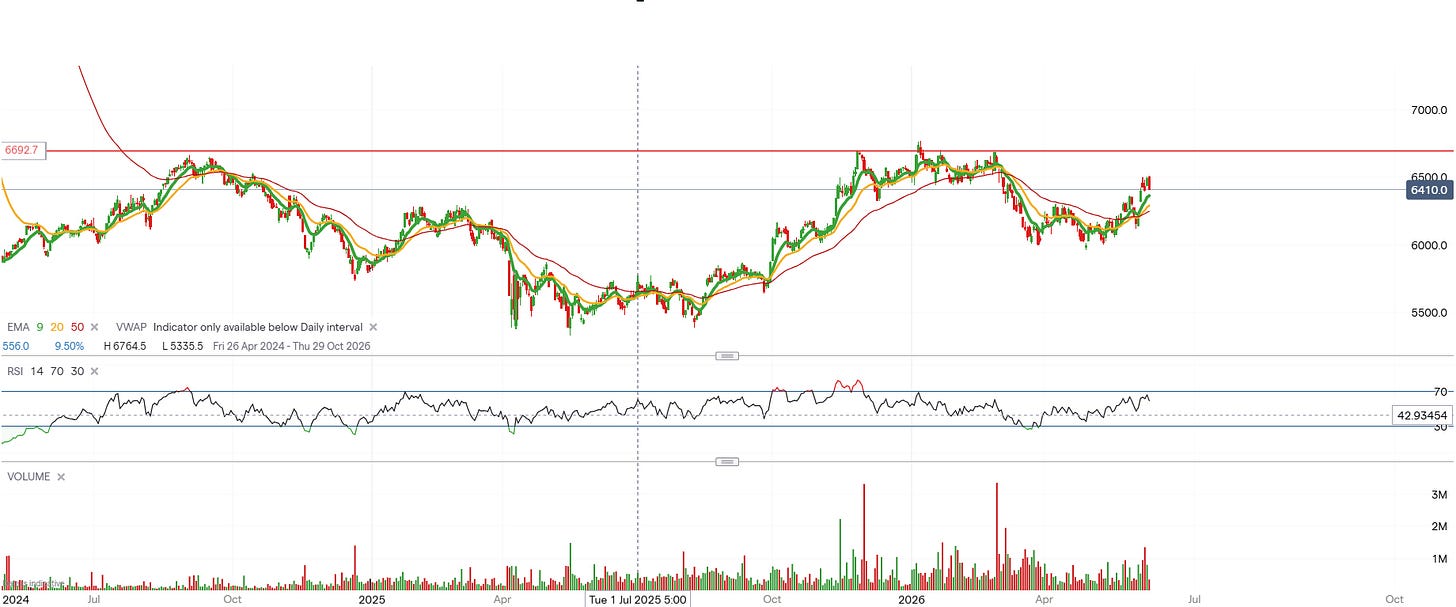
Right now the sector is mid-range in the consolidation box. Not a trade on the ETF yet. But the base is being built and the rotation money is already arriving. The setup is coming.
Where I'm Focused
CAH has the strongest setup right now. Best relative performance, cleanest chart technically, exceptional EPS growth, and the highest institutional activity in the group this week. The one caution is RSI — it's extended short term. Don't chase it. Wait for a pullback.
MCK is the quality long-term play. Lowest beta, biggest market cap, GLP-1 exposure fully intact, oncology growing hard. Still below key moving averages so it needs more time technically — but paradoxically, that means the entry risk/reward may actually be better than CAH right now. Earlier in the recovery, lower volatility, fundamental case intact.
LLY — already holding. The fundamental case is well established. Purely a technical question from here.
Both MCK and CAH are going through the full trading plan framework.
So, check the US watchlist section for a breakdown.
As always, please do your own research you filthy animals