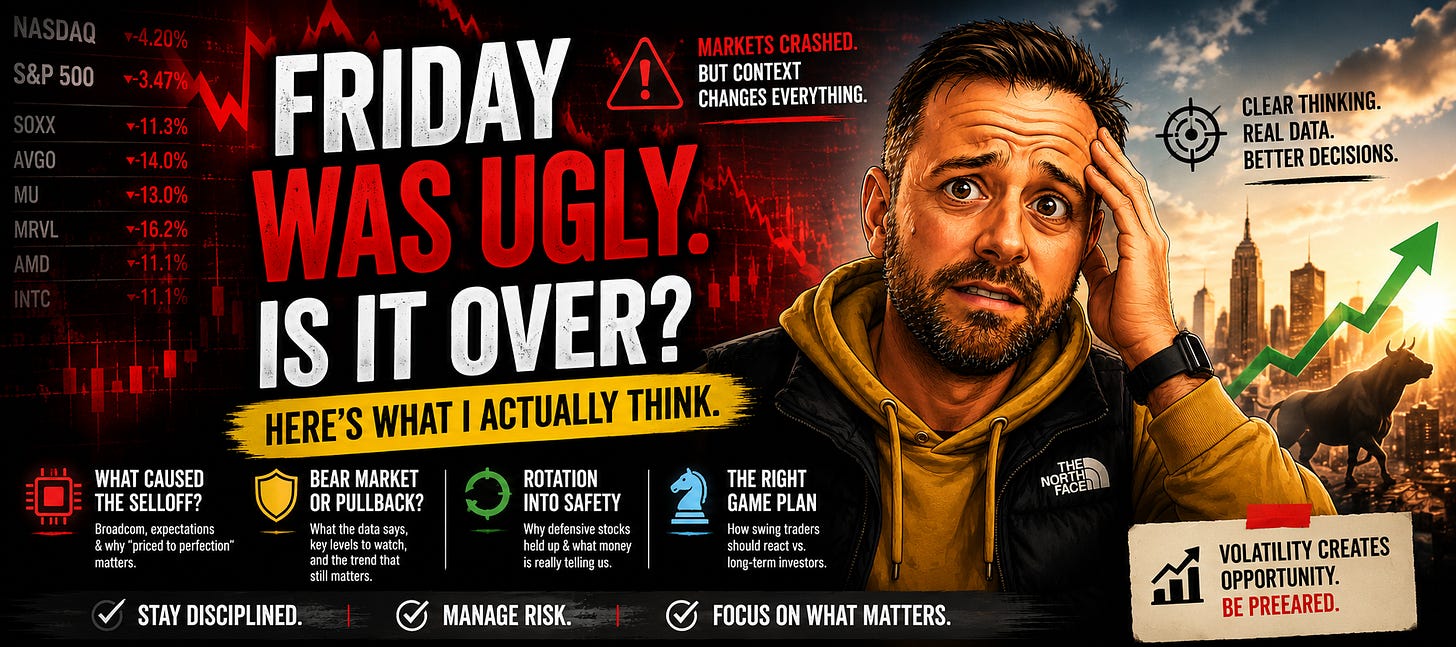
The Nasdaq dropped 4.2% on Friday. Semiconductors got absolutely hammered. Micron down 13%. Marvell down 16%. AMD and Intel both losing around 11%. The Philadelphia Semiconductor Index had one of its worst single days since early 2025.

By Friday afternoon the usual circus had started. CNBC suits in expensive ties explaining why this was inevitable. Twenty-one year old "expert economists" on YouTube telling you the bear market has begun and you should be very, very afraid. Bearish content flooding every feed because bearish content gets clicks. Fear sells. Always has.
I'm going to tell you what I actually think. Which is considerably less dramatic.
Bear Market or Pullback?
Let's Keep This Simple.
A bear market is a 20% decline from the highs. That's the definition. Not vibes. Not a bad Friday. Not a YouTube thumbnail with a red arrow.
The S&P 500 is still up roughly 10% on the year. It's sitting near record territory. One bad session — even a horrible one — doesn't change that. The index would need to fall from current levels by another 10% before we're even in correction territory, let alone a bear market.
Could it get there? I'm not in the guessing game. I follow the trend. I stay with the trend until something changes. And right now the trend hasn't broken — it's pulled back.
That said, I did reduce some of my positions on Friday. And that's worth explaining — because a swing trader and a long-term investor should be thinking about this completely differently.
As a swing trader, my timeframe is days to weeks. I'm in and out of positions, riding momentum, and cutting exposure when volatility spikes and the risk profile of my trades changes. A 4% down day on the Nasdaq is uncomfortable when you're leveraged and trading on a short timeframe. Reducing size in that environment isn't panic — it's risk management.
A long-term investor should be thinking about this differently. If you're investing with a five or ten year horizon, a bad Friday is noise. You don't need to do anything. History is very clear on this — the people who try to time short-term selloffs usually end up missing the recovery. If the underlying companies you own are genuinely good businesses, a pullback is either irrelevant or, if you have spare cash, an opportunity to add at better prices. Selling quality on fear is almost always a mistake on a longer timeframe.
Different tools, different rules. Know which game you're playing.
Now — here's what actually happened on Friday. It was ugly across the board. The Dow fell nearly 700 points. The Russell 2000 — which tracks smaller companies — dropped 3.47%. Nothing escaped completely unscathed.
The only things that held up were defensive names — Colgate-Palmolive up 4%, Coca-Cola up 3%, Johnson and Johnson up 2%. Consumer staples and healthcare caught the money leaving tech. That's a meaningful signal. Not a rotation into growth, but a rotation into safety. Money moving away from risk, toward things people need regardless of what the economy does.
That's different to a bear market. But it's also more cautious than a healthy bull market rotation. Worth paying attention to.
Does that mean everything is fine and nothing to worry about? No. There are real risks building in the background and I'll get to those. But the people telling you the sky is falling on Friday were the same people who missed the 15% rally in eleven days a few weeks ago. They're always certain. They're frequently wrong.
Stick to the charts. The data will tell you when the trend has genuinely changed. Until then — keep a clear head.
What Caused the Selloff?
The trigger was a company called Broadcom. Ticker AVGO. And the story of what happened to Broadcom on Thursday night is one of the best lessons in how markets actually work that I've seen in a while.
Broadcom reported earnings after the close on Wednesday. They were genuinely exceptional. Revenue up 48% year on year — the highest quarterly growth rate in nine years. AI chip revenue up 143%. Free cash flow crossing $10 billion for the first time in a single quarter. Record margins. Everything beat expectations.
The stock dropped 14% !
How does that happen? And why did it drag the entire semiconductor sector down with it?
The Most Important Lesson in Trading — Priced to Perfection
Here's the thing about Broadcom that explains everything.
In the weeks before earnings the stock had rallied 63% from its March lows. Sixty-three percent. In a few weeks. By the time the results came out the stock was already pricing in a perfect quarter — and then some. The market had already decided Broadcom was going to blow the doors off and had paid up accordingly.
When a stock has run that far that fast, it doesn't just need to be good. It needs to be extraordinary. It needs to raise guidance significantly. It needs to give the market a reason to keep paying a premium price.
Broadcom was good. It wasn't extraordinary.
The AI chip guidance for the next quarter came in at $16 billion. Analysts had expected $17.2 billion. That's a $1.2 billion gap on a company doing $22 billion in revenue. In normal circumstances that's a rounding error. When you're priced for perfection it's enough to trigger a 14% selloff.
There was also a strategic pivot that caught the market off guard. CEO Hock Tan announced on the call that Broadcom would focus on chips only going forward — dropping plans to provide complete integrated AI systems it had previously promised. The market hadn't priced that in.
So that's the first lesson. The results weren't the problem. The expectations were the problem. When a stock has already priced in 2027 and 2028 in 2026, the gap between reality and fantasy snaps shut fast.
What Even Is Broadcom?
I want to take a minute here because understanding Broadcom's place in the market is actually really interesting — and it explains why the selloff spread to the whole semiconductor sector.
Most people think of Nvidia when they think of AI chips. And they're right — Nvidia dominates the market for general-purpose AI processors with about 80% market share. But there's a different and arguably faster growing part of the AI chip market that Broadcom owns — custom silicon.
Think of it this way. Nvidia sells the same chip to everyone. One chip design, sold to thousands of customers. McDonald's chips. Fast, widely available, gets the job done.
Broadcom does something different. They sit down with Google, Meta, Anthropic, OpenAI and design a completely bespoke chip built specifically for that company's exact needs. A Michelin star meal made to order. Custom silicon. ASICs. And Broadcom has about 70% of that custom market.
If Nvidia is the brain of AI infrastructure — the processing power — Broadcom is the nervous system. The networking chips that connect thousands of AI processors together so they can actually function at scale. Without Broadcom's networking kit, Nvidia's chips can't do what they need to do.
That market — custom silicon — is forecast to grow at 27% per year through 2033. Faster than the broader AI chip market. The market had been pricing Broadcom as though it had already overtaken Nvidia. The results showed it hadn't yet.
And when the perceived leader in the fastest growing part of the AI chip market disappoints — even with a genuinely strong quarter — the whole sector feels it. AMD, Intel, Marvell — none of them had company-specific bad news on Friday. They just got dragged down in the wash.
There's been a lot of guessing going on with AVGO. And that's the real problem. When a stock runs 63% in weeks on the back of a compelling narrative, the crowd stops asking "what's already priced in?" and starts asking "how high can it go?" That's speculation, not investing. And when reality arrives in the form of an earnings report, the speculators get hurt.
The Narrative Is Still Intact — But Patience Is Everything
Here's what I want you to take away from the Broadcom situation.
The story is completely real. Custom silicon is the future. Broadcom owns that market. The $100 billion AI revenue target for 2027 wasn't cut — it was reiterated. CEO Hock Tan said demand remains "simply insatiable." The business is genuinely exceptional.
But being right about the story and making money from it are two completely different things.
The investors who lost money on Broadcom this week weren't wrong about the company. They were wrong about the timing. They bought the narrative at all-time highs without asking what was already priced in. They paid 2027 prices in 2026 and got burned when reality arrived in the form of an earnings report.
The patient trader watches a 14% drop on a genuinely strong earnings report and asks — is the story broken or is this just expectations resetting? If the story is intact, that pullback is potentially an opportunity. Not something to panic about.
We are going to make money off the impatient investor. Not by being smarter — by being more patient. By waiting for the chart to reset properly, the RSI to cool, the moving averages to catch up. By letting the panic sellers do their thing and then stepping in when the risk/reward is actually in our favour.
I'm watching AVGO. It needs time to base. But it's going on the watchlist.

The Jobs Report — Good News That Became Bad News
Right, let's talk about the other thing that spooked markets on Friday. The May jobs report.

172,000 new jobs created. Double what economists expected. On the surface — great news. More people working, money flowing into the economy, businesses hiring. Fantastic.
Except markets sold off on the news. Because good economic news right now is bad market news. Here's why.
Before I get into this — a quick word. I'm not an economist. I have an interest in this stuff, but I'm very much learning as I go. Writing these posts is part of that process — I research, I try to make sense of it, I share what I find. If something in here turns out to be wrong, I'll say so. I don't predict. I don't think anyone can reliably. The Federal Reserve — the most powerful monetary institution on the planet with hundreds of economists on staff — regularly gets it wrong. So take all of this as one bloke's attempt to understand what's happening.
With that said — here's what I think is going on.
When the economy is strong and lots of jobs are being created, the Federal Reserve has no reason to cut interest rates. But a too-strong jobs market with rising inflation risks something called a wage price spiral — and that's what's really keeping central bankers up at night.
Here's how a wage price spiral works in plain English. Energy prices go up because of the Iran conflict. Everything gets more expensive. Workers notice their wages aren't keeping up with prices. They demand pay rises. Companies give them pay rises but then raise their prices to cover the cost. Workers notice prices have gone up again. They demand more pay rises. And so it goes — each turn of the cycle embedding inflation deeper until it becomes self-sustaining.

The 1970s is the horror story here. The Fed kept rates too low for too long during an oil shock. Wages chased prices, prices chased wages, and by the late 1970s inflation was running at 14%. It took a Fed chair called Paul Volcker hiking rates to nearly 20% to break it — causing unemployment to hit nearly 11% in the process. The medicine was worse than the disease.
The Fed remembers this. They are absolutely determined not to let it happen again. Which is why even the hint of a too-hot jobs market — even when the economy is showing other signs of strain — pushes them toward higher rates rather than lower ones.
The Consumer — Feeling Terrible, Still Spending (For Now)
Here's the paradox at the heart of the current economy that I find genuinely fascinating.
Consumer sentiment just hit an all-time record low in the United States. The University of Michigan surveys people every month about how they feel about the economy. In May 2026 the reading came in at 44.8 — the lowest in the survey's 74-year history. Lower than the 2008 financial crisis. Lower than the peak of post-pandemic inflation. Americans haven't felt this gloomy since the survey began in 1952.

And yet they're still spending. Not as enthusiastically, not on the same things — more cheap restaurants and streaming services, less big ticket items — but the money is still flowing.
How? Savings. Credit cards. People are drawing down whatever financial buffer they built up during the pandemic years and putting it on plastic to maintain their spending habits while prices keep rising.
The problem is obvious once you see it. That buffer doesn't last forever. Two thirds of consumers say they're cutting back on spending due to rising prices. The savings drawdown is happening faster than it's being replenished. Healthcare costs are rising. Credit card debt is at record levels for middle income households. Fuel costs from the Iran conflict are taking a bigger and bigger chunk of the monthly budget.
At some point — nobody knows exactly when — the buffer runs out. Spending slows sharply. Companies hire less. The jobs numbers start deteriorating. And the economy that looks resilient today starts to look very different.
What About Here in the UK?
I'm based in the UK, so I don't see the American economy up close. I can read the data but I can't feel it the way I can feel what's happening on my own doorstep.
And here's how I actually judge the health of an economy — not by reading reports, but by paying attention in everyday life. Am I sat in the pub with friends who are telling me they've just booked another holiday? Is everyone volunteering to get another round in of beers without a second thought? Are people talking about upgrading their kitchens or buying a new car?
Or do people look a bit worried? Are they mentioning overtime being cut? Switching from Sainsbury's to Aldi? Cutting the Sky or Netflix subscription?
That gut check matters. And right now in the UK, the gut check isn't great.
UK consumer confidence fell to its lowest level since late 2022 in Q1 2026 — a 13.5 percentage point drop in confidence in the UK economy. Discretionary spending hit a three-year low. Clothing purchases down 11% on the previous quarter. Nine out of ten UK consumers name the cost of living as their biggest concern. Spending growth for the whole of 2026 is forecast at just 0.7% — barely above zero.
Sound familiar? The UK picture looks remarkably similar to the US one — people feel gloomy, they're cutting back, but the economy hasn't collapsed. The difference is the UK doesn't have the same credit card buffer the US consumer has been leaning on. UK households tend to be more cautious with debt. So when UK consumers pull back, they really pull back.
The pub test over here? A lot more people are getting a half rather than a pint. Make of that what you will.
The Fed's Impossible Problem
So here's the situation Kevin Warsh walks into for his first Fed meeting on June 16th-17th.

Inflation running above target. Jobs market too hot. Wage growth threatening to become a spiral. Iran pushing energy prices higher with no obvious end in sight.
All of that says raise rates.
But consumer savings are depleting. Credit card debt is at records. Real wages are flat. A slowdown is building on the horizon.
All of that says don't raise rates.
There is no good option. Only trade-offs. Raise rates and you accelerate the slowdown that's already beginning. Don't raise rates and you risk letting inflation become embedded in wages and prices for years.
Markets are currently pricing about a 70% chance of a rate hike by December. Traders were pricing in rate cuts just a few months ago. That's how quickly the narrative shifts. Goldman Sachs scrapped their forecast for rate cuts entirely after Friday's jobs report.
And just to add some theatre to the whole situation — Trump went on TV at the weekend and said "there's no reason to raise interest rates." The president who appointed Warsh specifically because he wanted lower rates is now publicly warning his own Fed chair not to hike on his first outing.
First meeting on June 16th. Popcorn ready.
So What Do We Actually Do?
Here's where I land after all of this.
The macro picture is genuinely complicated. There are real risks building. The consumer is under pressure on both sides of the Atlantic. The Fed is in an impossible position. The geopolitical backdrop remains fragile. A hot jobs report just shifted the rate conversation from cuts to hikes.
But the trend is still up. The S&P 500 is still near record levels. Earnings across the broader market have been genuinely strong. The AI infrastructure buildout is real and generating real revenue. The defensive rotation on Friday — into staples and healthcare rather than outright selling — suggests this is still a market digesting a shock rather than one in full panic.
I'm not calling a bear market. I'm not calling a continuation of the bull run. I'm watching the charts, following the data, and managing my risk.
When the trend changes I'll know because the charts will tell me. Not because a CNBC commentator in a nice suit told me. Not because a YouTube video with a scary thumbnail said so. The chart.
Until then — stops in place, position sizes appropriate for the volatility, patience on new entries, and a clear head when the noise gets loud.
The noise is getting loud right now. That's when the process matters most.
Not financial advice. I'm a bloke with a chart and an internet connection, not a financial advisor. Everything I write on here is my own research, my own opinions, and my own trades — for better or worse. The wins are mine. The losses are mine. Do your own research, size your positions properly, and never risk money you can't afford to lose. We're all just trying to figure this out.