WEEKLY MARKET UPDATE
It's been a hard few weeks. A tenant moved out of one of my properties, and I put in long days getting it ready for the next one. Then, just as I finished, norovirus knocked me flat. Several days on, I'm still struggling. Writing this has been an effort, and so has the research. But bills don't pay themselves, so here we are.
Last week was the big one for earnings: some of our favourite companies reported. I watched it in short bursts, and all I saw was a sea of red. In my condition, I honestly didn't care.
Trading is hard. It's even harder when you're trying to read a chart from the toilet.
Luckily, I had nothing open apart from Eli Lilly. I let that one run, and on Friday I took some profit off the table because the price looked overextended. That decision was made on the chart alone. I knew Lilly was reporting, but I honestly didn't know what they'd said. So, first job: let's find out.
I hate being this disconnected from the market. So this week we do what we always do: make an educated guess about where the market goes next. When we're wrong, the stop losses and the risk management are there to protect our capital.
First, Eli Lilly — what did I miss?
Turns out, quite a lot of good news. Lilly reported on Thursday, 29th October:
• Revenue up 39% to $24.4 billion, driven mainly by Mounjaro and Zepbound.
• Mounjaro: $10.7 billion in the quarter, up 65%. Zepbound: $5.4 billion, up 49%.
• Guidance raised: full-year revenue now $91–92 billion, with the midpoint lifted by $5.5 billion.
• Pipeline: in a head-to-head Phase 3 trial in type 2 diabetes, retatrutide (not yet approved) reportedly delivered around 20–21% average weight loss versus 9.4% for Ozempic. There were new FDA approvals too.
• Earnings per share: reported EPS rose 16% to $7.22, and adjusted EPS rose 7% to $7.48. Both figures absorbed a $4.57-per-share charge for buying in research projects, so the underlying business did better than the headline EPS suggests.
• For balance: about $900 million of the quarter's revenue came from one-offs (milestone payments and rebate adjustments) that won't repeat.
💡 My take on the Lilly trade
Taking partial profit on Friday was a chart decision, not a news decision, and I'm comfortable with that. Price was stretched. Strong results don't make an over-extended chart any less over-extended.
The rest of the position keeps running with the stop in place. The fundamentals clearly haven't cracked. If anything, they got better.
Earnings season: a quick brief on where we stand
Here's the strange thing. Strip away the headlines, and earnings season is actually going well. According to FactSet's latest update (30th October):
• 60% of S&P 500 companies have reported. 82% beat earnings estimates, above the 5-year average of 78%.
• Blended earnings growth for the quarter is 30.2% ("blended" mixes actual results with estimates for companies still to report). That would be the third straight quarter above 25%.
• All eleven sectors are reporting year-on-year earnings growth.
• The weak spot: the size of the beats is small — just 1.9% above estimates, against a 5-year average of 7.5%.
So companies are beating, but only just. In a market priced for perfection, "only just" isn't enough.
FactSet now has the Magnificent 7 growing earnings at 22.6% this quarter — while the other 493 companies are growing at 32.6%. The rest of the market is currently growing profits faster than the big tech names.
What did the big spenders say?
The market has one question for big tech right now: when does all this AI spending start paying for itself? Here's how the hyperscalers answered it last week:

And the worry has spread beyond share prices. On Friday, S&P Global moved its outlook on Meta's credit rating to negative, citing doubts about its AI spending and cash flow. When the credit analysts start asking questions, it's no longer just a stock-market mood swing.
On top of that, Intel dropped around 29% in a single day on a weak outlook. Put it all together and the Nasdaq lost about 5.2% in October — its worst month since March 2025. But I made a profit by finding strength away from the madness.
Is the spend justified? And what will make the suit happy?
The CEOs and CFOs say yes, it's justified. The suit on Wall Street isn't so sure. It helps to split "is it paying off?" into three separate questions:
• Is it making more money? Yes. Google Cloud more than doubled, Azure grew 48%, AWS grew 39%, and Amazon posted a record operating margin.
• Is there any cash left over after the spending? Increasingly, no. Alphabet has burned cash for two quarters running. Amazon's trailing 12-month free cash flow is minus $42.4 billion.
• Will shareholders get a decent return on all that capital? Nobody knows yet — and that's the bit the market is pricing.
Good points (the bull case for the spend)
• Cloud demand is real, and so are the operating profits.
• Amazon says AWS has a $578 billion backlog of contracted business, more than double a year ago, and expects AWS growth above 40% in both 2027 and 2028.
• Microsoft shows it can work: heavy spending, largely funded from its own cash, with returns showing up in the numbers.
Bad points (why the suit is unhappy)
• The cash gap is being filled with borrowed money and new shares. That means more debt competing with the US Treasury for capital, or existing shareholders getting diluted.
• Alphabet and Amazon both said spending goes up again in 2027. The finish line keeps moving.
• Even Microsoft isn't off the hook — its lower capex guide was partly down to chip deliveries slipping into 2027, not a decision to spend less.
💡 So what will make him happy?
Not simply less capex. The market isn't rejecting AI spending — it's getting choosier about how it's funded and how quickly revenue turns into cash.
My read: show free cash flow turning back up, and the spending starts to look like an investment again. Until then, every extra billion gets treated as a risk.
Away from tech: the rest of the market is fine
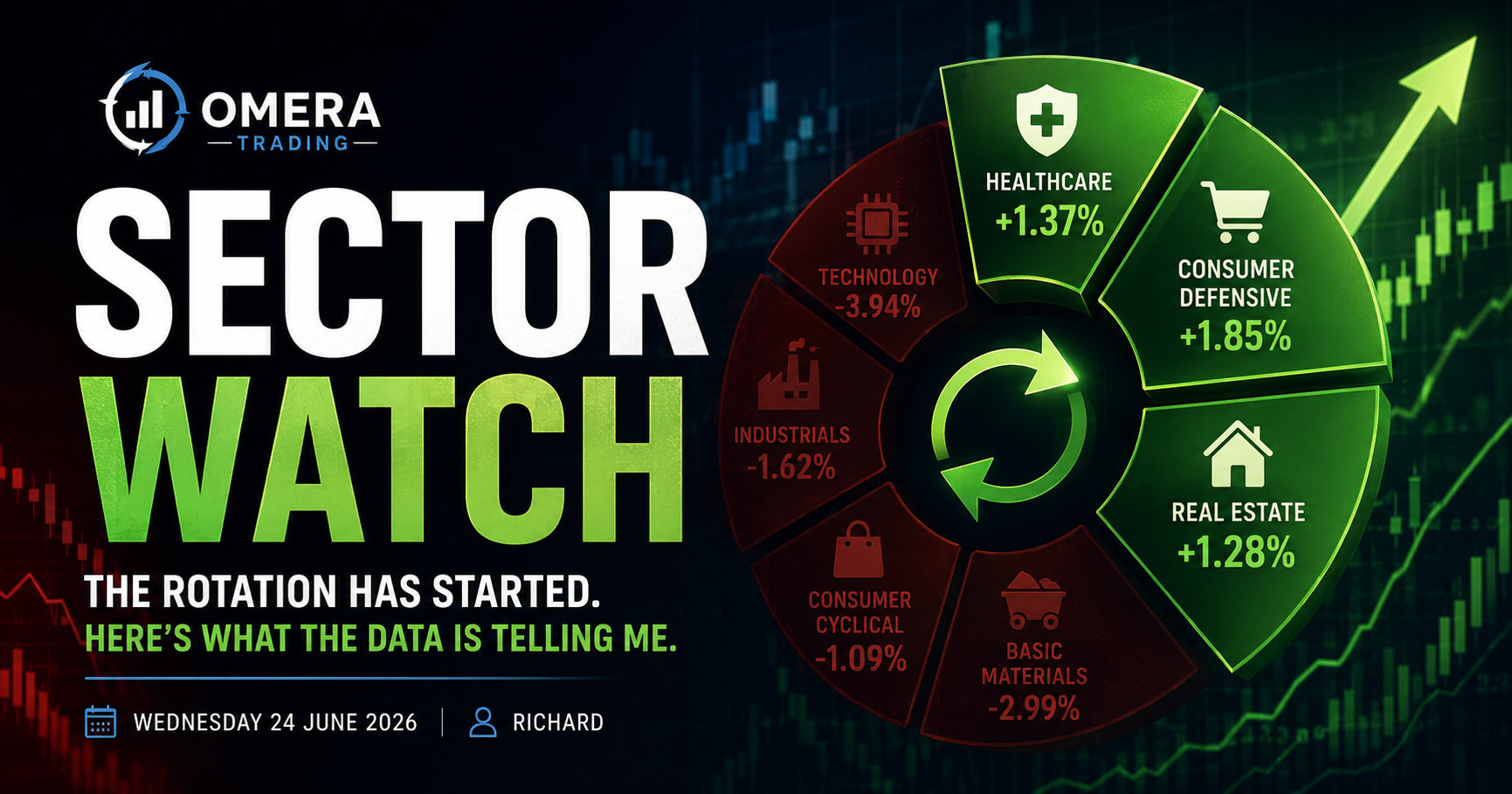
This is the part the headlines miss. While the Nasdaq had a rough October, the Dow actually rose about 1.5% on the month, and the S&P 500 only slipped around 1.2%. Technology and communication services were the only sectors to finish October considerably lower.

The equal-weight index and the Russell 2000 are holding up well too. And remember that FactSet number: the 493 companies outside the Mag 7 are growing earnings faster. For now, the damage looks concentrated in tech rather than spread across the market. That's encouraging — but it doesn't make the wider market immune.
⚠️ The warning
Tech is now such a big chunk of the S&P 500 that a proper bear market in tech and semiconductors could still drag the whole market down with it, however healthy the rest looks. Strong breadth buys time. It doesn't make the index bulletproof.
Consumer discretionary is trending above its moving averages. What does that tell us?

This one's interesting, because Amazon is one of the biggest weights in that sector — and Amazon fell hard last week. If the sector is still holding above its moving averages anyway, something else is carrying it. That could be broad strength across consumer stocks, or just a few other big names. Before reading too much into it, I'll check the equal-weight version and how many stocks in the sector are above their own moving averages.
• Good point: investors are still willing to back the US consumer. That's the opposite of what you'd expect if they were bracing for a recession.
• Bad point: the jobs market has been softening (more on that below). Discretionary is the sector most exposed if the consumer runs out of steam. This needs watching, not assuming.
SOXX: Nothing good ever happens under the 200

The semiconductor ETF (SOXX) is now sitting under its 200-day moving average. On 22 October it dropped 6.79% in a single day, closing at $475.69, right on top of the 200-day. It bounced, then got hit again in last week's tech selloff and finished the week around $471.50 — with the 200-day sitting at roughly $475.
As the saying goes, nothing good ever happens under the 200. It needs to reclaim it, and quickly.
⚠️ Why this one matters more than most
Semis have been the engine of this market. FactSet's preview had semiconductors alone accounting for more than 40% of the S&P 500's earnings growth this quarter. If the engine stalls, the car slows down.
What I want to see: a quick, decisive close back above the 200-day. A slow drift lower beneath it would turn a pullback into a trend change.
AMD reports on Tuesday 3rd November after the US close, and that will be a big test for the chip names.
The US midterms: what are they, and why should a trader care?
I'll be honest, I've got enough politics to put up with here in the UK without following America's too — but that's a blog for another day. Still, this one matters for the markets, so here's the simple version.
• What they are for my UK Readers: US elections held halfway through a president's four-year term. They don't pick the president.
• When: Tuesday, 3 November. The vote covers all 435 seats in the House of Representatives and 35 of the 100 seats in the Senate.
• Why it matters: Congress writes the laws and controls government spending and taxes. Whoever controls it decides how easily the president can pass new policy. A split Congress usually means gridlock — fewer big new laws.
How could it affect markets?
• In the short term: volatility. Uncertainty tends to lift before an election and ease once the result is known, whichever way it goes.
• Over the longer term, history is encouraging. Since 1990, the S&P 500 has been higher 12 months after Election Day in all nine midterm cycles, with an average return of 16.9% (YCharts).
• Sector impact depends on the outcome — areas like healthcare, defence, banks and energy can move on expected policy changes.
Jobs numbers and the Fed
Friday brings the US jobs report for October. All eyes are still on the Federal Reserve, and this time the question isn't "when will they cut?" — it's "will they hold, or raise?"
• Where we are: the Fed raised rates in September (its first hike since 2023) to 3.75–4.00%, then held on 28 October in a 10–2 vote. Markets are now weighing another hike in December.
• Last month: September's report was weak — just 29,000 jobs against roughly 90,000 expected, with unemployment ticking up to 4.2%.
• This time: forecasts are mostly in the 50,000–63,000 range, with unemployment expected around 4.1–4.2%.
How it could play out
• A hot number: more pressure for a December hike. Yields up. Bad for small caps (Goldman reckons around 32% of Russell 2000 companies carry floating-rate debt) and bad for richly valued tech.
• A weak number: takes a hike off the table, but raises fresh worries about the consumer — watch consumer discretionary.
• Somewhere in the middle: probably the best outcome for this market.
The Week Ahead
• Mon 2 Nov: Apple earnings (after the US close). Why it matters: Last of the mega-caps to report.
• Tue 3 Nov: US midterm elections. Why it matters: Results overnight; volatility likely.
• Tue 3 Nov: AMD earnings (after the US close). Why it matters: Big test for semis under the 200-day.
• Wed 4 Nov: First full session after the vote (14:30). Why it matters: The market's first proper verdict.
• Fri 6 Nov: US jobs report (13:30). Why it matters: Steers the December hike debate.
Where I Stand
No new positions. Lilly is partly banked, with the rest running under its stop.
The market is giving mixed signals. Earnings are growing strongly and there's still strength outside tech. But the semiconductor selloff is a concern, and Wall Street is asking harder questions about how the AI spending spree gets paid for. That's not a reason to turn bearish on everything. It is a reason to be selective.
What I'm watching this week
• Does SOXX reclaim its 200-day moving average — quickly?
• Does strength outside tech (equal weight, Russell 2000, the Dow) hold up?
• How the market reacts to AMD, the midterms and Friday's jobs numbers.
• Bond yields — a hot jobs number could push them higher and put a December hike firmly on the table.
If the market confirms its strength, there'll be opportunities. If it doesn't, I keep my capital. After a week spent mostly between the bed and the bathroom, sitting on my hands shouldn't be too difficult.
Next blog, I'm going to dissect the market properly and find where the strength really is. But it's Monday, and we're heading into a volatile week. Stick with me.
Watched, not chased.