Open TikTok. Open Instagram. Open YouTube.
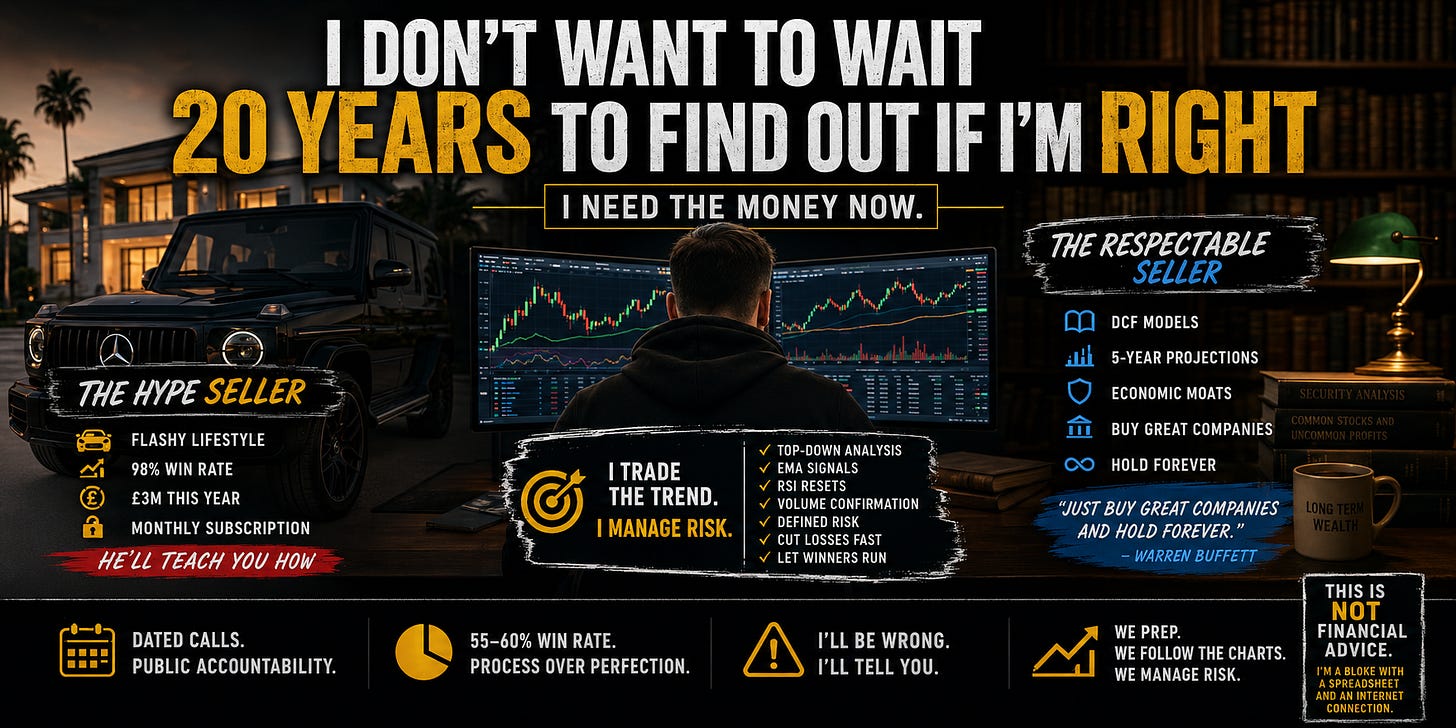
Within thirty seconds you'll find him. Twenty-something lad, abs you could grate cheese on, Armani everything, a G-Wagon parked outside a rented mansion, and a laptop showing what looks like a trading screen. He's got a 98% win rate, he's made £3 million this year, and for a very reasonable monthly subscription he'll show you exactly how to do the same.
Scroll a bit further and you'll find a different type. The thoughtful one. Glasses. Library background. Talking about discounted cash flow models, five-year earnings projections, and economic moats. Very serious. Very respectable. "Just buy great companies and hold forever," he says. "That's what Warren Buffett does."
Both of them are selling you something. And both of them, in very different ways, are asking you to take something on faith.

Let me be clear — I'm not having a go at Warren Buffett. The man's a genius. He built a fortune through a relentless focus on value investing: finding undervalued companies and holding them for the long term. Works for him. Works brilliantly.
But here's the thing about the Buffett approach that nobody on social media wants to tell you: nearly all of his gains came after he turned 65. The man is 94 years old. He started investing as a teenager. That's eighty years of compounding. That's not a strategy — that's a lifestyle sentence.
The internet is flooded with DCF models, five-year projections, and "amazing companies that are going to 100x." Loads of content. Beautiful thumbnails. Compelling narratives. And when those calls go wrong — and they do, because everybody's wrong sometimes — where do those videos go?
They get buried. Drowned under the next amazing prediction. The algorithm does the forgetting for them.
I can't do that. I don't want to do that. And honestly, I can't afford to — not financially, and not in terms of time.
I Need Money Now!
Here's something investing influencers never talk about: buy-and-hold is a brilliant strategy if you have a job you enjoy and disposable income you can lock away for twenty years.
That's not a criticism. That's genuinely good advice for a lot of people.
But that's not my life. I'm not putting spare cash from a comfortable salary into a UK ISA or SIPP and hoping for the best at 65. Trading is my income. The positions I'm in today need to pay the bills in the coming weeks and months. I'm not waiting two decades to find out if I was right about a sector. I need to know now.
That changes everything about how you approach the market.
The Trend Is the Job
Swing trading — what I do — is about finding the trend that exists right now. You need to be right roughly half the time just to break even. I'm hitting 55–60%.
But here's the thing about that win rate: it doesn't sound sexy. No influencer's going to build a following claiming a 57% success rate. It doesn't fit in a thumbnail. You can't park a G-Wagon next to 57%.
The dirty secret is that batting average isn't even the main thing. What matters is holding your winners longer than your losers. Cut the losses fast. Let the profits breathe. That's what keeps the lights on.
The Accountability Problem
This is where I'll say something that might sound arrogant but isn't meant to: swing trading commentary is harder to hide behind than long-term investing commentary.
When I write about a setup — when I say CENX looks strong here, or that this sector is rotating, or that I'm in this position at this price — that call is dated. It's public. It's on Substack. It's in the video. In a month, in six weeks, you can look back and see whether I was right or completely wrong.
Long-term investors don't have that problem. "This company is going to be massive in five years" is an unfalsifiable statement for five years. By the time it's proven wrong, there are a thousand newer videos on top of it.
I talk about the trend today. Research suggests that around 80% of trading advice on social media is potentially misleading, and fewer than 13% of videos include any kind of disclaimer. The difference between that content and what I do is accountability baked into the format. I don't delete the posts when a trend goes wrong.
That's probably why this corner of the market is smaller. It's harder to hide.
The Stats Nobody Wants to Show You
Let's talk numbers for a second, because this is important.
More than 80% of traders lose money within their first year. Around 40% quit within a month. After three years, only 13% remain active. According to the UK FCA and platform disclosures, somewhere between 70–80% of retail traders lose money full stop.
These are brutal numbers. And they're almost never mentioned in the content that's supposedly helping people trade.
Why? Because if you're selling a course, a signal service, or a subscription promising incredible returns, those numbers are the enemy. So you bury them. You lead with the success stories. You show the good months. You build the mythology.
I'm not saying everyone in this space is a fraud. Some people are genuinely trying to help. But the incentive structure of social media means the loudest voices are usually the ones with the least to lose from being wrong.
What's Happening in the Market Right Now
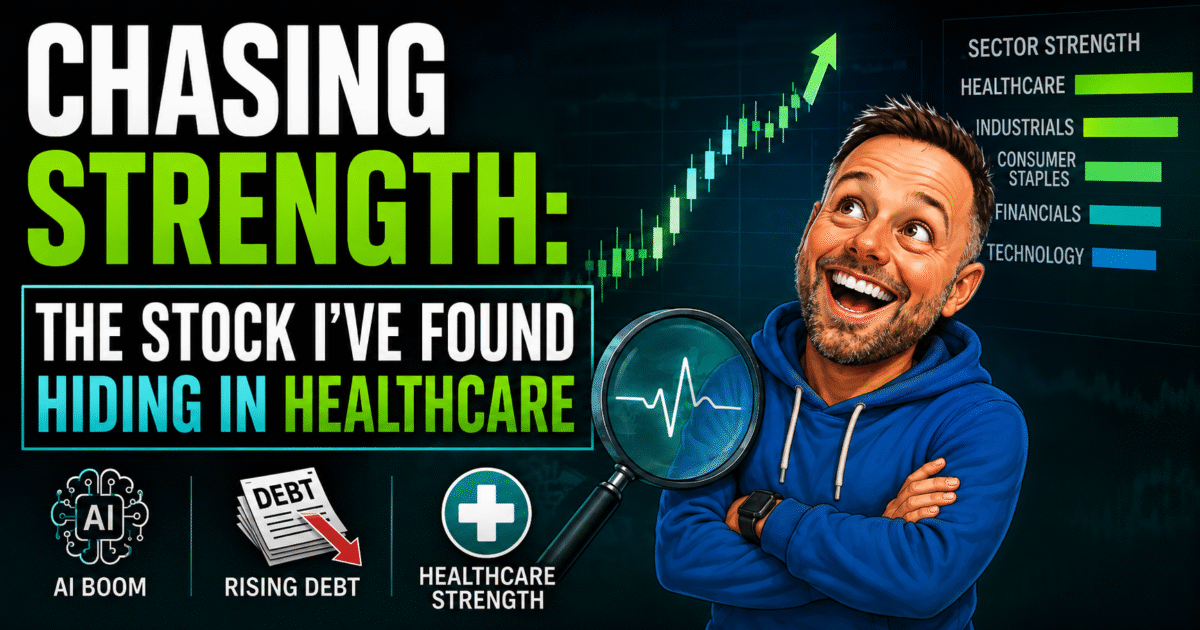
This week I've been talking about sector rotation. The big AI plays had become overextended and were starting to pull back. The question I've been asking is: what does that pullback look like, and where does the money rotate to?
That's why we build watchlists. You don't chase the move — you prepare for it, so when the rotation confirms, you're already in position to act.
Last week the macro picture looked genuinely ugly. Everyone was nervous — the SpaceX IPO sucking attention and capital, Broadcom signalling potential slowdown in AI infrastructure spend, Trump threatening to resume strikes on Iran. The Strait of Hormuz had been looking very much like it wasn't opening anytime soon, and oil was sitting on knife edge.
Then on Friday, something shifted. Iran peace talks showed signs of progress. The Strait could reopen. Oil fell. The macro jitters eased. All the big AI names started recovering. My positions in Intel, Micron, the QQQs and AMD — none of which had hit their stops — started heading back up towards their highs.
Will that continue into next week? I don't know. No one does. Anyone telling you otherwise is selling something.
What I know is that we're prepped. The watchlist is ready. Consumer defensives like Walmart have been on the radar. Healthcare — specifically McKesson and Cardinal Health — are my current favourites. These aren't exciting names. They don't go viral. But they're where the strength could be rotating.
What I'm Actually Selling Here

I'm a bloke with a chart and an internet connection, not a financial advisor.
What I offer — if you want to call it selling — is a process. A methodology. Top-down sector analysis, EMA signals, RSI resets, volume confirmation, defined risk on every single position, and the discipline to cut losses fast and let winners run.
I'll be wrong a lot. I tell you when I'm wrong. Some weeks will be rough. Some setups will fail. That's trading.
But I'll be here in years to come, still looking for the trend in the market. And when something fails, you won't have to dig through years of content to find it.
It'll be right there, fresh, in the last post.
We prep. We follow the charts. We manage risk.