
Steel Dynamics — The Quality Name in a Sector That’s Working
I’ve been running my top-down sector screen across all 11 US SPDR ETFs and Basic Materials keeps coming up as one of the strongest setups in the current market. Within that sector, steel is one of the two leading sub-sectors. And within steel, one name stands above the rest on every metric I care about.
Steel Dynamics. STLD.
This is my full breakdown.
The Sector Backdrop
Before I get into the stock, you need to understand why steel is working right now. Because this isn’t just chart momentum — there’s a genuine fundamental story underneath it.
Tariff protection. The 25% tariffs on imported steel have effectively walled off the US market from foreign competition. Chinese steel, Korean steel, European steel — all materially more expensive in the US market now. Domestic producers are selling into a protected market with real pricing power. That’s a structural tailwind, not a one-week headline.
Infrastructure spending. The US is in the middle of a multi-year buildout. Roads, bridges, grid upgrades, data centres, reshoring of manufacturing — all of it is steel intensive. The Infrastructure Investment and Jobs Act committed over $1 trillion in spending. This isn’t a one quarter catalyst. It’s baked into government budgets for years.
Defence manufacturing. Elevated global geopolitical tension means rising defence budgets across NATO and allied nations. Military hardware is steel intensive. US domestic producers are the natural beneficiary.
Reshoring. Companies bringing manufacturing back to the US — semiconductor fabs, EV battery plants, industrial facilities — need steel. Demand that simply didn’t exist domestically a few years ago is now real and growing.
The tailwinds are stacking, and they’re not going away with a single headline.
Why STLD Specifically
Steel Dynamics isn’t just another steel company. It’s the third largest steel producer in the US and it operates on a fundamentally different model to traditional integrated steelmakers.
STLD runs electric arc furnace mini-mills. Instead of iron ore and coking coal, they use scrap metal as their primary input. That distinction matters more than most people realise.
Lower cost structure — scrap metal is cheaper and more locally available than iron ore. Input costs are more predictable and less exposed to global commodity shipping disruption.
Flexibility — EAF furnaces ramp up and down faster than blast furnaces. STLD can respond to demand changes quicker than traditional integrated steelmakers. When the cycle turns, they can throttle back. When demand surges, they can scale up fast.
Lower carbon footprint — EAF produces significantly less CO2 per tonne of steel. As carbon regulations tighten, this becomes a competitive advantage rather than just a marketing point.
Capital efficiency — mini-mills require less capital to build and operate. STLD has consistently generated better returns on capital than integrated peers as a result.
The Fundamentals
I’m a swing trader not an investor. I need to know the numbers are moving in the right direction and the fundamentals aren’t a landmine.
Revenue troughed at $3.87B in Q4 2024 and has been recovering since. Most recent quarter came in at $5.20B — up 19.1% year on year and the strongest print in the dataset. Annual revenues were $18.2B in 2025 and analysts are modelling $22.3B for 2026. That’s 22% growth. The trough is clearly behind it.
EPS followed the same pattern. Diluted EPS bottomed at $1.35 in December 2024, now recovering to $2.78 most recently. Forward 2yr EPS CAGR of 48.1% expected. Clean revenue-driven recovery — no one-off distortions in the numbers.
Margins are recovering but not back to peak. Gross margin was 27-29% during the 2021-2022 cycle peak. It contracted to 11.1% at the trough and is now recovering to 14.7%. Operating margin similarly — peaked at 23%, now at 10.3% and climbing. The margin recovery story has plenty of runway left.
FCF is a genuine positive here. Sep-25 quarter was a standout at $556.9M. Analysts are modelling $2.05B in FCF for 2026. This is a real cash-generating business.
Balance sheet is in solid shape. Net Debt $3.64B, Net Debt/EBITDA 1.57x — manageable for a business of this size. Debt/Equity 46%. Cash $556M. Retained earnings strongly positive at $16B — this has been a consistently profitable business for a long time. Management is actively buying back stock and paying a growing dividend — 0.8% yield, 21.4% payout ratio, conservative and room to grow.
Valuation & PE
This is where you need to pay attention.
LTM trailing PE: 28.76x — elevated, reflecting the earnings trough still showing in trailing numbers. NTM forward PE: 15.39x — more reasonable on forward estimates. Historical average NTM PE: 10.44x.
Here’s the honest read — STLD is trading above its historical average on forward numbers. The market has already started pricing in the earnings recovery. You are not buying this cheap. The easy money from the trough has largely been made.
The bull case is that earnings inflect sharply higher through 2026, the forward multiple compresses quickly as EPS delivers, and the stock re-rates toward the historical high of 20x. At $15.36 EPS estimated for 2026 and even a modest 13x multiple, you’re looking at a significantly higher price.
PEG ratio on forward numbers: 0.32. Reasonable given the growth rate. Not screaming cheap but not expensive either.
Investor Sentiment & The Tech Rotation
This is the part of the thesis that makes STLD particularly interesting right now.
Tech is pulling back. Hard. And when tech sells off, money doesn’t just disappear — it rotates. Institutional investors rebalance and look for areas with different characteristics. They want earnings visibility, tangible assets, domestic revenues, and policy protection. Steel ticks every one of those boxes.
STLD is the complete opposite of a high-multiple software name. Real economy business, physical assets, domestic revenues, infrastructure tailwinds. In an environment where investors are questioning 30x PE tech valuations, a recovering industrial with tariff protection and a credible earnings growth story looks relatively attractive.
This isn’t speculation — it’s a well established pattern. When growth and tech underperform, value and cyclicals tend to outperform. Basic Materials has already been outperforming this year and that tends to accelerate when tech weakness becomes a sustained theme.
STLD also pays a dividend and buys back stock. In uncertain markets, capital returns attract a different category of investor than pure growth names. Money flowing out of tech needs somewhere to go, and STLD is exactly the kind of name that shows up on institutional screens in that environment.
The risk to this narrative — if the tech pullback becomes genuine recession fear rather than rotation, cyclicals get hit harder than almost anything. Steel demand collapses in a recession. The tariff protection doesn’t help if nobody is building anything. And STLD has already had a significant run — up over 20% in a month — so some of the rotation trade may already be priced in.
The Chart
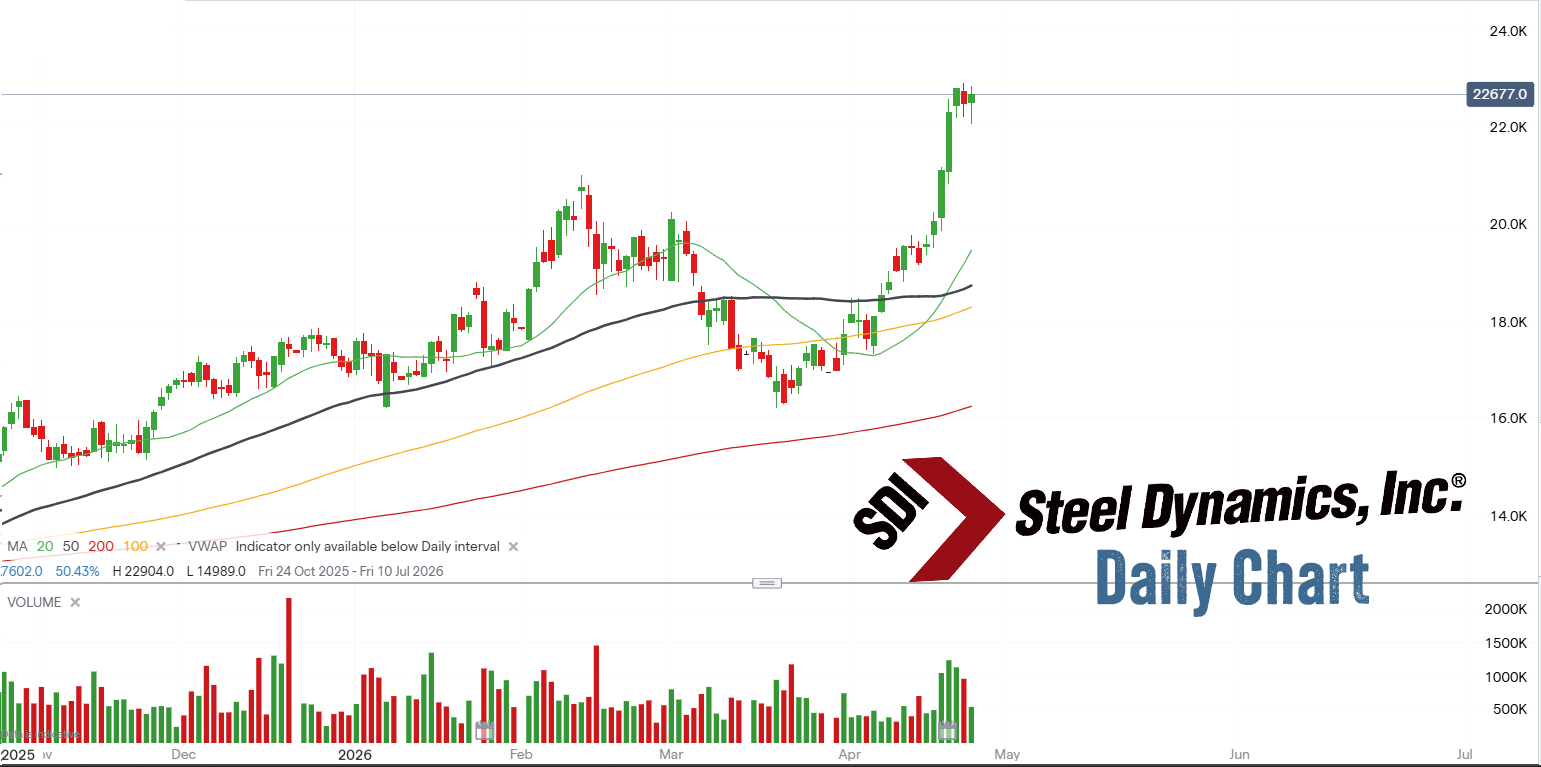
STLD has been in a clean uptrend from October 2024. The April selloff tested the 200-day moving average around $190 and bounced decisively — textbook support hold. Since then the stock has ripped from around $180 to $226. Volume on that move is the highest on the chart — real institutional buying behind it.
The problem is RSI is elevated after that run. The entry was weeks ago. Chasing here is exactly what the framework exists to prevent.
What I’m waiting for — a pullback to the 20 EMA in the $205-$210 area, a few days of consolidation, and a confirmation candle. That’s the entry. Until then I’m watching.
Trade plan:
- Entry: pullback to 20 EMA, confirmation candle in $205-$210 zone
- Add: first hold above prior highs after entry confirms
- Stop: below the swing low from the April correction
The Risks
Tariff rollback on a trade deal hits pricing immediately. Recession fear kills steel demand. The stock has already run — some of the upside may already be priced in. Levered FCF has been negative through most of the last 8 quarters due to heavy capex. Beta 1.49 — still moves on headlines.
Bottom Line
Quality operator. Right sector. Right macro moment. Earnings trough behind it, recovery underway, rotation trade adding fuel.
The entry isn’t right now. The stock has run hard and I want a proper pullback before I touch it. But it’s firmly on the watchlist and the alert is set.
When the pullback comes, I’ll be ready.
Not financial advice. Do your own research. Manage your risk.