When good news can't push a market higher, that tells you everything you need to know.
We saw it play out in plain sight this week. Micron dropped earnings that by any normal measure were solid. Revenue smashed expectations, AI-driven demand for memory chips holding up, forward guidance that should have had the bulls running. The stock did pop — surging about 20% on Thursday to an all-time high. But by Friday it was already giving it back, closing down nearly 7% from that peak.
When good earnings can't hold a chart higher, that tells you something. It might not mean crash. It might not even mean correction. But it's a warning worth paying attention to.
So What Comes Next?
That's the question everyone's asking, and here's the honest answer: nobody knows. It could be a period of sideways chop while the market digests recent gains. It could be a measured pullback — healthy, orderly, a reset before the next leg up. It could develop into a proper correction. In a worst-case scenario, something more severe. The chart doesn't send you a memo in advance.
What you can control is this: when the trend isn't your friend, you don't have to be in the trade. Cash is a position. Sitting on the sidelines watching a directionless or deteriorating market is not weakness — it's discipline. And if the current sector isn't offering clean setups, the move is simple: find one that is.
Strength exists somewhere in the market at all times. The job is to find it, wait for it to confirm, and only then commit. Not before.
The Macro Backdrop — Same Story, Still Unresolved
As covered in last week's blog, the macro environment is doing the heavy lifting right now — and not in a helpful direction. The market is stuck in a holding pattern waiting on the numbers that actually move the dial: jobs data, CPI, PPI, PCE, and the Federal Reserve's next move on interest rates.
Until those readings give a clear signal that inflation is genuinely tamed and the economic picture is stabilising, the argument for a sustained tech and AI rally is difficult to make with conviction. The fundamentals don't support chasing the price higher when the underlying conditions are still uncertain.
That said — and this is worth saying plainly — the market does what it wants. It has a well-documented habit of doing the exact opposite of what most participants expect. Late on Friday, tech stocks were catching a bid. A little green crept back in. And yes, it's tempting to get excited.
Hold the horses.
One afternoon of buying interest is not a trend. It's not confirmation. It's noise until proven otherwise, and right now the bar for proof needs to be high.
The Iran Situation — And Why This Week Just Got Complicated
If the macro backdrop wasn't already enough to keep investors cautious, the weekend added another layer of uncertainty that markets will have to digest when trading opens on Monday.
The US carried out further military strikes against Iranian targets following renewed attacks on commercial shipping linked to the Strait of Hormuz. Both sides have accused each other of violating the fragile ceasefire, underlining just how quickly tensions in the region can escalate. Whatever the political narrative, the key takeaway for investors is simple: geopolitical risk has moved back up the list of market concerns.
The Strait of Hormuz remains the critical pressure point. Around a fifth of the world's oil supply passes through this narrow shipping lane, making any disruption a potential catalyst for higher energy prices, renewed inflation concerns and increased market volatility. Even if shipping continues largely uninterrupted, the mere threat of disruption is enough to influence sentiment.
Technically, a ceasefire remains in place and diplomatic efforts continue. In reality, however, both sides are still exchanging military action and accusations, leaving the situation highly unpredictable. For investors already navigating uncertainty around inflation, interest rates and economic data, it's another reason to remain patient rather than chase short-term market moves. by the day. That is not a backdrop that encourages risk-on positioning.
Where Is the Money Going?
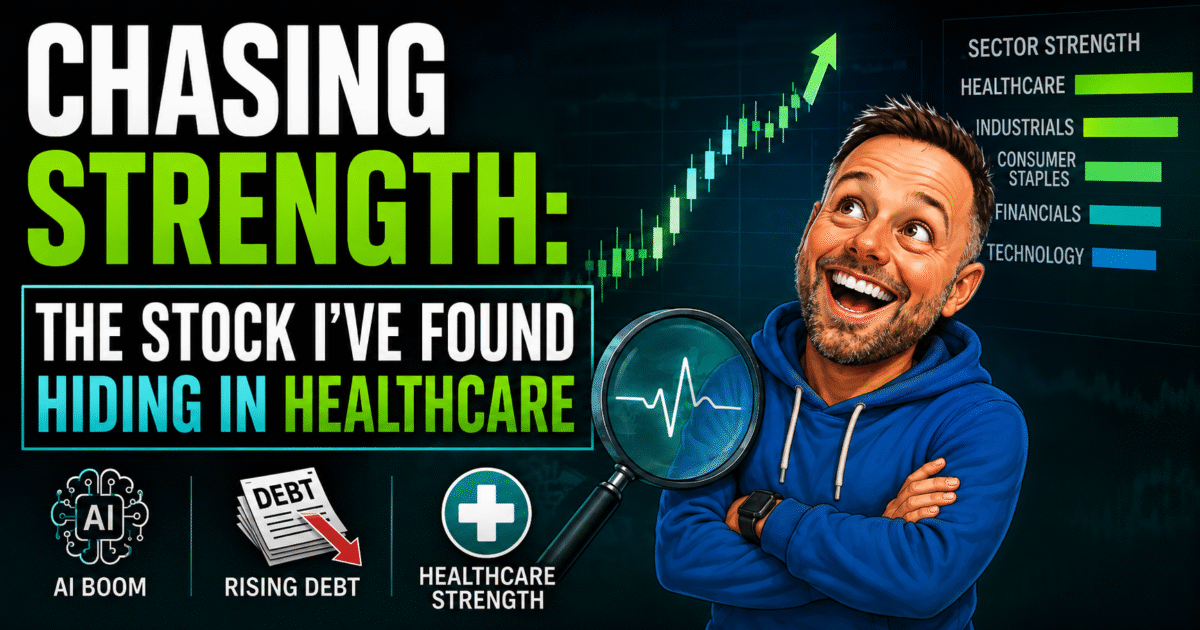
Through the week, as always, I'll be tracking where the money is actually flowing. And right now it's not hard to see — healthcare is dominating, and there are some very good reasons why this move has had legs.

It starts with tech. When the Magnificent Seven started showing cracks — muted reactions to earnings, stretched valuations, real questions about whether all that AI capital expenditure was ever going to generate the returns the market had priced in — institutional money had to go somewhere. Healthcare was the obvious landing spot. Defensive characteristics, reliable cash flows, lower PE ratios. Safe harbour with a growth story attached.
On top of that, a cloud that had been hanging over the sector for years finally lifted. The IRA drug price negotiations had kept a lid on pharma valuations — nobody wanted to own assets when the regulatory risk was unknown. On January 1, 2026, the first set of negotiated drug prices took effect. The feared cuts came in, and the industry didn't collapse. Once that fear was de-risked, the money moved in fast.
Then there's the GLP-1 story. This isn't just defensive rotation — there's genuine, explosive growth in the sector. Eli Lilly's Mounjaro saw sales jump 125% year over year in Q1 2026, and in April the FDA approved Foundayo, an oral GLP-1 pill that removes the injection barrier and opens up an entirely new addressable market. Lilly is a heavyweight in XLV — when it runs, it pulls the whole sector up with it.
Add to that the demographic reality that doesn't care about Fed minutes or geopolitics: the Baby Boomer generation is entering peak healthcare utilisation. That's a structural tailwind that institutions can hold through volatility without losing sleep. And in midterm election years — which 2026 is — healthcare has historically outperformed the S&P 500 by an average of nearly 17% going back to 1994. Institutional money knows that history and positions accordingly.
The result? XLV – State Street Health Care Select Sector SPDR ETF – gained over 3% on Friday alone and was up nearly 8% for the week ending June 26. That's not slow, steady defensive rotation. That's active money moving with purpose.
Drilling Down Into the Industries
Not every corner of healthcare is winning equally. Looking at the sub-industry data across multiple timeframes, the picture becomes clearer.

Diagnostics and Research is the standout on a confirmed basis — barely registering on the single day but up 9.73% on the week and 14.43% on the month. That building acceleration is exactly what you want to see. This isn't a spike, it's sustained institutional accumulation. The AI in drug discovery angle is likely feeding this — companies using machine learning to accelerate clinical trials and compound identification, reducing the cost and time of bringing drugs to market.
Health Information Services is the most consistent performer across every timeframe on the chart — up 4.54% on the day, 8.10% on the week, and 13.08% on the month. Steady, broad-based flow. Health data infrastructure, digital medical records, health tech platforms. Defensive with a genuine growth angle and no exposure to the kind of binary regulatory risk that haunts pharma.
Drug Manufacturers General is showing strong, consistent numbers across all three timeframes. This is where the GLP-1 story lives — Lilly, Novo Nordisk. The big guns with blockbuster drugs and pricing power.
Biotechnology is solid across the board and actually stronger on the month than the week alone suggests, meaning it had a strong earlier run that predates the recent rotation acceleration. FDA pipeline approvals are driving this.
Healthcare Plans — the insurer end of the sector — is quietly building. Only 2% on the day but over 10% on the month. Insurers were the weak spot earlier in the year, squeezed by higher utilisation costs and unfavourable Medicare reimbursement rates. Seeing them now join the rally is a meaningful signal that the rotation is broadening and deepening across the whole sector.
The one red flag: Pharmaceutical Retailers are down 9.56% on the month. CVS, Walgreens territory — brick-and-mortar pharmacy chains with structural margin pressure. The market is being very deliberate here. It wants innovation and data. It doesn't want retail.
Through the start of this week, I'll be watching to see whether the party in this sector continues. Does the smart money parked here keep adding, or does the excitement of AI pull it back as it has done so many times over the last year — macro risks be damned?
One for the Brave —
Spero Therapeutics

I'm primarily a trend trader, but occasionally something crosses my desk that I can't leave alone. Spero Therapeutics is one of those. Not for the faint-hearted, and a very small percentage of the overall portfolio — but I like the story.
The stock moved 15% on Friday. I've been in the stock for about 6 months.
Spero Therapeutics has probably been my most interesting investment over the past year. I originally got involved because I believed tebipenem had a strong chance of FDA approval and saw real value in GSK choosing to license and commercialise the drug. That thesis proved correct. Utebzi is now FDA approved as the first oral carbapenem antibiotic in the US for adults with complicated urinary tract infections who have limited or no alternative oral treatment options. GSK will launch the product commercially by the end of 2026.
The investment story, however, has changed completely. Before approval, the question was whether the drug worked. Today the question is how much value flows back to Spero shareholders. Bulls point to future milestone payments, royalty income, and the possibility that GSK could eventually simplify the structure by acquiring the remaining economics — or even the whole company. Bears argue that antibiotics have historically struggled commercially, the label is relatively narrow, and management may choose to rebuild the pipeline rather than maximise shareholder returns.
Despite the uncertainty, the current valuation deserves scrutiny. GSK has spent years and significant capital developing this asset because it believes there is a commercial opportunity. The next 12 to 24 months will tell us far more than the clinical trial ever could. Commercial uptake, milestone payments, royalty potential, and management's capital allocation decisions will ultimately determine whether today's share price represents fair value or a significant mispricing.
It's a bit of a gamble. But I like the story. Time will tell.
I'm now heading to the charts to break down those strong industries to find strong trending companies. Head back soon to find what's going on the watchlist