
A quick word to my American readers before you skip this one: yes, Jet2 is a UK holiday airline you've probably never heard of. Stay with me anyway. What happened to it this morning happens on your side of the pond every single earnings season — it's the same mechanism that had US airlines popping on capacity cuts and Micron selling off on record numbers. A company reported falling profits and the stock ripped 16%. If you can explain that, you understand earnings season. If you can't, this post is worth your five minutes, because the lesson and the checklist at the end apply to every ticker on the NYSE, the Nasdaq and the LSE alike.
Jet2's full-year results landed this morning.
Profits fell 8%. I read the RNS at the open, put out a cautious take, and then watched the stock gap up and run as much as 16% at the high.
For the Brits: Jet2 is the Leeds-based package holiday giant, about a £2.5bn company. For the Americans: think a leisure airline and tour operator rolled into one — imagine if Allegiant also ran the hotel booking desk.
The Headline Numbers
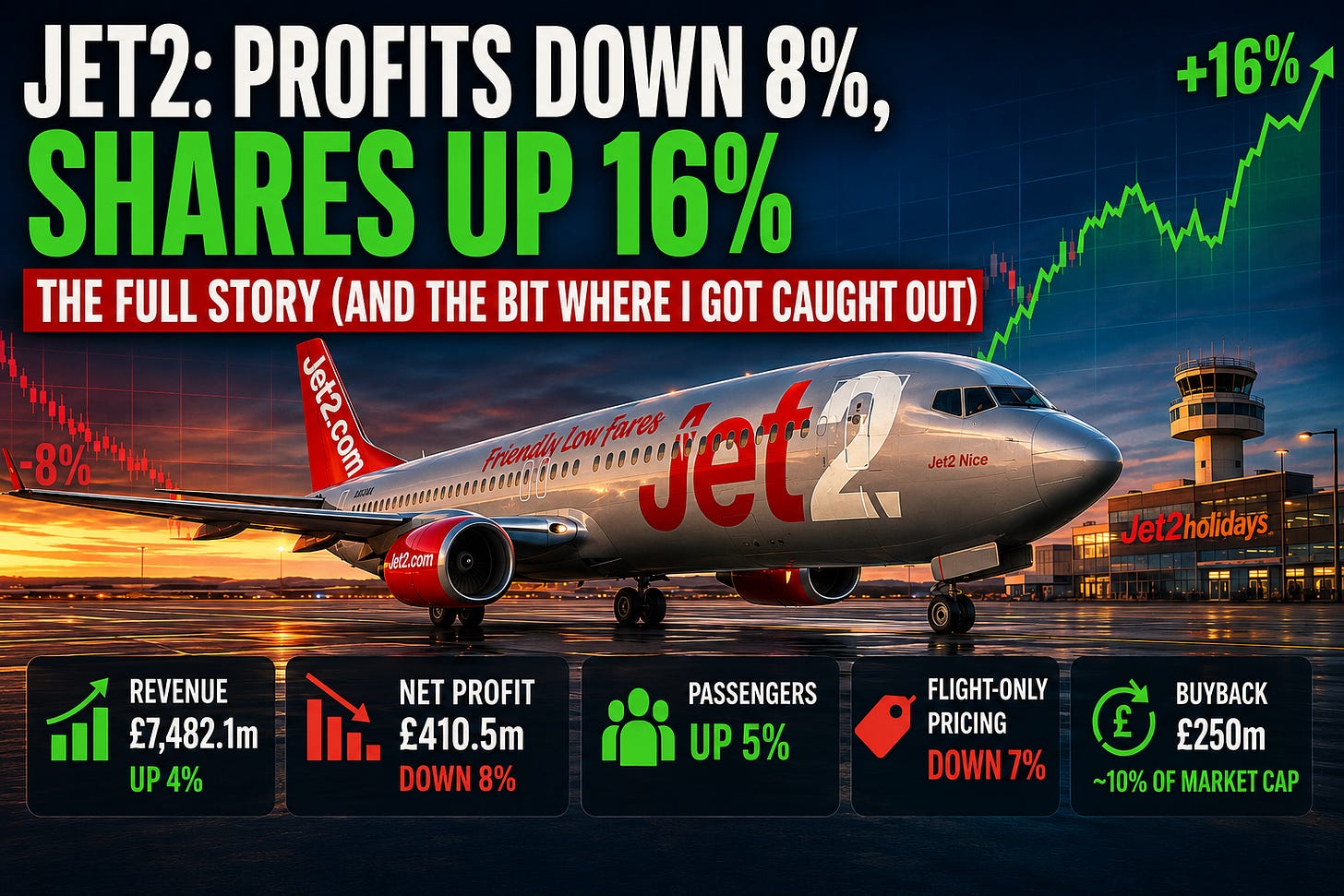
Revenue £7,482.1m, up 4%. Operating profit £439.6m, down 2%. Profit before tax £551.0m, down 7%. Net profit £410.5m, down 8%. Load factor 86.8%, down 1.9 points. Operating cash flow £886.6m, down 16%.

Record revenue, but every measure of profit went down. Let's be clear before we get to the share price: the business made less money than last year. Today's move does not change that. What moved was something else, and we'll get there.
The EPS Line
Basic EPS came in at 211.2p against 213.1p — "broadly stable." How does profit fall 8% while EPS stay flat? Jet2 bought back 22.1 million shares during the year, cutting the weighted count from 209.7m to 194.4m. Same shrinking profit, fewer slices.
Two readings, both true. The trap: if flat EPS is your proof the business had a flat year, you've been had by the maths — the profit pool shrank £36m and the buyback masked it. The treat: if you're a shareholder, you own a meaningfully bigger slice of this company than a year ago, and management bought that extra slice at around 5–6x earnings. Retiring shares that cheaply is one of the highest-return things a company can do with cash.
And they've just gone again: a new buyback programme of up to £250m, equivalent to roughly 10% of Jet2's market value at yesterday's close, on top of £363m returned to shareholders last year. How many shares that ultimately retires depends on the prices they pay — but a buyer that size in the market, at this valuation, is a serious tailwind. If earnings ever inflect upward, a shrinking share count into a profit recovery is how big rerating moves are made.
Discounting Dressed Up as Strategy — Or a Land Grab?
Jet2 grew seat capacity 8% but passengers only 5%. Load factor dropped nearly two points, and flight-only pricing fell 7% to £110.92. The company calls it "targeted price investment to stimulate demand." My translation: they're cutting prices because customers won't pay last year's fares. Meanwhile hotels are up 7%, landing and handling up 9%, maintenance up 10%, staff costs pushing £914m, plus around £50m of new employment taxes and SAF costs and £11m of Gatwick start-up. Operating margin slipped from 6.2% to 5.9%. Costs inflating, yields falling.
But the bull's answer deserves a fair hearing, because it's coherent: this is offence, not defence. Jet2 is the country's biggest tour operator, with the balance sheet to price at levels that hurt competitors more than itself. Cut price now while the cost base is old, take the share — and then the new fleet arrives.

Jet2 has committed to 146 A321neos on pricing secured years ago, aircrafts the company says deliver a fuel and carbon cost saving in the region of 20% per seat versus the planes they replace. That's a structural unit-cost advantage landing underneath the customer base they're buying today. Its the Ryanair playbook: win on volume, then win again on cost. Today's 5.9% margin is the before photo; the bull is buying the future cost base at 6x this year's depressed earnings.
Two years of margin pressure in exchange for a decade of structural advantage. That's the bet. The risks are obvious. Airlines have a habit of competing away cost savings through lower fares, particularly once rivals gain access to similarly efficient aircraft. There's also no guarantee that customers won through discounting will stick around when prices eventually rise.
But that doesn't make the strategy wrong. Jet2 is sacrificing margin today to grow market share while preparing for a significantly more efficient fleet tomorrow. Whether it works remains to be seen, but it deserves to be viewed as a deliberate long-term strategy with a potentially significant payoff — not simply as a business cutting prices because demand is weak.
The £2 Billion Cash
The bit the "trading for free" crowd needs to hear. Headline: £3.3bn of total cash, £2bn net cash. Sounds like a fortress, and every bull quotes it.
Here's the adjusted way I look at it — and I'm not alone; serious commentators make the same adjustment. Around £2.1bn of that cash is advance customer deposits: your mate's holiday money for a fortnight in Benidorm next August. It sits in Jet2's bank account, but it comes with an obligation attached — deliver the holidays. Set it aside and Jet2's "own cash" is somewhere in the £1.2–1.4bn range depending on exactly how you cut it, against roughly £1.3bn of borrowings and lease liabilities. On that view, the fortress is more modest than the headline. It's an interpretation, not a line from the accounts — but it's the interpretation I'd want you thinking about before you treat the £2bn as shareholder money. Especially since over £5bn of gross aircraft spending is planned across the next six years. The cash funds planes, not special dividends.
Also from the cash flow statement: the working capital inflow collapsed from £235m to £77m, because customers are booking later. Which brings me to the most useful thing in these results.
What Jet2 Just Told Us About the British Consumer
Buried in the commentary is one of the best real-time consumer surveys anywhere — five million people voting with their wallets.

The holiday is protected, but everything about it is negotiable. People are still going away — the passenger numbers prove that. But they're booking later, holding out for deals and only committing when the price is right.
They're also trading down. Package mix fell from 66.5% to 63.3%, with more people choosing flight-only and sorting their own accommodation — something I've always done myself. Even within package holidays, customers are becoming more selective about hotel quality and how long they stay.
Then, when tensions in the Middle East flared in June, bookings paused before recovering. That tells you something about the state of the consumer. People still want their holiday, but they're thinking harder before spending the money. The holiday might be the last thing they're willing to give up, but how they book it, where they stay and how much they spend is already changing.
If you've followed my Consumer Defensives work, none of this surprises you — the same trade-down behaviour is showing up everywhere. The last thing to go is the holiday. The way people buy it has already gone.
Meanwhile, Across the Atlantic
There's no true US equivalent of Jet2 — nobody over there runs an integrated airline-plus-package-tour-operator at this scale that I can find, and the periods don't line up neatly either (Jet2 has just reported a March full year; the US names' latest numbers are calendar Q1). So treat this as directional, not a like-for-like face-off.
Directionally, though, it's striking. Jet2 grew capacity 8% into softening yields. Allegiant — the closest thing to a pure US leisure carrier — has been cutting capacity, guiding it down around 6.5% for Q2, and reported unit revenue up sharply in Q1.
Southwest grew capacity just 1.5% and posted double-digit unit revenue growth, with a reported 60% or so of customers upgrading from the base product as it pushes premium options. Same squeezed consumer on both sides of the pond, opposite answers: the Americans are restricting supply, protecting price and moving upmarket; Jet2 is adding supply and cutting price. One approach defends margins now; the other bets on market share now and margins later.
Jet2's 90% fuel hedge does give it better cost visibility than US peers wrestling with the fuel spike — but the near-term earnings momentum in leisure travel is currently American. Jet2's is a jam-tomorrow story, and today the market decided it can smell the jam.
So Why Did It Jump Double Digits on Falling Profits?
The lesson I got taught this morning, passed on for free: results don't move share prices. Results versus expectations move share prices. And the bar was low.
The headline profit numbers had largely been de-risked by April's trading update — the market already knew profits were falling and flight-only pricing was down 7% — which shifted the real focus onto outlook, bookings and capital allocation. Brokers had spent months trimming targets, which lowered expectations and created the conditions for a positive surprise (not automatically bullish — but it moves the bar). The valuation, at 5–6x earnings, priced something close to a profit warning.
What arrived instead: numbers in line, summer bookings up 7.1% with load factor up 1.2 points, "strong bookings in recent weeks" as Middle East tensions eased, Gatwick performing ahead of expectations, fuel hedging lifted to 90% — and a buyback worth roughly a tenth of the company's market value. No new bad news when bad news was priced, genuinely improved forward indicators, and a very large new buyer of the shares announced. That's the move.
On the short-seller angle, since squeeze theories are already doing the rounds: the FCA's public register shows disclosed short interest in Jet2 is minimal — a single fund above the 0.5% disclosure threshold, and positions below that line are invisible. So whatever today was, it wasn't a mass short squeeze. This was buyers. Which, if you're bullish, is actually the better answer — squeezes fade, buyers accumulate. Either way, checking the register before a results day takes two minutes at shorttracker.co.uk.
Was the Pop Justified?
Partly — and it's worth being precise about which part. The buyback justifies a real chunk: a buyer that size is mechanical demand for the shares. The outlook justifies more: booking momentum recovering after the June wobble, with load factor up, is genuinely new information. The rest is fear being repriced — a warning that didn't come. What the pop is not is a verdict that the margin squeeze is over. Profits still fell. Yields are still down. The £5bn capex programme hasn't gone anywhere. Today repriced the fear; whether it gets to reprice the earnings is a question for the AGM trading update on 3 September.
One live risk to that, and it's not the one people think. Overnight strikes have oil up again, and the reflex is "bad for airlines." On fuel cost, barely — Jet2 is 90% hedged, so this year's bill is largely locked. The real transmission channel is demand: these very results showed bookings pausing when the Middle East flared in June. If escalation makes families hesitate during peak booking weeks, it hits the exact "strong recent bookings" line that drove today's rerate. Watch the headlines for that reason, not the fuel one.
The Chart

The results changed the technical picture significantly.
Jet2 had already been recovering from its spring lows, making higher highs and higher lows since May as the short-term moving averages turned upwards. Results then provided the catalyst for the shares to gap through the 200-day moving average on significantly increased volume.
That's the important development here. The 200-day had acted as resistance for months, and the shares have now broken through it with momentum and volume behind the move.
The problem is timing. RSI has pushed above 70 and ATR has jumped sharply, telling me momentum is strong but volatility has expanded with it. Neither means the move has to reverse, but after a double-digit gap, the easy entry has gone.
So the technical picture has improved considerably. The downtrend has been challenged, a major resistance level has been broken, and buyers have taken control. The question now isn't whether I like the chart — I do. It's whether the market gives me a sensible entry.
What I'm Actually Doing
I'm waiting.
There are three ways I see this playing out from here.
Scenario A — the pullback. Price retraces towards the £13.80–£14.20 area, holds the breakout zone and gives me confirmation. This would be my preferred setup: defined risk, somewhere sensible for the stop, and a clear target back towards the results-day high.
Scenario B — the flag. The shares refuse to give back the gap and consolidate above roughly £14.30–£14.50. A few days of sideways action would allow momentum and volatility to settle before a potential break of the results-day high.
Scenario C — the trap. The shares lose the 200-day moving average and eventually fill the gap. At that point, the breakout has failed and the setup goes back on the watchlist. No trade, no argument.
That's it. I missed the initial move, but missing a move and missing an opportunity are not the same thing. If the rerating is genuine, there will be another setup.
Standard 1% risk, sized down to account for the wider volatility rather than tightening the stop into it.
The Checklist This Morning Paid For
Future signs to watch — the questions to run on any stock in the week before results. How has it traded into the print, on both the one-week and three-month view? Have the numbers been de-risked by a trading update — and if so, what's actually left to surprise? Could they announce a buyback, and how big against the market cap? Have brokers been trimming (bar lowered — conditions for a positive surprise) or raising (bar raised — danger)? What scenario does the valuation already price? What does the FCA short register show? What's the retail mood — demoralised bulls into a known event often mark the low? What have sector peers just reported? Which outside factor — oil, weather, currency — could hijack the day, and is the company hedged against it? And what does this specific stock historically do on results days?
Run that on Jet2 last night and most answers pointed the same way: the fundamentals said caution, but the results-day risk was skewed up, not down. Both things were true at once. My morning thoughts only carried one of them. That's the miss, that's the fix, and you got both in the same day.
My Summary
Good business. Falling profits. A real long-term story in the fleet. A consumer trading down but still flying. A buyback that's simultaneously masking the decline and building serious per-share value. And a share price that reminded everyone — me included — that markets move on expectations, not headlines.
Jet2 has been added to my UK Consumer Cyclical Watchlist. View Here
Nothing here is financial advice — it's a journal of what I'm looking at and why. I don't hold a position in Jet2. Do your own research, honour your stops, and never trade money you can't afford to lose.