
Jet2 Just Hit My Watchlist — But I’m Not Buying Yet
Jet2 wasn’t on my watchlist before this week. It is now.
The company reported falling profits, weaker margins and lower flight-only pricing. The shares responded by jumping as much as 16%.
My initial reaction to the results was cautious. Costs are rising, yields are falling and the British consumer is clearly becoming more price-sensitive. Add in a difficult macro backdrop and a wider market that has been rolling over, and Consumer Cyclicals aren’t exactly where I’ve been looking for trades.
But the market disagreed.
That forced me to go back through the results and look at the story again. Not because a rising share price automatically makes the bull case right, but because, as a swing trader, I’m always looking for change.
A change in expectations. A change in momentum. A fundamental catalyst. And, ideally, a chart confirming that investors are starting to pay attention.
The more I looked at Jet2, the more I realised it might now have all four.
I’m not buying the gap. I’m not even convinced the wider sector is ready yet.
But Jet2 is firmly on my watchlist in preparation for when that changes.
Here’s why.
My Process Starts With the Market, Not the Company
Anyone who has followed my trading for a while will know that I use a top-down approach.
Market. Sector. Industry. Company.
I’m not interested in finding a great company and ignoring everything happening around it. A strong stock fighting against a weak sector and deteriorating market has a much harder job than one with the wind behind it.
And right now, Jet2 doesn’t have that wind.
Jet2 sits in the Consumer Cyclical sector, and it’s not an area of the market I particularly want to be involved in at the moment.
The macro backdrop remains difficult. The consumer is under pressure, economic uncertainty remains high and people are becoming increasingly selective about where they spend their money.
We can see that in Jet2’s own results. Customers are booking later, shopping around for better deals and becoming increasingly price-sensitive.
More broadly, the market itself has been struggling. Leadership has narrowed, money has been rotating towards more defensive areas and an increasing number of stocks and sectors have started rolling over.
That matters.
I want the market behind me. I want the sector behind me. Then I want to find the strongest companies within those areas.
Jet2 doesn’t currently tick all those boxes.
So why is it on my watchlist?
Because the stock has just done something very interesting despite everything working against it.
Investors Are Telling Us Something
Jet2 reported its full-year results this week.
Revenue increased 4% to £7.48bn, but operating profit fell 2%, profit before tax dropped 7% and net profit declined 8%.
Jet2 grew seat capacity by 8%, but passenger numbers increased by only 5%. Load factor fell nearly two percentage points and flight-only pricing dropped 7%.
Yet the shares exploded higher.
That immediately gets my attention.
Despite falling profits, margin pressure, a squeezed consumer, a weak sector and a difficult wider market, investors aggressively bought the shares.
The stock jumped double digits.
Someone clearly thinks Jet2 is cheap.
That doesn’t automatically make them right. But my job as a swing trader isn’t to argue with the market.
It’s to watch where the money is moving and then understand why.
I follow investors.
When they start buying a stock aggressively, particularly against a difficult backdrop, I want to know what they’re seeing that the rest of the market might be missing.
So I went back through the results.
And the bull case is more interesting than I initially gave it credit for.
The Market Was Already Expecting Bad News
Markets don’t move on whether results are good or bad.
They move on whether things are better or worse than expected.
That’s an important distinction.
Expectations for Jet2 were already low. The headline profit numbers had largely been de-risked by April’s trading update, brokers had been trimming forecasts and the shares were trading on roughly 5–6 times earnings.
The market knew profits were under pressure.
It knew pricing was weak. It knew costs were rising.
A lot of bad news was already in the price.
What investors didn’t know was whether things were about to get worse.
Instead, Jet2 reported improving summer bookings, a recovering load factor, Gatwick performing ahead of expectations, increased fuel hedging and a new £250m share buyback.
No profit warning. No new disaster.
Instead, there were signs that things might actually be starting to improve.
Suddenly, the question changed.
The market was no longer asking:
How bad are things going to get?
It started asking:
What happens if this is as bad as it gets?
For a swing trader, that change in expectations is exactly what I’m looking for.
The Bull Case Is Starting to Get Interesting
The more I looked through the results, the more I started to understand what investors might be seeing.
Jet2 is sacrificing some margin today to grow capacity and take market share.
Looking backwards, that’s uncomfortable.
Costs are rising. Yields are falling. Profits are under pressure.
Jet2 grew seat capacity by 8%, while passenger numbers increased by only 5%. Flight-only pricing fell 7% as the company invested in price to stimulate demand.
My initial interpretation was simple: customers won’t pay last year’s fares, so Jet2 is cutting prices to fill planes.
There’s truth in that.
But there’s another side to the argument.
Jet2 is the UK’s largest tour operator. It has the scale and balance sheet to compete aggressively on price, potentially putting pressure on weaker competitors while growing its own customer base.
At the same time, the company is investing heavily in a new fleet.

Jet2 has committed to 146 A321neos, which should bring significant improvements in fuel efficiency and unit costs compared with the aircraft they replace.
The potential strategy becomes clear.
Grow the customer base today. Take market share. Then put a more efficient fleet underneath it tomorrow.
If management can pull that off, the current margin pressure could prove temporary.
A larger customer base. Lower unit costs. A more efficient fleet. And, eventually, the potential for recovering margins.
Two years of margin pressure in exchange for a decade of structural advantage.
That’s the bet.
There are obvious risks. Airlines have a habit of competing away cost savings through lower fares, particularly once rivals gain access to similarly efficient aircraft. There’s also no guarantee customers won through discounting will stick around when prices eventually rise.
But swing trading isn’t about finding perfect companies.
It’s about finding situations where expectations could be changing.
I don’t need to believe Jet2 is perfect.
I need to believe the market could be underestimating what comes next.
And judging by the reaction to these results, investors might be starting to believe exactly that.
The £250 Million Buyback Matters
Then there’s the buyback.
Jet2 has announced a new share buyback programme of up to £250m. At the company’s market value before the results, that’s equivalent to roughly 10% of the entire business.
That isn’t background noise.
During the previous year, Jet2 bought back 22.1 million shares, helping reduce the weighted share count from 209.7m to 194.4m. That’s one reason basic EPS remained broadly stable despite profits falling.
There are two ways of looking at this.
The bear will argue that buybacks are masking the deterioration in underlying profits.
The bull will argue that Jet2 is buying back significant amounts of its own stock at roughly 5–6 times earnings, reducing the number of shares participating in any future profit recovery.
Both arguments have merit.
As a potential shareholder, the second one interests me.
A shrinking share count. A potentially improving cost base. Recovering booking momentum. And a cheap valuation.
Individually, none of those is enough for me to trade.
Together, they start building a thesis.
The Consumer Is Still the Biggest Risk
I don’t want to turn this into a one-sided bull case because there are still plenty of reasons to be cautious.
Jet2’s results gave us a fascinating insight into the state of the British consumer.
People are still going on holiday, but everything about that holiday is becoming negotiable.
Customers are booking later, holding out for deals and only committing when the price is right. Package mix fell from 66.5% to 63.3%, with more customers choosing flight-only and arranging their own accommodation — something I’ve always done myself.
Even within package holidays, customers are becoming more selective about hotel quality and how long they stay.
Then, when tensions in the Middle East flared in June, bookings paused before recovering.
That tells me the consumer is still spending, but they’re thinking much harder before parting with their money.
The holiday might be the last thing they’re willing to give up. But how they book it, where they stay and how much they spend is already changing.
That matters to the Jet2 bull case.
The company is adding capacity into a price-sensitive market. If the British consumer weakens further, or Jet2 has to continue cutting prices simply to fill those additional seats, the margin recovery could take much longer than expected.
This is also why I keep coming back to the wider sector.
I can like Jet2 without liking Consumer Cyclicals.
I can see the potential bull case without believing the time to buy is today.
There’s an important difference between finding an interesting company and finding a trade.
Right now, Jet2 is the former.
The £2 Billion Question
Another area where I remain cautious is the balance sheet.
The headline numbers look incredible.
£3.3bn of total cash and around £2bn of net cash.
But I don’t think it’s quite that simple.
Around £2.1bn of that cash represents advance customer deposits.
Your mate’s holiday money for a fortnight in Benidorm next August.
The money might be sitting in Jet2’s bank account, but it comes with an obligation attached.
Deliver the holiday.
Strip customer deposits out and the balance sheet looks more modest, particularly when Jet2 has more than £5bn of gross aircraft spending planned over the coming years.
I’m not saying the balance sheet is weak.
Far from it.
But I’m also not treating the headline £2bn net cash figure as money sitting around waiting to be handed to shareholders.
Jet2 is in the middle of a major investment programme.
The bull case depends on that investment eventually delivering.
This Is Why I Build Watchlists
This is where I think people sometimes misunderstand watchlists.
A watchlist isn’t simply a collection of stocks I want to buy tomorrow.
It’s preparation.
Right now, the Consumer Cyclical sector isn’t where I’m seeing the best opportunities. The macro backdrop is difficult, the consumer is under pressure and the wider market has been showing signs of weakness.
But markets change.
The macro environment will change. Money will rotate.
Eventually, areas of the market that are currently being ignored will come back into play.
I don’t want to wait until that happens and then start looking for companies. I want to have already done the work.
I want to know which companies are fundamentally interesting.
Which stocks are holding up better than their peers.
Where investors are already showing their hand.
And which companies I want to own if the wider conditions begin moving in their favour.
That’s why Jet2 is now on my watchlist.
The sector isn’t ready.
The wider market might not be ready.
But the stock is showing signs that investors are already looking ahead.
And we follow the money.
The Chart
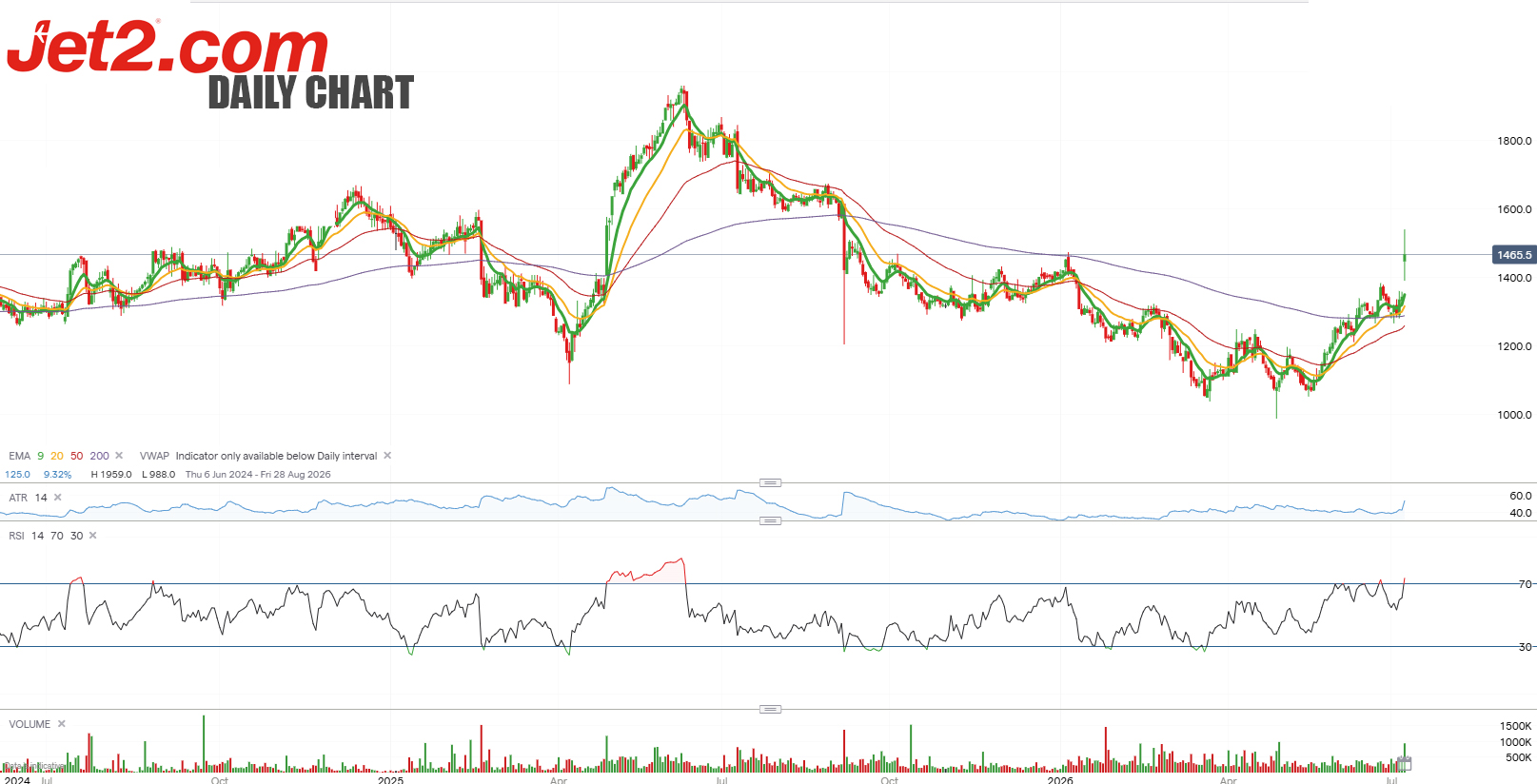
This is where the fundamental story and technical picture start coming together.
Jet2 had already been recovering from its spring lows. Since May, the shares had been making higher highs and higher lows, the short-term moving averages had turned upwards and momentum was improving.
Then came results.
The shares gapped straight through the 200-day moving average on significantly increased volume.
That matters.
The 200-day had acted as resistance for months. The shares have now broken through it with a genuine fundamental catalyst, increased volume and strong momentum behind the move.
This is exactly the combination I’m looking for as a swing trader.
Changing expectations. A fundamental catalyst. Increased volume. Improving momentum. Major technical resistance broken.
But there’s something else I find particularly interesting.
Relative strength.
Jet2 is making this move while the Consumer Cyclical sector isn’t particularly attractive and the wider market is struggling.
That gets my attention.
A stock showing strength when everything around it is strong tells me something.
A stock showing strength when the environment around it is weak can tell me even more.
Investors are choosing to buy Jet2 despite the backdrop.
I want to know why.
Now I think I do.
So Why Am I Not Buying?
Because price matters.
And so does the wider environment.
The shares have just made a double-digit move. RSI has pushed above 70 and ATR has jumped sharply. Momentum is strong, but volatility has expanded with it.
Buying immediately after a move like this would leave me with poor risk-reward and nowhere sensible to place my stop.
I also don’t have the support of the wider sector or market.
That matters to my strategy.
I missed the initial move.
That’s fine.
Missing a move and missing an opportunity are not the same thing.
If the Jet2 rerating is genuine, I don’t need to catch the first candle.
I need to wait for the market to give me a trade.
What I’m Waiting For
There are two parts to this now.
The first is the stock.
I’d like to see either a controlled pullback towards the breakout area around £13.80–£14.20, or a period of consolidation above the 200-day moving average.
A pullback would give me the opportunity to see whether previous resistance can become support. Consolidation would allow volatility to settle and potentially create a continuation setup.
Either could give me something I don’t have today: defined risk and somewhere logical to place my stop.
The second part is the wider environment.
I want to see signs that the market is stabilising.
I want to see money beginning to move back towards cyclical areas.
I want to see Consumer Cyclicals improving.
The perfect scenario would be Jet2 holding this breakout while the wider conditions begin catching up.
That would give me a company with an improving fundamental story, demonstrated relative strength, a technical breakout and an increasingly supportive market environment.
That’s when things get interesting.
What would invalidate my interest?
A complete failure of the breakout.
If Jet2 loses the 200-day moving average, fills the gap and falls back into the previous range, the setup goes back on the shelf.
No trade.
No argument.
Why Jet2 Is Now on My Watchlist
This is what swing trading looks like for me.
I’m not trying to predict exactly where Jet2 will trade in five years.
I’m looking for change.
Something has to make investors view a company differently tomorrow than they do today.
Jet2 now has several potential catalysts working in its favour: improving booking momentum, a significant share buyback, an expanding customer base, a more efficient fleet arriving over the coming years and a low valuation.
The shares have now broken a major technical level on increased volume.
And perhaps most importantly, they’re showing strength despite an unsupportive sector and wider market.
Investors are telling us something.
Maybe they’re wrong.
Maybe the consumer weakens further, margins remain under pressure and the breakout fails.
That’s always possible.
But I’m not here to argue with investors.
I’m here to watch where the money is moving, understand why it might be moving and then wait for an opportunity where I can define my risk.
Right now, the sector isn’t ready.
The wider market might not be ready.
And after a double-digit move, the stock isn’t giving me an entry.
That’s fine.
Jet2 has done enough to get my attention.
I’ve done the research. I understand the bull case. I know the risks. I know what I want to see from the chart and I know what I want to see from the wider market.
Now I wait.
Because if conditions improve and money starts rotating back towards Consumer Cyclicals, I already know one of the first stocks I’ll be looking at.
Nothing here is financial advice. It’s a journal of what I’m looking at, what I’m researching and why a stock has made it onto my watchlist. I don’t currently hold a position in Jet2. Do your own research, honour your stops and never trade money you can’t afford to lose.