DIPLOMA PLC — THE QUIET COMPOUNDER THAT’S BEEN MAKING PEOPLE VERY RICH
Diploma PLC (LSE: DPLM) | FTSE 100 | Industrials / Specialist Technical Distribution | Market Cap ~£9.6bn Current Price: ~7,165p | Verdict: WATCHLIST — Q3 update 16 July, charts to follow
Diploma is not a name that comes up in pub conversations about the stock market. Nobody’s posting about it on TikTok. There are no war play narratives or AI headlines attached to it. It’s a business that supplies specialist technical components to industrial, healthcare and defence customers across the UK, Europe and North America.
And yet. Total shareholder return in excess of 850% over the last decade. EPS growth of 36% in the first half of 2026. Operating margins expanded to 24.5%. Fifteen acquisitions in the last twelve months. A stock that just hit a fresh 52-week high on the back of a major analyst upgrade.
Sometimes the boring ones are the ones worth watching most carefully.
WHAT DOES IT ACTUALLY DO?
London-based, founded in 1931, FTSE 100 constituent. Diploma is a decentralised, value-added distribution business operating through three sectors.
Controls supplies wire and cabling, interconnect solutions, speciality fasteners, speciality adhesives, and industrial automation products. Think aerospace wiring harnesses, defence interconnect systems, data centre cabling infrastructure. The recent acquisition of a US aerospace fastener business gives you the flavour of where this division is heading.
Seals supplies sealing solutions, fluid power products, gaskets, hoses, fittings, pumps and valves — primarily for aftermarket repairs, original equipment manufacturing, and maintenance and overhaul projects. Heavy industry, manufacturing, hydraulic systems. The kind of product that has to be exactly right, or the machine stops working.
Life Sciences sources and supplies equipment, consumables and instrumentation for surgery, disease diagnosis, critical care support, and scientific research. In vitro diagnostics, surgical instruments, medical devices, endoscopes, and patient monitoring. Highly regulated, highly sticky.
Market cap around £9.6bn on revenue of approximately £1.65bn trailing twelve months. This is a proper large-cap quality business, not a speculative mid-cap story.
WHERE IT FITS IN THE SECTOR — AND WHY IT’S DIFFERENT
Diploma sits within specialist technical distribution — but that classification undersells the model completely. There is a fundamental difference between a distributor that moves product from A to B, and one that provides technical expertise, supply chain management, regulatory knowledge, and hands-on service alongside the product.
Diploma is firmly the latter. When a manufacturer needs the exact right sealing solution for a critical hydraulic system, or a hospital needs specialist surgical instrumentation maintained to regulatory standards, they are not shopping around on price. They are calling the supplier who knows the product intimately, can provide technical support, and has built a relationship over years. That stickiness is why gross margins are nearly 48% — an extraordinary number for any distribution business. You don’t achieve those margins by being a commodity supplier.
The decentralised model is the structural moat. Each acquired business retains its own management, its own customer relationships, and its own operational identity. Diploma provides capital, governance, and the platform to grow. Founders sell to Diploma precisely because they don’t want their business swallowed up and homogenised into a corporate machine. Word has gotten around that Diploma is a good home. That makes the acquisition pipeline self-sustaining — they rarely have to chase deals because the deals come to them.
Total shareholder return exceeding 850% over the last decade is not luck. It is the compounding effect of a business with genuine pricing power, extremely low customer churn, and a disciplined acquisition strategy that keeps adding scale without destroying returns on capital.
THE CFO SITUATION
In August 2025, CFO Chris Davies resigned with immediate effect following a lapse in personal conduct at a company event. The board was clear that the resignation was unrelated to financial performance and that full-year guidance remained unchanged. Diploma shares fell 3% on the day.
Wilson Ng, the Group Financial Controller, was appointed Acting CFO immediately. He has over 20 years of international finance experience, joined Diploma in 2022, and has since been confirmed as permanent Group CFO following a formal internal and external selection process.
The media covered it heavily at the time. It is now fully resolved. New permanent CFO in place, no ongoing uncertainty, and the H1 2026 results — delivered by Wilson Ng alongside CEO Johnny Thomson — were some of the strongest in the company’s history. It is a footnote. It does not change the thesis.
THE ACQUISITION ENGINE
This is the part of the Diploma story that most people don’t fully appreciate. The business does not grow organically alone — it grows by buying founder-led businesses that are already excellent, giving them capital and a platform, and letting them keep doing what they do well.
Fifteen deals in the last twelve months for approximately £310m at an average acquisition multiple of 8x. That disciplined multiple — not paying 15 or 20x for vanity acquisitions — is what keeps returns on capital going up rather than down. Return on capital was 22.7% in H1 2026, up 360 basis points year on year. You don’t get those numbers by overpaying for acquisitions.
The expansion into defence and data centres is notable. The recent acquisition of CDM, a US interconnect business into defence with approximately $80m revenue, reflects where management sees the growth. Defence spending across NATO is structurally higher for years to come. Data centre infrastructure buildout is a decade-long cycle. Diploma is positioning its Controls segment directly into both.
WHAT THE MEDIA IS SAYING
Coverage has shifted meaningfully in 2026. A year ago Diploma was a well-regarded but relatively quiet FTSE 100 name. Now it’s getting active attention driven by a string of results beats and analyst upgrades.
In early June 2026 shares climbed to a fresh 52-week high on the back of a major analyst upgrade raising the price target and reaffirming confidence in the specialist distribution model. Morgan Stanley has raised its price target more than once in recent months, most recently to 8,250p with an Overweight rating. The analyst community is not finding reasons to sell.
The H1 2026 results in May were the catalyst for the most recent leg higher — revenue up 17%, EPS up 36%, operating margin up 300 basis points to 24.5%, return on capital up 360 basis points to 22.7%. The stock rose 3.77% on the day of the announcement.
When a FTSE 100 business with a £9.6bn market cap moves nearly 4% on results day, it is telling you the numbers genuinely surprised on the upside.
INVESTOR SENTIMENT
Institutional analysts are broadly bullish with one important nuance. Twelve analysts recommend buying, zero recommend selling. Average 12-month price target approximately 6,815p — which is actually below the current price of 7,165p. The stock has run ahead of even the upgraded analyst targets. That tells you two things. First, the business has been consistently beating expectations. Second, at current levels, you are paying ahead of where the analyst community currently sits. The next leg higher requires another round of upgrades, which the track record suggests is credible but is not guaranteed.
The retail investor community is quietly positive but not frothy. This is not a stock that generates Reddit threads or excitable forum posts. It is owned by people who understand what a quality compounder is, who are sitting on significant gains, and who are patient and informed. That creates a stable demand base — shareholders like this don’t panic sell on a single bad data point.
The one area of genuine debate in the investment community is valuation. The stock is priced for continued execution. Any stumble in organic growth on the 16 July Q3 update and the re-rating could be swift. More on that in the price targets section.
WHERE DIPLOMA SITS IN THE SECTOR
Diploma operates in markets with high technical barriers, strong after-sales service requirements, and deep regulatory complexity. The Life Sciences division deals with medical devices and in vitro diagnostics — some of the most heavily regulated products in existence.
The Controls division increasingly serves aerospace and defence customers who demand traceability, certification, and reliability that generic distributors cannot provide. The Seals division operates in industrial aftermarket repair — where downtime is costly and customers need the right part immediately from a supplier they trust.
These characteristics mean Diploma’s customers do not switch suppliers easily. Switching means requalifying products, retraining engineers, rebuilding relationships. That friction is the moat. And because each Diploma business operates locally with deep market knowledge, that moat is replicated across dozens of acquired businesses rather than concentrated in one.
THE RISKS — AND THEY ARE REAL
The valuation risk is the biggest one for a swing trader. At approximately 28-30x forward earnings the stock is priced for continued delivery. A PE de-rating from 30x to 22x on the same earnings would mean a 27% fall in the share price without a single penny of earnings disappointment. Quality does not protect you from multiple compression.
The acquisition pace risk is the second one. Fifteen deals in twelve months is aggressive. Each acquired business needs integrating, managing, and delivering returns. So far the numbers say it is working — returns on capital are going up not down. But the pace of acquisition activity is higher than it has historically been and that increases execution risk.
Tariff and trade policy creates direct input cost risk for the Controls business in particular. Wiring, interconnect, and fastener products have complex international supply chains. Rapid shifts in US trade policy — which have been a consistent feature of 2025 and 2026 — can increase costs faster than they can be passed through to customers in the short term.
Currency is a structural headwind. A meaningful and growing proportion of revenue is earned in US dollars. A strengthening pound reduces the sterling value of those earnings. The FX drag has already been visible in prior years and will remain a factor to watch.
Life Sciences regulatory risk is real but slow-moving. FDA, MHRA, and EU MDR all evolve constantly. A significant regulatory change in medical device distribution could disrupt that segment — not overnight, but over time.
Finally — the CFO is newly permanent. Wilson Ng has delivered strong H1 2026 results and the market has broadly moved on from the Davies resignation. But a new CFO navigating an accelerating acquisition programme while growing organically at 15% is a lot of plates to keep spinning.
UPCOMING RNS — THE BLACKOUT QUESTION
Q3 trading update is scheduled for 16 July 2026. That is three weeks away. Any entry between now and 16 July needs to be weighed against the binary risk of a trading update that disappoints — which at current valuation levels could easily cause a 10-15% correction even on modestly softer numbers.
Full year preliminary results are scheduled for 17 November 2026. That is your next major results event after July.
Right. Two clean charts. Let me read these properly.
WEEKLY CHART
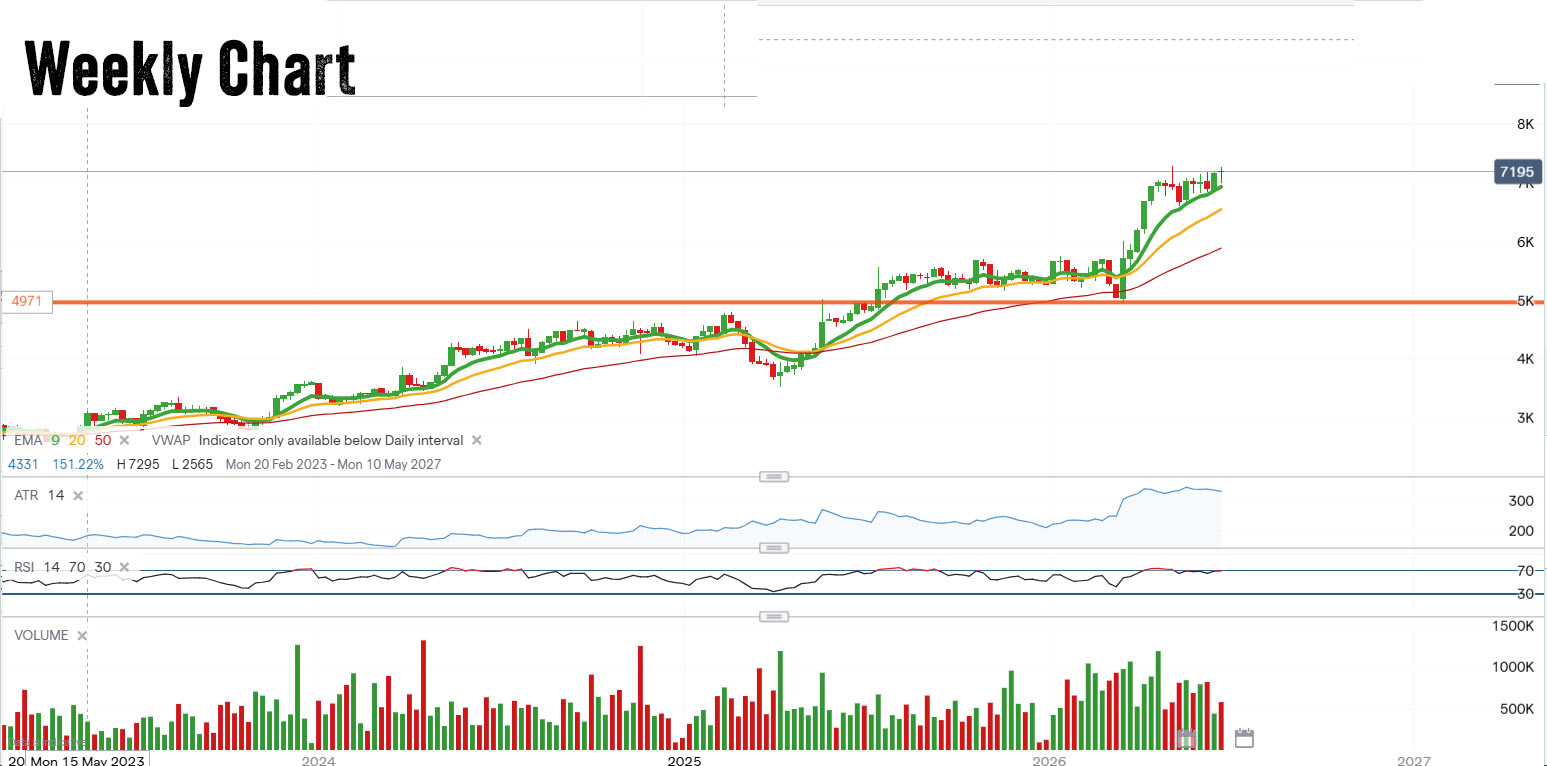
The big picture first. This chart goes back to late 2024 and the orange horizontal line at 4,971p is the key reference level — that was prior consolidation support and now acts as a long-term floor. I drew this line a year ago. I wish I had traded off it!
From late 2024 through to around October 2025 the stock spent roughly a year grinding sideways between roughly 4,500p and 5,500p. EMAs tangled, low ATR, low conviction in either direction. Classic accumulation phase on the weekly timeframe.
Then in late 2025 something shifted. A sharp move higher through the 5,500p area with meaningful volume, and from that point the weekly EMAs separated cleanly into traffic light order — 9 green above 20 amber above 50 red, all pointing upward. The stock has not looked back since.
From that late 2025 base the stock has run from approximately 5,000p to the current 7,192p. That’s a 44% move in roughly six to seven months. The weekly 50 EMA (red) is currently sitting around 5,800-6,000p — price is roughly 20% above it.
Weekly RSI has been oscillating between 60 and 70+ for the entire uptrend. Currently it looks to be just below 70. That is the ideal zone — strong momentum without being in overbought territory. The weekly trend has room to continue without needing a major correction first.
Weekly ATR has expanded significantly since the breakout — from around 150-180p per week to approximately 250-300p per week. That’s the daily noise level you need to account for in any stop placement.
DAILY CHART
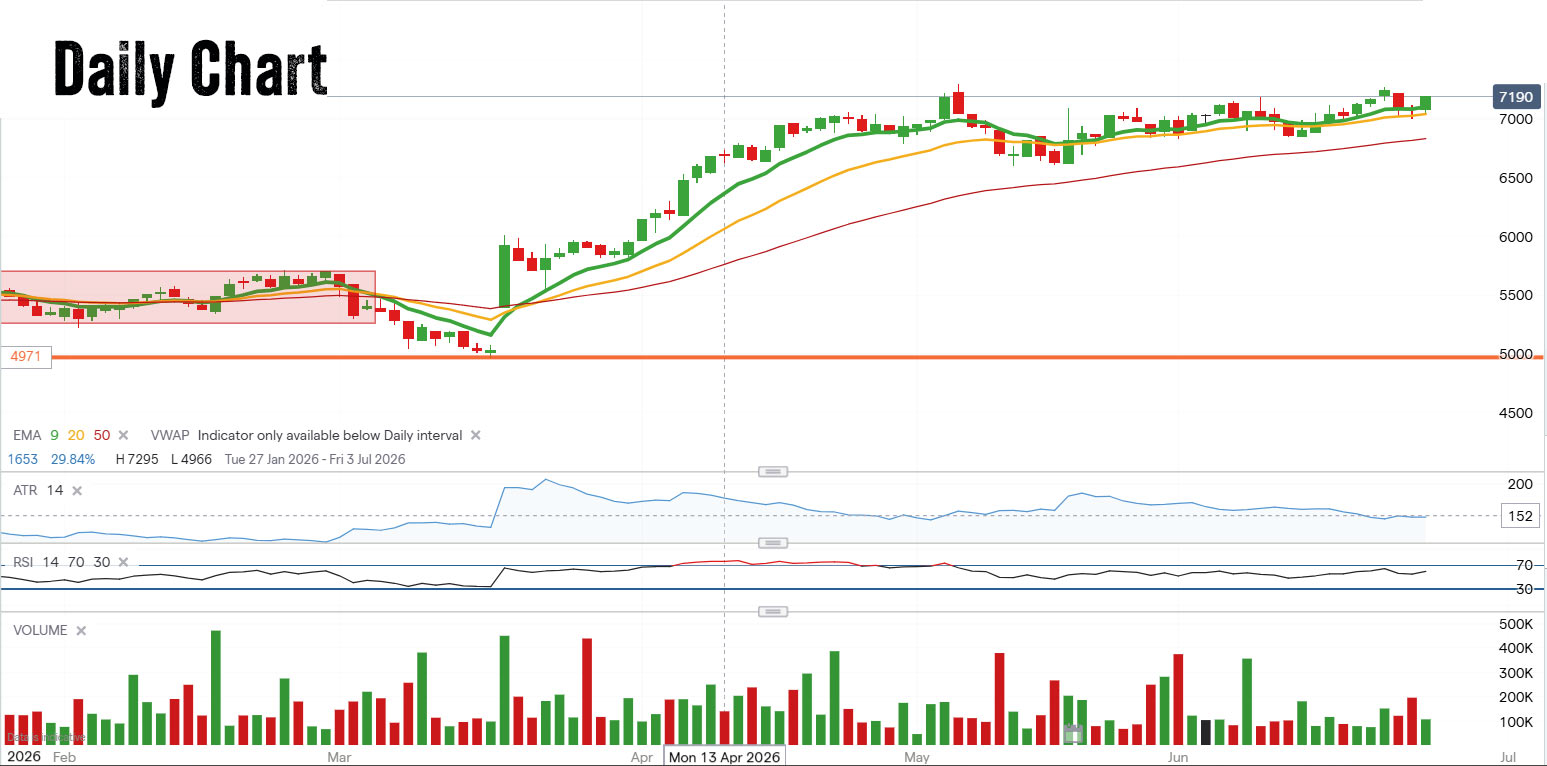
This is where it gets interesting. You can see the full daily picture clearly. The red shaded consolidation box on the left — roughly December 2025 through to mid-February 2026 — is the base. Price was grinding sideways between 5,200p and 5,700p, EMAs compressed together, volume light.
Then in late February / early March 2026 a sharp breakout. A big green candle, volume spike, and the EMAs immediately separated. From that breakout at approximately 5,000-5,200p the stock ran to the recent high of 7,295p. That’s a 40%+ move in approximately four months.
Current situation — price is at 7,190p and doing something genuinely constructive. After the run to 7,295p the stock pulled back mildly and is now consolidating in a tight range between roughly 6,900p and 7,300p. The candles are small, volume is declining on the red days and picking up on the green days. This is a healthy consolidation pattern — not distribution.
The daily EMAs are in traffic light order — 9 EMA (green) sitting right at current price around 7,150-7,200p. The 20 EMA (amber) is around 7,000-7,050p. The 50 EMA (red) is rising steadily around 6,600-6,700p. All three pointing up.
Daily RSI appears to be around 58-62 — right in the ideal 50-70 entry zone. Not overbought, not weak. Healthy mid-trend reading.
ATR on the daily is around 152p — that’s your noise level. Any stop needs to be at least this wide to avoid being taken out by normal daily movement.
THE SETUP
This is a genuinely interesting technical picture. The weekly trend is powerful and not yet overbought. The daily is showing a tight consolidation just below the recent high of 7,295p with EMAs in order, RSI healthy, and volume behaviour constructive.
The daily setup is actually quite clean. Price is sitting on or just above the 9 EMA. Volume is drying up on the pullback. If you get a green confirmation candle closing above 7,200p on decent volume — that’s my entry signal under my plan.
THE ONE THING STOPPING AN ENTRY
Q3 trading update 16 July 2026. Twenty-one days away. Under the plan the two-week blackout rule means we are already inside or approaching the zone where a new entry carries results risk. The stock could move 5-10% in either direction on the update regardless of how clean the chart looks today.
This is frustrating because the technical setup is genuinely one of the better ones we’ve seen in this session. Tight consolidation, healthy RSI, EMAs in order, volume drying up. If there were no scheduled RNS in three weeks this would be very close to a valid entry.
Missing a setup costs nothing. Being on the wrong side of a Q3 update at 7,190p with a 28-30x forward PE costs real money.
Key levels:
Support: 9 EMA ~7,150p, 20 EMA ~7,000p, consolidation base ~6,900p Resistance: 7,295p recent high, then 8,000p above that — clear air
Verdict: Wrong week to enter. Watch 16 July. If Q3 is clean, this becomes the first entry on the watchlist.
Not financial advice. I’m a bloke with a chart and an internet connection and a cuppa tea, not a financial advisor. Always do your own research. — Richard, Omera Trading