CURRYS PLC (CURY) — THE TURNAROUND NOBODY ON THE HIGH STREET BELIEVED IN
LSE: CURY | LSE Main Market | Consumer Discretionary / Speciality Retail Price: ~150p | Market Cap: ~£1.6bn | Verdict:
WATCHLIST
Everyone knows Currys in the UK. The place you go to buy a washing machine and get talked into an extended warranty you don’t need. The stock that spent years being written off as another dying high street retailer, slowly being eaten alive by Amazon. I was in that camp. Except it hasn’t died. It’s the opposite. And the share price has quietly been telling you that for over a year while the financial press was still writing the obituary.
Let’s dig in.
WHAT DOES IT ACTUALLY DO?
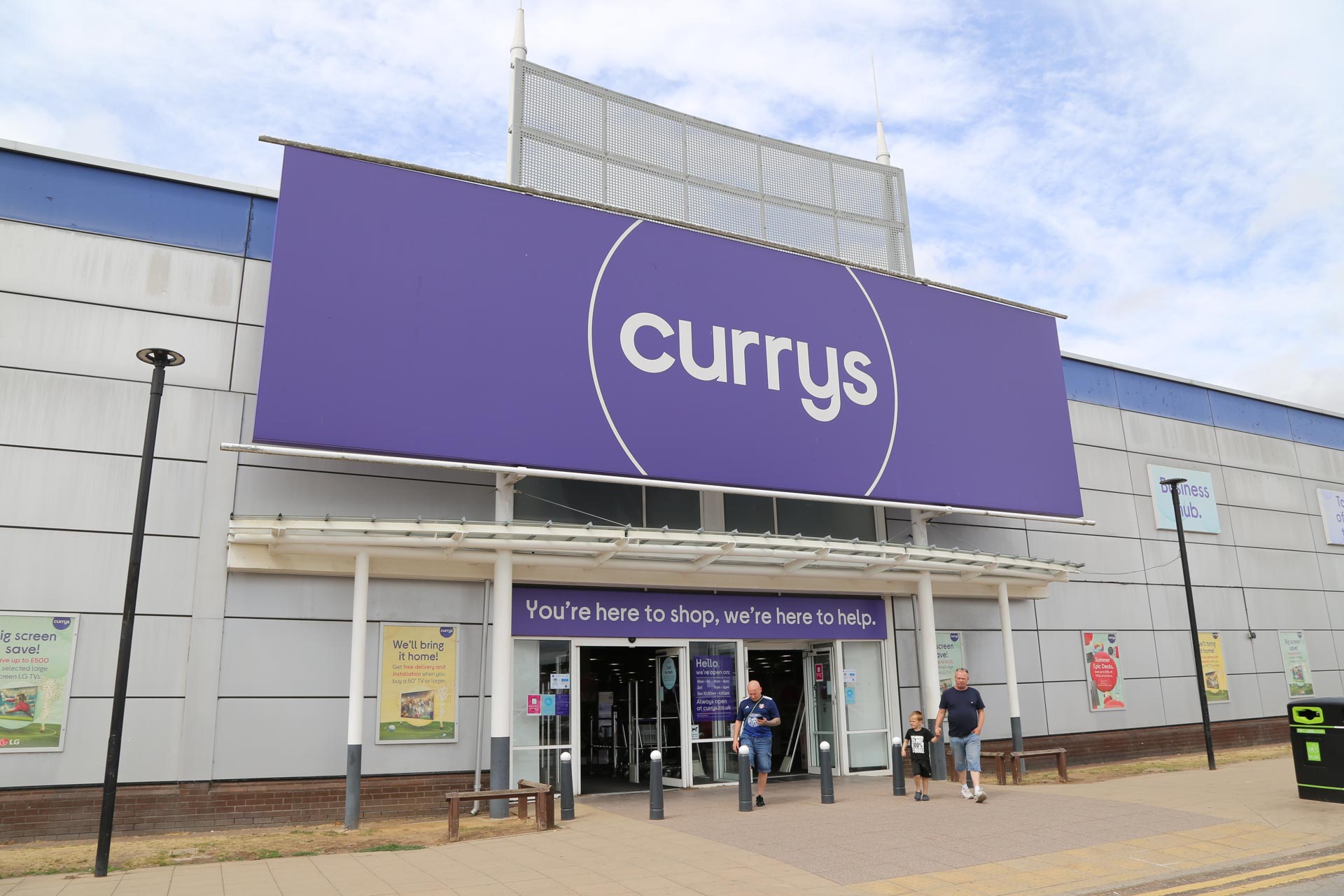
London-based, founded 1884, LSE Main Market. Currys is the UK’s largest omnichannel retailer of consumer technology — laptops, TVs, white goods, mobile phones, gaming, and increasingly services wrapped around all of it. They operate over 700 stores across six countries, trading as Currys in the UK and Ireland and Elkjøp in the Nordics. Market cap around £1.6bn on annual revenue of £9bn. This is not a small business.
The product mix matters for understanding the business. It’s not just boxes off a shelf anymore. The higher margin revenue streams — iD Mobile (their own virtual network), repair services, insurance, B2B sales, and the Nordics kitchen business — are increasingly driving the profit improvement. They’re turning a low-margin retailer into something with more recurring, defensible revenue. That’s the story.
OPERATING IN A TOUGH ENVIRONMENT
Here’s the contradiction that got my attention. The media narrative on the UK consumer is relentlessly grim. Household finances under pressure. Discretionary spending squeezed. Electronics retail — the kind of stuff people delay buying when money is tight — should be struggling.
Yet Currys grew UK adjusted EBIT by 53% in the first half of their current financial year while the core UK technology market actually declined 1.2%. They didn’t just survive a difficult market. They took market share in it. UK market share now sits at 16.9%, up 50 basis points year on year. In the Nordics they’re the clear market leader at 28.1% share.
How? A few things are working together. First, scale — when consumers are price-conscious, they go to the retailer they trust to have the best deals, and Currys wins that comparison with independents and smaller chains. Second, the services offering — repair, insurance, trade-in — keeps customers in the ecosystem and generates margin that pure product sales don’t. Third, iD Mobile grew its subscribers 18% in the last year. That’s a recurring revenue line that doesn’t disappear when someone delays buying a new laptop.
The company also has something Amazon fundamentally can’t replicate at scale — humans. Engineers who install your washing machine, advisors who explain which laptop suits your needs, repair centres that fix your TV rather than telling you to bin it. In a market that went too far toward pure online, that physical and human element is proving to be a moat rather than a liability.
THE CEO SITUATION
Alex Baldock is leaving. He joined in 2018 when Dixons Carphone — as it was then — was a mess. He simplified the business, sold off underperforming divisions, fixed the balance sheet, rebuilt profitability, and executed one of the more credible retail turnarounds in recent UK corporate history. The numbers prove it. He leaves with the business in genuinely better shape than he found it.
His replacement is Fredrik Tønnesen, who takes over in August 2026. Fredrik has been running the Nordics operation since 2023, where he more than tripled operating profits. He started as a shop floor sales assistant over 20 years ago and worked his way up. That’s not a parachuted-in outsider — it’s an internal appointment with deep operational knowledge.
The transition is a watchpoint, not a red flag. Markets always get nervous around CEO changes, even good ones. The risk is not that the new man is wrong for the job — he looks well qualified. The risk is that he uses his early months to kitchen-sink any issues, reset expectations lower, or signal a strategic pivot that the market doesn’t like. That’s the standard playbook for an incoming CEO and it can weigh on a share price even when the underlying business is fine.
For a swing trader the CEO transition is relevant because it adds uncertainty to the 2 July results announcement. The formal results will be Baldock’s last as CEO. The market will be listening carefully to what Tønnesen says about his priorities going forward.
THE TURNAROUND
Three years ago this business was loss-making. FY2023 delivered a net loss of £481m driven by goodwill impairments and restructuring charges as the old Dixons Carphone era assets were finally written down. The balance sheet carried significant debt and a large pension deficit.
What changed? As said, Baldock stripped out the complexity. Sold the Greek and Cypriot operations. Exited loss-making divisions. Focused the portfolio on the UK and Nordics where they actually have market leadership. Cut costs while investing in the things that drive customer loyalty — store refits, digital tools, colleague training.
The result is a business that now generates real profits on a clean basis. Operating margins have recovered from near zero to 2.4-2.5% and are targeting 3%+. The pension deficit has been dramatically reduced from over £480m to just £16m at last count. The balance sheet went from net debt to net cash. And free cash flow, which is the real measure of whether a business is healthy, has recovered strongly.
It’s not a glamorous story. There are no AI angles or EV charging narratives here. It’s a well-run retail business that fixed what was broken, and the market is slowly starting to believe the improvement is durable.
UPCOMING RESULTS
The headline numbers are largely already known. The Q4 trading update in May confirmed adjusted pre-tax profit of approximately £191m for the full year — an 18% increase on the prior year and ahead of the previous guidance range of £180-190m. Net cash at year end above £170m. £74m returned to shareholders through dividends and buybacks during the year.
So 2 July is not really a surprise event on the headline numbers. What it is is the formal full year results with the detail behind the numbers, and crucially the first formal guidance for FY2027 under the incoming CEO.
The market will be watching for four things specifically. First, confirmation of the £191m PBT figure. Second, FY2027 guidance — any upgrade here would be a strong positive catalyst. Third, management commentary on the consumer outlook heading into the second half of 2026, particularly given rising bond yields and a weak pound increasing input costs. Fourth, any update on capital returns — the share buyback programme and dividend trajectory.
The risk going into results is not the FY2026 numbers. Those are done. The risk is a cautious tone on FY2027 from an incoming CEO who wants to manage expectations downward before he starts. That’s the scenario that could cause the stock to sell off on what look like good numbers on the surface.
INVESTOR SENTIMENT
Analyst consensus is Moderate Buy. Average 12-month price target of 176-177p from the analysts covering the stock — roughly 18% upside from current levels. The high target is 215p, the low is 155p. That spread tells you there’s genuine disagreement about how much the turnaround is worth.
The bull case from analysts centres on continued market share gains, the Nordics recovery accelerating, and the market eventually awarding a higher multiple to a now-proven profitable business. The bear case centres on the UK consumer outlook deteriorating, sterling weakness increasing product costs, and the new CEO resetting expectations.
Forum sentiment on LSE and Reddit has shifted meaningfully over the past twelve months. Twelve months ago the dominant narrative was still sceptical — “why would you own this when Amazon exists.” That tone has changed. There’s now a growing cohort of retail investors who’ve watched the price move from 106p to 162p over the past year and are either in and holding or kicking themselves for missing it. That kind of sentiment shift is part of what sustains a trend.
One specific thing worth flagging — the stock spent years being associated with the failed Carphone Warehouse merger and all the goodwill write-downs and restructuring charges that came with it. The rebrand to Currys PLC and the progressive clean-up of the balance sheet has removed that overhang. New investors looking at this stock today see a different business to what it was three years ago.
THE FINANCIALS — IS IT MAKING MONEY?
Yes, and the direction is clearly improving across every meaningful metric.
Revenue went from £10.3bn in FY2021 down to £8.5bn in FY2024 — four years of decline as the business was restructured and non-core operations were sold. Then it turned. £8.7bn in FY2025, £9bn on a trailing twelve month basis, with forecasts of £9.3bn in FY2026 and £9.6bn in FY2027.
Operating profit recovered from £139m in FY2021 — through a loss year in FY2023 — back to £205m in FY2025 and £221m on a trailing twelve month basis. The recovery has been steady and the direction is unambiguously up.
Gross margins are improving. They collapsed to around 2% during the FY2023 cost crisis and have recovered to 2.4-2.5% now, with forecasts pointing toward 20-21% on a gross basis by FY2028 as the services mix continues to improve.
Net income: £108m in FY2025, £132m trailing twelve months, forecast to reach £127m in FY2026, £136m in FY2027 and £146m in FY2028. Profitable and growing steadily.
EPS normalized: 11p in FY2025, 13p forecast FY2026, 14p FY2027, 15p FY2028. Not explosive growth but consistent and in the right direction.
Free cash flow is the standout number. Cash from operations hit £453m in FY2025. Capex is modest at £77m — this is not a capital-hungry business. Free cash flow of £149m in FY2025 is forecast to dip to £74m in FY2026 — watch this on 2 July, the reason for that dip needs to be understood — before recovering to £122m in FY2027 and £113m in FY2028. That FY2026 FCF drop is likely the timing of pension contributions but confirmation is needed.
DEBT — WHAT’S ACTUALLY GOING ON
This section needs a bit of explanation because the numbers can look confusing at first glance.
There are two completely different types of “debt” on Currys’ balance sheet and it’s important to understand which is which.
The first is financial debt — money borrowed from banks that has to be repaid with interest. This is the dangerous kind. The kind that sinks companies when cash dries up. Three years ago Currys carried meaningful amounts of this alongside a £482m pension deficit. Today that financial debt is effectively zero. They’ve gone from net debt to net cash — there’s £133m sitting in the bank. That’s a genuine transformation of the balance sheet and one of the most important things Baldock’s tenure achieved.
The second type is lease liabilities. This is where it gets confusing. A few years ago, accounting rules changed — under IFRS 16, companies now have to put the full future value of their store leases onto the balance sheet as a liability. So Currys’ 700+ stores, each with a multi-year lease, show up as £702m of what looks like debt. But it isn’t debt in any meaningful sense. It’s just future rent. They’d be paying this whether they had any borrowings or not. Every physical retailer carries this. It’s the cost of occupying space, not a sign of financial stress.
When you see figures like total debt to equity of 40% or net debt to EBITDA of 1.63x — those numbers include the lease liabilities. Strip those out and the picture is net cash positive with no bank borrowings. Most experienced analysts look through the lease liabilities when assessing financial health and so should you.
The simple version: no bank debt, £133m cash in the bank, and the apparent £702m “debt” is just accountants showing future store rent on the balance sheet. It looks scarier than it is.
One more ratio worth understanding — the current ratio of 0.87x means current liabilities slightly exceed current assets. For a retailer this is completely normal and actually intentional. Currys gets paid by customers immediately at the point of sale but takes weeks to pay its suppliers. That means they’re always sitting on cash they technically owe to suppliers — so the balance sheet naturally runs with more short-term liabilities than assets. It’s a feature of the retail model, not a warning sign.
THE PENSION — NEARLY DONE
Defined benefit pension schemes confuse a lot of people so let me explain how this works before giving you the numbers.
When a company runs a defined benefit pension, it promises its retired employees a set income for life. To fund those future payments, the company pays into a pension pot which is invested in bonds, equities, and other assets. The problem arises when the value of those investments falls short of what the company has promised to pay out. That shortfall is called the deficit — and it’s a real liability that has to be funded.
Currys’ pension deficit stood at £482m in FY2021. That was a significant problem. A hole that size on the balance sheet constrains management’s cash use and makes investors nervous about the business’s long-term financial health.
Since then three things have worked in Currys’ favour. Investment returns on the pension assets have been solid. Rising interest rates actually helped — higher rates reduce the calculated present value of future pension obligations, which shrinks the deficit on paper. And the company has been paying regular cash contributions into the fund to close the gap. The combined effect has been dramatic. The deficit now stands at just £16m. Nearly closed.
Now here’s where it can look confusing, if the deficit is only £16m, why does Currys still have £277m of scheduled pension contributions to pay at £78m per year through to 2028/29?
Because the payment schedule was agreed with the pension trustees at a time when the deficit was much larger. Think of it like this. Imagine you owed a friend £482m and agreed to pay them back at £78m a year. Halfway through the repayment plan your friend recalculates what you actually owe and says it’s now only £16m. You’d want to renegotiate the repayment schedule — and so would Currys.
That renegotiation is exactly what is happening right now. The triennial pension review has completed and Currys is in discussions with the trustees to agree a revised contribution schedule that reflects the dramatically improved deficit position. The expectation — and management have signalled this clearly — is that annual contributions will reduce materially from the current £78m level.
In the meantime the existing £277m schedule is already built into management’s cash flow forecasts. It’s a known commitment, not a surprise. And if the renegotiation delivers lower contributions — which looks likely given a £16m deficit — that frees up cash that can go back to shareholders instead.
The pension has gone from being one of the most cited reasons not to own this stock to a manageable, shrinking liability on a clear path to full resolution. Understand it, factor it in, and move on.
EXPECTATIONS — NEXT THREE YEARS
The forward picture from analyst consensus is positive but not exciting. This is not a high-growth story anymore. The turnaround recovery phase is largely complete. What follows is steady improvement from a now-profitable base.
Revenue: £9.3bn FY2026, £9.6bn FY2027, £9.8bn FY2028. Low single digit growth. EBITDA: £523m → £530m → £544m. EPS normalized: 13p → 14p → 15p. Net income: £142m → £146m → £157m.
The investment case from here is not about explosive earnings growth. It’s about whether the market re-rates the stock to a higher multiple as confidence in the durability of the turnaround increases. At 10-12x forward PE the stock is cheap relative to its history but not obviously mispriced.
PRICE TARGETS — BULL, BASE AND BEAR
Current price: ~150p. NTM Normalized EPS: 13p.
The historical PE chart going back to 2016 tells an important story. Mean PE 8.69x. Historical high 13.14x. Current PE 11.69x — near the top of its historical range.
Bear case — PE reverts to historical mean of 8.69x on 13p EPS. Price target: 113p. That’s 25% downside from here. This happens if results disappoint, consumer outlook darkens, new CEO resets expectations lower, or sterling weakness compresses margins.
Base case — PE holds at current 11.69x on 13p EPS. Price target: 152p. Essentially flat. The stock is fairly valued at current levels if the multiple doesn’t expand further. The trend continues but upside is limited without a catalyst.
Bull case — PE re-rates to historical high of 13.14x on 13p EPS. Price target: 171p. Around 14% upside. This is the scenario where 2 July results confirm the beat, FY2027 guidance is maintained or upgraded, and the market decides the turnaround is proven and durable.
WHAT THE TECHNICALS ARE SAYING
The Big Picture
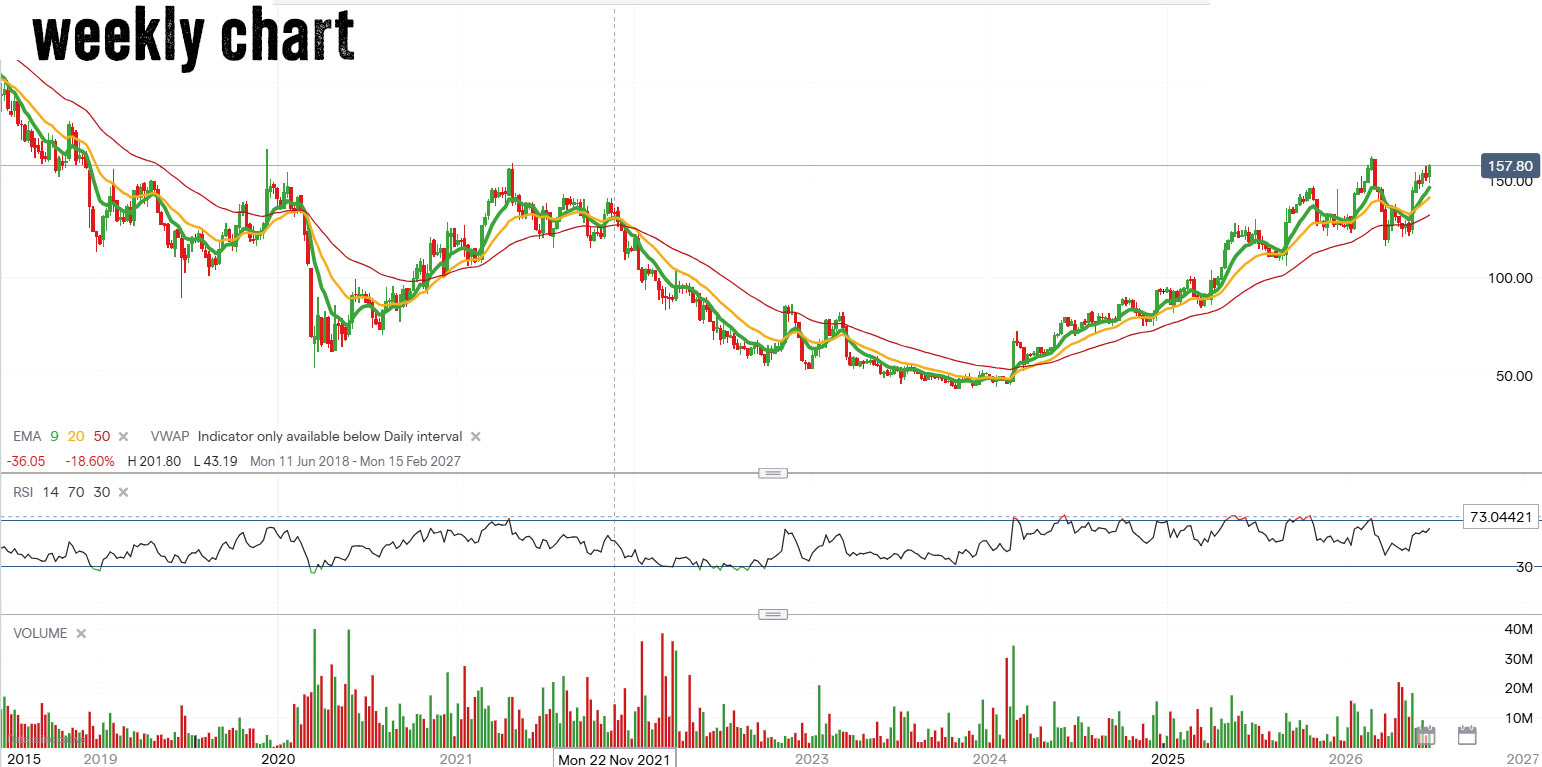
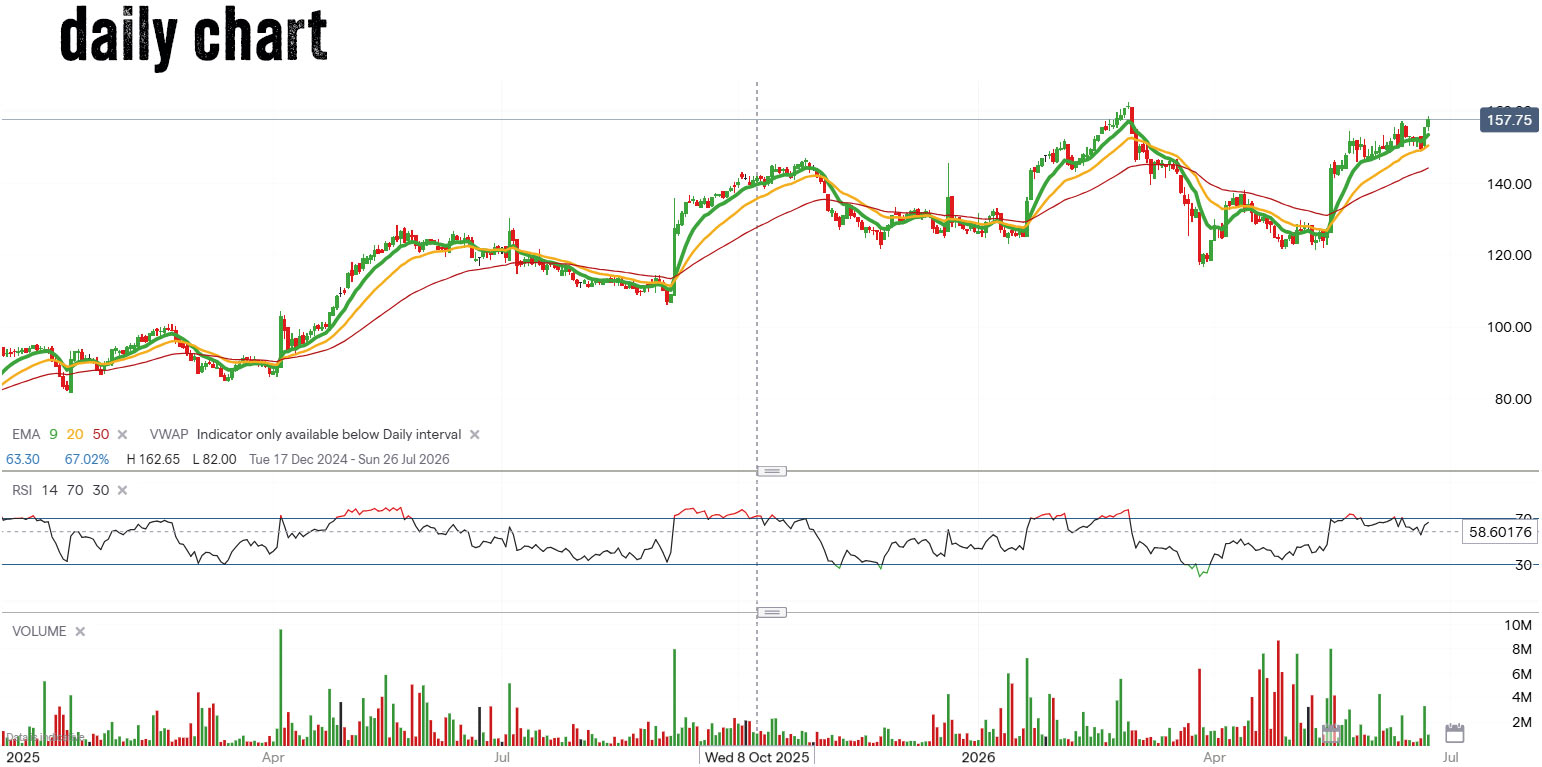
This stock was 170p in 2020, fell 75% to 43p by early 2024, and spent three years in a downtrend. Then the structure shifted. Higher highs, higher lows started appearing. The weekly EMAs — 9 green above 20 amber above 50 red — are now in full traffic light order pointing upward. The weekly RSI is sitting at 55-60. Healthy, not extended. Plenty of room to run on the weekly timeframe.
The Daily Setup
From the May 2025 breakout around 90p the stock ran to 162p. The daily EMAs are in traffic light order. Price has pulled back mildly from 162p to 157p on lighter volume — that’s healthy, not distribution. RSI on the daily is 51.8 — right in the ideal 50-70 entry zone.
Everything on this chart is saying the trend is intact and the setup is clean.
Why I’m not entering this week
Full year results land 2 July. Seven days away. The stock could gap 15% either way on the day.
What I’m Watching For
Clean results on 2 July, positive guidance, let price settle for a session. Then look for a pullback to the 9 EMA around 148-150p on declining volume with a green confirmation candle. That’s the entry signal.
Support: 148-150p (9 EMA), 143-145p (20 EMA)
Resistance: 162p recent high, then 166p above that
Verdict: Watchlist. Back on 2 July.