Or the Dip of a Lifetime?
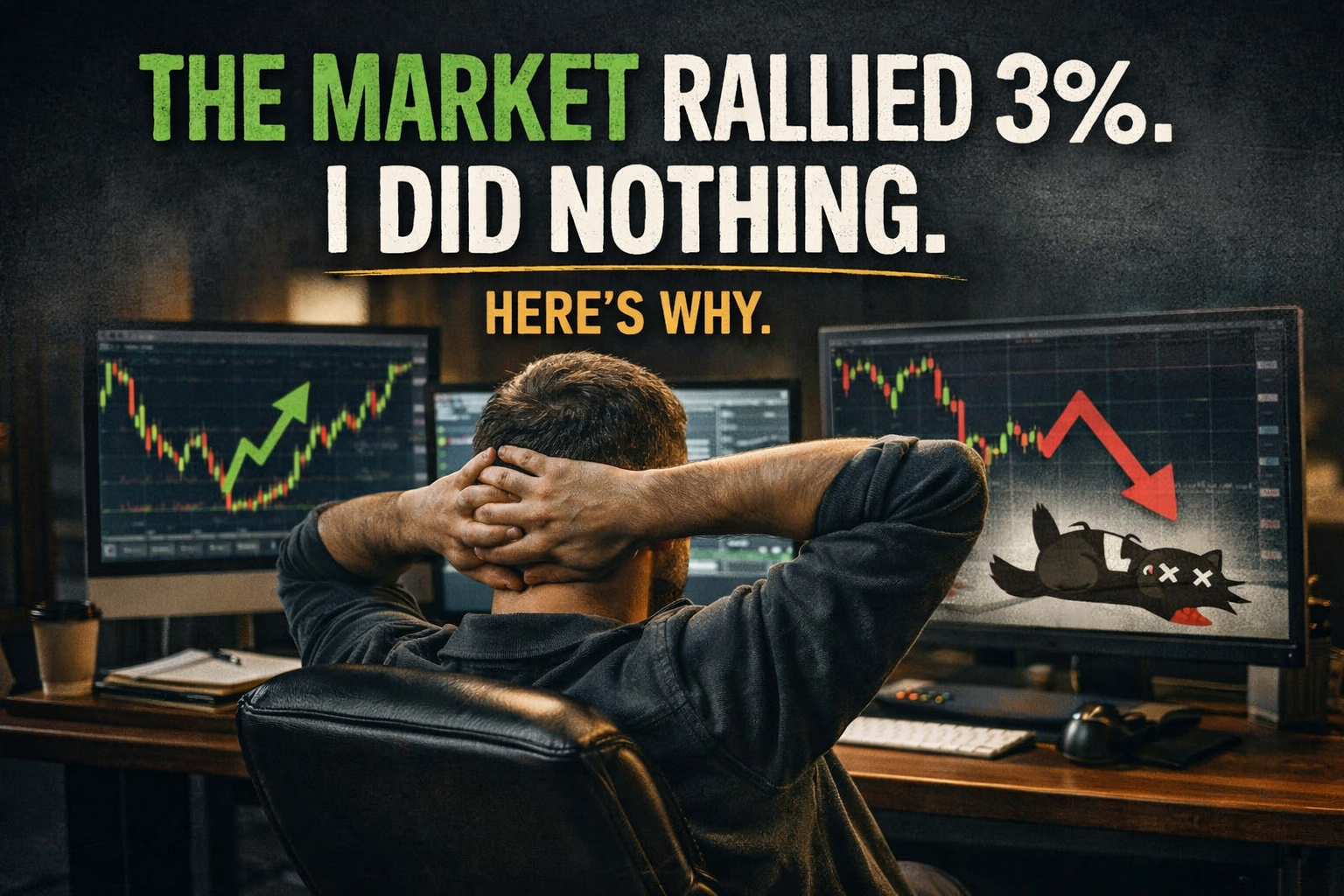
Markets rallied 3% yesterday. Here’s why I did absolutely nothing — and why that might be the smartest trade I never made.
Yesterday, the S&P 500 and the NASDAQ both rallied by more than 3%. Green across the board. Financial influencers were buzzing. Analysts were calling the bottom.
Quality names that have been absolutely hammered over the last few weeks — Nvidia, the Mag 7, big tech — were all getting volume piling in.
And here at Omera Trading, we did absolutely nothing.
Not because we were scared. Not because we panicked. Because there was no trend. And I don’t trade without a trend. Follow the plan. Follow the strategy!
I felt nothing watching that rally. No FOMO. No anxiety. No second-guessing. And I want to explain why — because if you’re a beginner trader and you felt something watching that move, if your finger was hovering over the buy button, this blog is for you.
The hardest skill in trading isn’t finding the right stock. It’s doing nothing when everything in you wants to act.
What Is a Dead Cat Bounce — And Why Should You Care?
The name is a bit grim, I’ll be honest. But the logic behind it is simple.

Even a dead cat will bounce if it falls from a high enough height. It doesn’t mean it’s alive. It just means physics happened.
In markets, a dead cat bounce is a sharp short-term rally that happens inside a broader downtrend. The price has been falling. It gets oversold. Some buyers step in — short sellers take profit, bargain hunters dip their toes in, and algorithms react to the move. The price jumps, sometimes violently. And then the selling resumes, often taking it to new lows and wiping out everyone who thought they’d caught the bottom.
The cruel part is that dead cat bounces feel exactly like real recoveries when you’re in them. The price action looks the same. The volume can look similar. The sentiment shifts. Influencers start calling the bottom. And if you’re not careful, you get sucked in.
Dead cat bounces don’t announce themselves. That’s what makes them dangerous.
The only way you truly know it was a dead cat bounce is after the fact — when the market rolls over again and takes out the lows. By which point, a lot of retail traders are sitting on losses they didn’t expect, wondering what went wrong.
I’ve Been That Person. Covid Taught Me the Hard Way.
I’m not going to sit here and pretend I figured all this out from a textbook. I didn’t. I learned it by losing money. I felt the pain.
During the covid crash in 2020, the S&P 500 fell by over 34% in about five weeks. It was the fastest bear market from all-time highs in stock market history. Brutal. Relentless. Every day felt like another gut punch.
And then — without warning — the market snapped back. Nearly 18% in three days at one point. The headlines shifted overnight. People were calling the bottom. The narrative changed from ‘this is the end’ to ‘the worst is over.’ And I fell for it. Along with a lot of other people.
I bought into that bounce. And then watched it roll over and head lower.
There were multiple false starts like that during COVID. Sharp rallies that sucked people in, followed by another leg down. It wasn’t a straight-line crash — it never is. And every one of those bounces felt real when you were in it.
That pain is still with me. And honestly? I’m glad it is. Because now, when I see a 3% up day in the middle of a downtrend, with five consecutive negative weeks behind it, a war still going on, oil still elevated, no macro resolution in sight — I don’t reach for the buy button. I watched. I waited. I look for confirmation.

Why Yesterday Didn’t Have Confirmation
So why specifically did I sit on my hands yesterday?
As a trend trader, my job is simple. I follow the crowd. I want to know if the crowd is excited!
Yes, there was volume. Yes, quality names moved. But when I looked at what was driving it, I couldn’t find a meaningful reason—no macro resolution. The war’s still going. Oil’s still elevated. The Fed still doesn’t know whether to cut or hike. The jobs data this week has been soft. Consumer confidence is cracking at the edges.
The financial influencers were talking about stocks looking cheap. And fair enough — some of them are cheaper than they were six months ago. We mentioned that ourselves in the last blog, noting Nvidia was looking interesting on a forward PE of around 20x compared to its historical average of 70x. But a lower price isn’t the same as a confirmed trend. Cheap can get cheaper.
It only takes a handful of people with conviction and size to get involved for others to start feeling FOMO. And FOMO is what drives a lot of these short-term bounces. Not fundamentals. Not macro clarity. Just the fear of missing the move.
I’m a trend trader. No trend, no trade. Simple as that. Did I miss potential gains yesterday? Yes. So be it.
This isn’t psychological fear of a dead cat bounce. It’s not anxiety or hesitation. It’s a plan. It’s a strategy. And the strategy only works if you stick to it when it’s uncomfortable — which is exactly when most people abandon it.
Higher highs. Higher lows. That’s what I’m waiting for on the S&P and the NASDAQ. When I see that — when the chart tells me the trend has shifted — then I’ll get involved and ride the wave. Until then, I’m watching.
But What If It’s Not a Dead Cat Bounce?
Here’s the honest other side of this.
What if this is the bottom? What if the war de-escalates faster than expected, oil falls back, the Fed starts cutting again, and we look back at this pullback in six months and say — that was the dip of a lifetime?
I can’t rule it out. Nobody can. And I think it’s important to hold both possibilities in your head at the same time without letting either one push you into a bad decision.
Because here’s what I do believe, regardless of what the market does in the next few weeks. The AI revolution is real. It’s not hype. It’s not going away. And the companies at the centre of it are still building, still growing, still spending.
The five biggest tech companies in the world — Amazon, Google, Microsoft, Meta, Oracle — are collectively spending over $600 billion on AI infrastructure in 2026 alone. That’s more than the Apollo space programme. Nobody spends that kind of money and then just stops. This is a decade-long buildout, and we’re still in the early chapters.
So while I’m cautious about the short term — genuinely cautious, not performing caution — I’m also thinking longer term. Where shall I put money that I’m happy to leave alone for 10 years? Utilising the ISA allowance as we go into a new financial year. Let’s compound our accounts so we can buy that yacht.
Later today, I’m going to look at what companies could be worth locking away in that ISA. And what platform would be best for our strategies?
Don’t take this as financial advice. I could be an idiot.

Want to take your investment game to the next level? Open an IG account with the link below to get £50. We’ll both get a reward when you’ve got your account set up and make your first investment.
Your capital is at risk.
The value of shares, ETFs and ETCs bought through a share dealing account or a stocks and shares ISA can fall as well as rise, which could mean getting back less than you originally put in. Past performance is no guarantee of future results.