
I’m back after a tricky few weeks away, and this time it feels different. I’ve taken the leap and quit my job to trade full-time. It’s been a long road to get here – moving from losses, to break-even, to finally turning consistent profits – and now feels like the right moment to take things further.
This hasn’t been a rushed decision. It’s the product of over 12 years spent learning, studying, and chipping away at the markets. All that work has put me in a position to finally do what I love, day in and day out.
Researching and writing these blogs has become part of that process. It sharpens my thinking, keeps me grounded, and helps me approach trading with the discipline it deserves. So you’ll be hearing a lot more from me from here on.
So back in the thick of it, I am watching the markets, and the world holds its breath as Nvidia is about to report earnings. For swing traders like me, events like this always demand extra attention. These moments put an unusual amount of weight on market analysis, because Nvidia has become such a key driver of sentiment.
Right now, the big debate is whether the market’s all-time highs are a bubble. Tonight’s Nvidia earnings could either fuel another leg higher, trigger a correction, or even spark a sharper sell-off. It’s a guessing game and I’d rather not be caught on the wrong side if the worst-case scenario plays out.

Digital stock market chart on a tablet screen
I trade with a swing mindset, sometimes dipping into intraday plays when the setup is right. Unlike long-term investors who often have to sit through repeated bouts of pain, I’m comfortable stepping to the sidelines and waiting for my spots. That’s a core advantage of trading over investing: I don’t need Warren Buffett’s patience, nor do I have the luxury of unlimited cash flow to ride things out month after month.
Instead, I adhere to a strategy that suits both my temperament and my circumstances: taking profits where possible, managing risk tightly, and capitalising on opportunities in the market in a manner that works for me.
In many ways, the stock has become a bellwether not only for the semiconductor industry but also for the entire trajectory of the artificial intelligence (AI) boom. Analysts pore over its revenue numbers, traders brace for volatility, and investors debate whether we are witnessing a sustainable technological revolution or something that echoes the excesses of the late 1990s.
Is the market putting too much weight on Nvidia? Have AI companies become today’s Cisco Systems, the must-own stock of a generational tech cycle? And what can the history of the internet boom tell us about the risks lurking in today’s AI-driven rally?
Nvidia’s Dominance and the AI Trade
Nvidia today holds around 80–90% of the market for AI accelerators and over 90% of GPU usage in neural network training. Its CUDA software ecosystem has become the standard for AI research and deployment, creating lock-in that is difficult for rivals to displace. In 2025, the company became the first listed firm to surpass a $4 trillion valuation.
Every quarter, its earnings set the tone for global markets. Analysts expect tens of billions in revenue each quarter, with year-over-year growth often exceeding 50% even as growth rates naturally slow from the triple-digit surges of 2023–24. The company, in short, is the driving force behind the AI trade.
And yet, this concentration of market attention raises familiar questions. We’ve seen this movie before.
The Ghost of Cisco in 1999
To understand today’s excitement and anxiety, we need to rewind to 1999–2000, the height of the dot-com bubble.
At the time, Cisco Systems was the darling of Wall Street. As the supplier of routers and internet infrastructure, it was viewed as the company that would literally “build the internet.” Its market cap surpassed $500 billion, making it the most valuable company in the world for a brief period. Like Nvidia today, Cisco’s earnings reports were treated as referendums on the internet revolution itself.
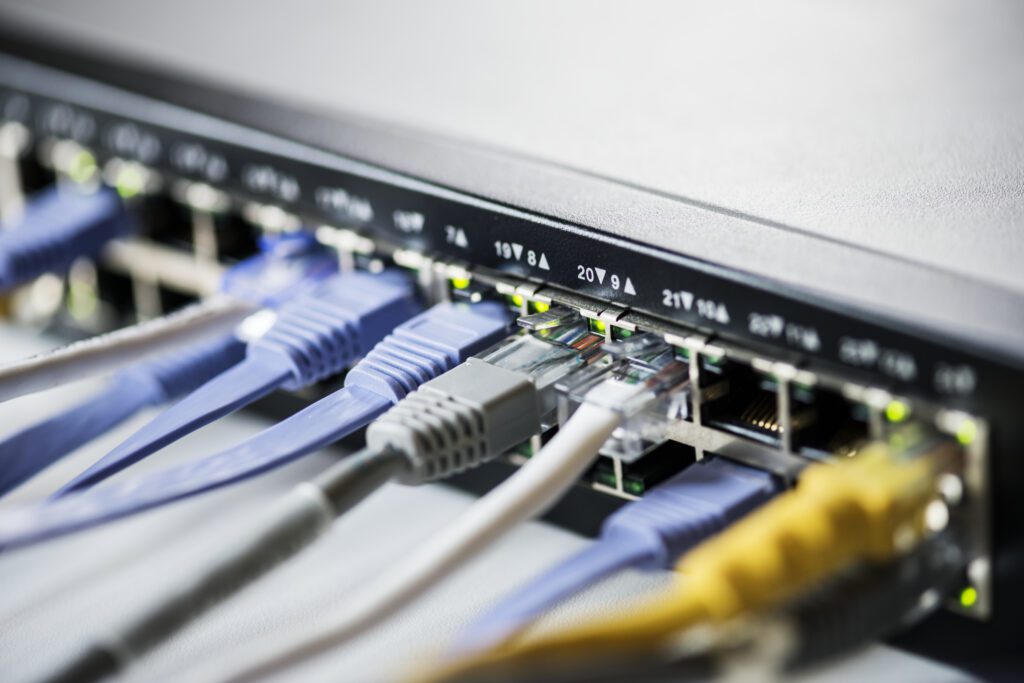
Cables connected to a hub
The similarities are striking:
Cisco then = Nvidia today: dominant supplier of core infrastructure.
Internet = AI: transformative technology narrative.
Valuations are stretched: Cisco trades at ~100 times earnings, while Nvidia trades at ~57–70 times, depending on the estimates.
However, there are notable differences as well. Cisco’s growth significantly declined after the dot-com bust, resulting in a stock drop of more than 80%. Two decades later, the company has yet to regain its peak valuation. In contrast, Nvidia is capitalising on an AI boom, where demand is already being monetised on a large scale by trillion-dollar hyperscalers.
The question is whether the comparison to Cisco serves as a warning or merely an imperfect analogy.
Why AI Growth Could Slow
One of the main risks to Nvidia and the broader AI boom more broadly is the assumption that adoption will continue to accelerate indefinitely. There are several reasons why growth could decelerate:
Enterprise adoption lag: Many companies are experimenting with AI, but not all are finding profitable use cases. The cost of running AI models is high, and return on investment isn’t guaranteed.
Cloud Capex Pullback: The hyperscalers — Microsoft, Amazon, Google, and Meta — are driving demand for AI. If the economy slows or a recession looms, they could cut capital expenditure, directly hitting GPU sales.
Energy and infrastructure limits: Training and inference consume a significant amount of electricity. Power grid constraints and political concerns could become bottlenecks.
Regulation and geopolitics: U.S. export restrictions already cost Nvidia billions in lost Chinese sales. Additional regulations could further curtail global growth.
Competition: AMD, Google’s TPUs, and in-house silicon are slowly chipping at Nvidia’s moat. If credible alternatives emerge, Nvidia’s margins could face pressure.
Hype vs utility: Just as the internet took years to translate into stable profits, AI might take longer than investors expect to deliver broad productivity gains.
Macro headwinds: Higher rates or tighter financial conditions could choke off capital for start-ups and slow corporate adoption.
Each of these risks doesn’t mean AI demand disappears, but they do mean growth could plateau or fall short of lofty expectations. And for a stock like Nvidia, priced for perfection, even a modest slowdown could spark volatility.
The IPO Frenzy: 1999 vs 2025
One of the starkest contrasts between the dot-com bubble and the AI cycle is the IPO landscape.

Colleagues applauding, sharing excitement after achieving corporate milestone in workplace
1999 Internet boom:
- 289 internet IPOs in a single year, raising $24.66 billion.
- Internet IPOs made up ~60% of all IPOs.
- Average first-day gain was 90%. Some tripled or quadrupled on debut.
- Most of these companies were unprofitable and burned through cash at an alarming rate.
2024–2025 AI cycle:
- Just three notable AI-related IPOs in the past year: CoreWeave, Pony.ai, and SailPoint.
- Two more planned in China (Moore Threads, MetaX).
- These companies, at least, have meaningful revenue, and their IPO quality is higher.
- In other words, the dot-com boom was a quantity bubble of hundreds of speculative listings. The AI boom so far is a valuation bubble concentrated in a few firms, not a flood of public offerings.
- This is why it feels different. The froth hasn’t spilt into retail IPO mania. It’s hidden elsewhere.
The Private Market Bubble
Instead of showing up in a flood of IPOs like we saw in the dot-com era, most of the froth today is concentrated in venture capital and private company valuations. At first glance, it’s easy to overlook this because, unlike IPOs, which make headlines and splash across trading screens, private valuations happen quietly behind closed doors. They don’t appear in the market every day, so as traders, we can almost forget they exist.
I’ll admit, this is all new thinking for me. I don’t have much experience digging into the private capital side of things, and it’s an area I’m only just beginning to understand. As a swing trader, my focus has always been on listed stocks, technical setups, and momentum. But looking back at history, particularly the internet boom, it’s clear that where bubbles form matters. Back then, the excess was visible in IPOs and public markets; today, much of it is hidden in private AI valuations.
The more I read and think about it, the more I realise how important it is not to ignore that. Because while those valuations may be out of sight for most traders, the ripple effects from a crash in private capital could easily spill over into the listed markets I trade every day.
- OpenAI: valued at $150–200 billion in secondary trades.
- Anthropic: $18–20 billion.
- Cohere, Mistral: $5–10 billion each.
- CoreWeave: Approximately $19 billion in private funding before IPO, and approximately $30 billion after.
Many of these firms are loss-making and dependent on constant funding to cover GPU access and R&D costs. This raises a key risk: what happens if private valuations crash?
What Happens if Venture Capital Loses Money?
At first glance, you might think: so, what? If venture capital funds lose money on AI start-ups, that’s their problem. But the ripple effects go much further.
1. Start-ups collapse or consolidate
Without VC money, cash-burning AI firms would be forced to cut costs, merge, or shut down. This means fewer customers for Nvidia, AMD, and cloud platforms.
2. Cloud giants take hits
Microsoft, Amazon, and Google have invested billions into AI startups. If valuations collapse, they must write down these stakes. It wouldn’t be catastrophic for them, but it would dent earnings and their narrative.
3. Sentiment shifts in public markets
Listed AI-adjacent stocks trade heavily on narrative. If private AI firms implode, public investors will question whether demand for GPUs and AI services is sustainable. Multiples compress quickly.
4. IPO market shuts down
If private firms can’t go public at high valuations, VC exits dry up. That chills further private investment and reduces the hype cycle.
5. Labour market impact
AI firms employ thousands of highly paid engineers. A crash means layoffs, weaker demand for housing and services in tech hubs, and spill over into local economies.
6. Feedback loop into Big Tech
Capex cuts → fewer GPUs bought → Nvidia feels it → semiconductor cycle weakens. This ripple is very similar to what happened in 2001–02, when dot-com failures led to a decline in demand for Cisco’s routers and Nortel’s telecom gear.
While VC bears the initial losses, the aftershocks spread across the tech ecosystem and into public markets.
Was the Dot-Com Boom a Valuation Bubble?
In truth, it was both. On one hand, it was a quantity bubble – hundreds of flimsy IPOs rushed to market, many with no profits and barely any revenues. On the other hand, it was a valuation bubble – companies were priced at eye-watering levels, with the Nasdaq trading on a P/E ratio of nearly 200 and internet stocks carrying median price-to-sales ratios of around 32x.
That’s why the crash was so brutal. Too many flimsy companies, all priced for perfection.
AI today lacks the quantity element. However, the valuation element remains very much alive, particularly among Nvidia and private unicorns.
Average Valuations: Then vs Now
- Dot-com 2000:
- Nasdaq P/E ~200×.
- Internet content firms had P/S ratios over 30×.
- Many companies had no earnings at all
- AI 2025:
- S&P 500 forward P/E ~22×. Tech sector ~40×.
- Nvidia trades at ~57–70× earnings.
- Private AI firms are often valued at 25–30× revenue in funding rounds.
- Today’s valuations are stretched, but not as extreme as they were in 2000. There is substance to Nvidia’s revenues, which are substantial and substantial, but expectations remain very high.
What Would an AI Crash Look Like?
Let’s sketch two scenarios.
Cisco 2000 Scenario (Bubble Burst)
- Private valuations collapse.
- Startups fail, GPU demand slows.
- Cloud CapEx gets cut.
- Nvidia misses revenue expectations → stock drops 50–70%.
- Big Tech multiples compress; Nasdaq corrects.
Microsoft Scenario (Soft Landing & Dominance)
- AI adoption continues, though growth moderates.
- Nvidia retains a dominant share, similar to Microsoft with Windows/Office.
- Valuations cool, but profits continue to grow steadily.
- The market consolidates around a few winners, with Big Tech capturing the majority of the gains.
Both are plausible. The outcome depends on whether AI translates into widespread productivity and revenue gains quickly enough to justify the trillions being spent.
The Investor’s Takeaway
- Nvidia is central: its earnings aren’t just about one company, they are about the trajectory of AI itself.
- Private markets hold hidden risk: the froth is in venture capital, but the shockwaves will hit public markets.
- Valuation matters: AI today has real revenues, but multiples still assume perfection. Cisco’s lesson is that great companies can be bad investments if bought at the wrong price.
- Concentration risk: Unlike 1999, the AI boom is highly concentrated in a few firms. That makes the system less fragile in breadth, but more vulnerable in depth. If Nvidia falters, the whole trade could wobble.
- History rhymes, not repeats: The internet really did change everything, but it took longer than the market priced in. AI will likely do the same. The question is timing and how much investors overpay in the meantime.
My Final Thoughts
The late 1990s were marked by numerous weak companies trading at inflated valuations. The AI era is shaping up as a story of fewer companies at very high valuations.
Both carry risks, but the shape of the bubble is different. If private valuations crack, the losses start in venture capital but ripple through Big Tech, chipmakers, and public markets via capital expenditures and sentiment.
The internet boom didn’t mean the internet was a fad; it was just too early for investors to accurately price it. The same is likely true of AI: transformative in the long term, but possibly overvalued in the short term.
History doesn’t repeat, but it rhymes. Investors today would do well to study 1999 not because AI is a carbon copy, but because bubbles, whether in quantity or valuation, always end the same way: with volatility, corrections, and opportunities for those who stay disciplined.
so today, I watch all this with interest, but I do so cautiously. Trading earnings straight out the gate is little more than guesswork, and I’ve learnt the hard way after having my fingers burnt more than once. These days, I prefer to step aside and let the dust settle. Let everyone else pile in, chase the headlines, and swing about in the volatility. I’m happy to wait until the market has shown its hand.
Once things calm down, that’s when I go to work. I watch for the trend to emerge and only step in when it lines up with my strategy. It keeps me disciplined and, more importantly, keeps me out of the sort of random trades that can undo weeks of progress.
If tonight’s numbers bring bad news, I’ll be looking closely at whether the big players in the sector start trending lower. Catching a move like that would be the modern equivalent of shorting Cisco or Microsoft back in 2000 – a chance to ride the downside of a sector that had run too hot. Of course, I won’t force it. The setup must be in place; everything must align. But if the opportunity comes, I’ll be ready to join the move and go with the flow.
I hope the party continues to rise, but I recognise that everything ultimately corrects itself.